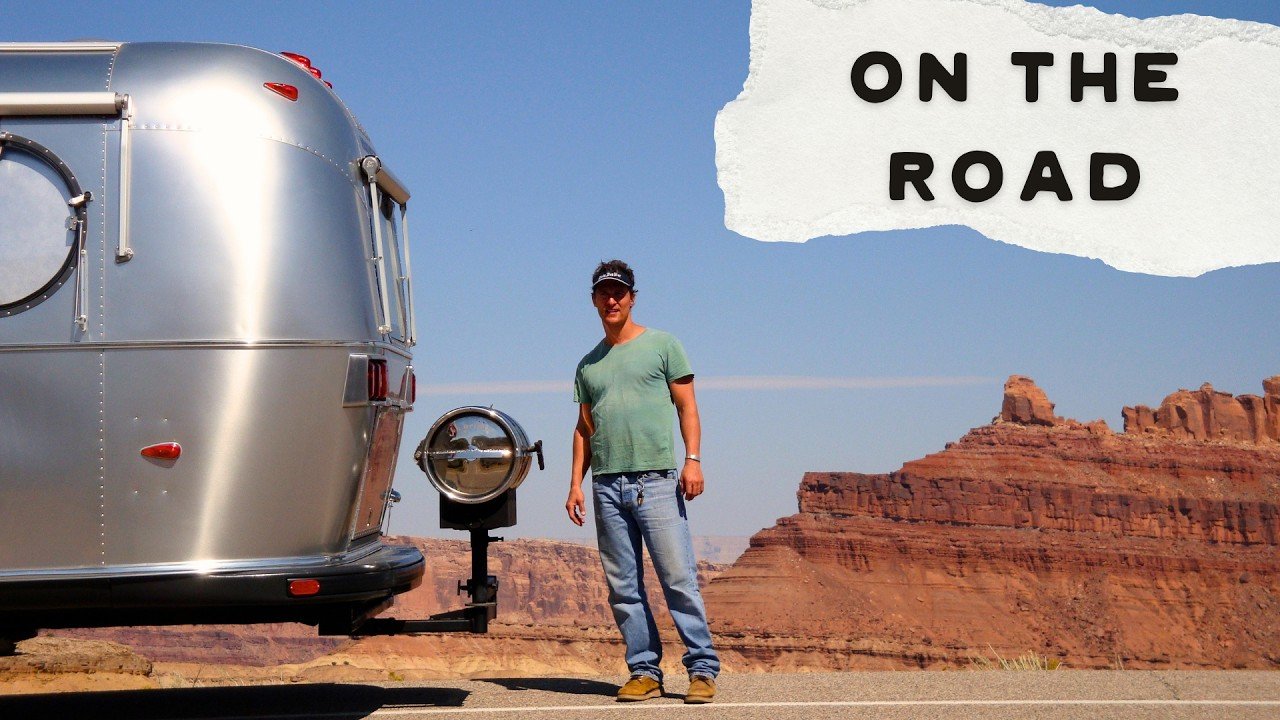
Matthew McConaughey pulled out of Albuquerque, New Mexico with three days to reach New York and a Roger Clemens start on his calendar. No publicist, no itinerary, no fixed address. Just a 28-foot Airstream International CCD, a dog named Miss Hud, and a compass that pointed wherever he felt like pointing it. For anyone who has ever fantasized about trading a fixed address for open highway, McConaughey actually did it, and the story of how he got there, and what happened on a reservation in Vancouver, is worth the telling.
How a van, a dog, and a cassette recorder became a whole lifestyle
It started right after filming Robert Zemeckis’ Contact with Jodie Foster. McConaughey bought a 1996 GMC Savannah van, gutted the interior down to two front captain chairs, and built it into something closer to a mobile studio than a camper. He installed a custom console with a hideaway cooler and a drain, a PA system he described as matching the one he had in his high school truck, and a Rode NT1-A shock-mounted microphone on a bendable arm, connected to a cassette recorder mounted in the ceiling above the driver’s seat so he could make high-end voice recordings while driving. Miss Hud rode along as the co-pilot.
After a few months of sleeping in the van on a leopard skin bed in the back, or pulling into motels when the mood struck, the two of them decided to go all the way. They added the Airstream to the back of Cosmo, the van, and became what the trailer world calls full-timers. Over the years that followed, they carved trails from Manitoba to Guatemala, covering 48 of the 49 reachable United States along the way.
The scheduling was entirely improvised. Film directors who needed a meeting would fly into whatever city sat ahead of him on the route. He would pick them up at the local airport, drive together for seven hours talking through a project, and drop them at the next airport down the highway. ‘Behind the steering wheel has always been my favorite seat,’ he said. ‘And driving the highways of America has always been my ideal office.’
The chief, the salmon, and a carved paddle that changed everything
On one film shoot, McConaughey settled the Airstream into a trailer park on the Squamish Nation Indian Reservation just south of the Second Narrows Bridge in Vancouver, Canada. The chief of the reservation was named Mike Hunt. Yes, seriously. Chief Mike Hunt and McConaughey became fast friends.
The Squamish had developed a remarkably efficient method for catching Coho salmon. Rather than heading out in canoes with bait and hooks, they waded into shallow streams and lined up an alley of stones channeling fish into the open entrance of an abandoned shopping cart from the local supermarket. McConaughey cooked beef ribeye steaks on his outdoor Airstream grill and traded them for the freshly caught salmon.
When a paparazzo moved into the park looking to photograph him, Chief Hunt and his brothers walked over and told the man he was not welcome. The photographer pushed back, citing his paid rent and a free country. Chief Hunt’s reply was direct: ‘Not on this reservation it is not.’ The man was escorted out that night and never returned. McConaughey never saw him again, and the photographer never got a single shot.
Six weeks later, as McConaughey was packing up to leave, the chief and his brothers brought him a hand-carved canoe paddle engraved with the Squamish Nation’s Thunderbird symbol. Chief Hunt told him: ‘This paddle is what gives the Squamish Nation its direction on the water. May this be your compass and watch over you on your travels, brother Matthew.’
From that day forward, McConaughey has called his Airstream the canoe.
The paddle that still has no fixed address
The hand-carved Thunderbird paddle, a parting gift from a chief whose name reliably stopped a room, now travels with McConaughey as the Airstream’s informal mascot.
The canoe is still moving. Miss Hud, Cosmo, Chief Mike Hunt, the Squamish salmon alleys made from borrowed shopping carts, and seven-hour pitch meetings somewhere between Boulder and Lincoln, Nebraska: that is what a life run on its own compass actually looks like from the inside.
 Wake up to Only Happy News!