Nick DiGiovanni peeled back the plastic wrapper on a tuna mayonnaise onigiri inside a $1 capsule hotel in Tokyo, careful not to wake the stranger sleeping a few feet away, and took a bite that he would spend the rest of the trip trying to top. That tension, between a perfectly seasoned convenience store snack and some of the most technically ambitious cooking in the world, is what makes this journey worth following. Starting with a capsule hotel and ending on a $100,000 private superyacht in Greece, DiGiovanni moved through six hotels, six price points, and a rotating cast of friends and brothers to find out whether extraordinary money actually buys an extraordinary meal.
From Tokyo convenience stores to an underwater shark tank
The capsule hotel haul set an unexpectedly high bar. A fruit sandwich, fried chicken that DiGiovanni called ‘some of the most juicy and well seasoned I have ever tasted,’ a layered dessert bar whose crunch was loud enough to draw a complaint from a neighboring pod, and a strawberry milk to close it out. The whole spread cost almost nothing and landed with genuine pleasure.
The $100 stop was a water park hotel in Texas, where DiGiovanni brought along his friend Ryan. The two arrived soaking wet from a full afternoon on the slides, collapsed into a bunk bed safari suite, and ordered what Ryan described with complete sincerity as ‘the biggest burger I have ever laid eyes on,’ topped with a single chicken wing and loaded with ingredients he had never seen on a burger before. The milkshake that followed, stacked with donut holes, whipped cream, and sprinkles, prompted Ryan to call it the best day of his life.
Australia brought the $1,000 tier: Jamala Wildlife Lodge, a hotel built inside a zoo, where DiGiovanni and his friend Bayashi ate a four-course Australian dining experience while lions pressed against the glass a few feet from the table. Between courses they visited a cheetah named Zambi, a pair of lemurs that peeled bananas with their mouths, and a giraffe that accepted carrots before the dessert round. The multi-layered dark and white chocolate mousse that closed the meal was nearly stolen by Bayashi, who had already claimed the tomahawk steak from course two.
London’s Mandarin Oriental penthouse handled the $10,000 slot. Chunkz, eating Michelin Star food for the first time in his life, worked his way through beetroot crackers, crab florentine, chicken liver pate shaped like a tangerine, triple-cooked chips with a puree so smooth it looked like an oil painting, miso cod marinated for two days, and a tableside dessert called Mount Fuji that erupted in meringue the moment the waiter poured the sauce. Chunkz’s verdict: ‘It made you feel so good, you want to slap your mum.’
Dumplings in Macau and lobster beneath the Indian Ocean
The $25,000 penthouse in Macau came with a private pool, a gym, a sauna, a massage room, and a meal from Jade Dragon, one of the world’s few three-Michelin-Star Chinese restaurants. DiGiovanni brought Max, who speaks conversational Mandarin and had never encountered a grape that size in his life. The soup dumplings alone, one packed with lobster and one with Wagyu beef, were enough to stop the conversation. The warm crab butter, made from dozens of Japanese hairy crabs reduced into a single dipping sauce and served with a scallion pancake, turned out to be DiGiovanni’s personal favorite bite of the entire course.
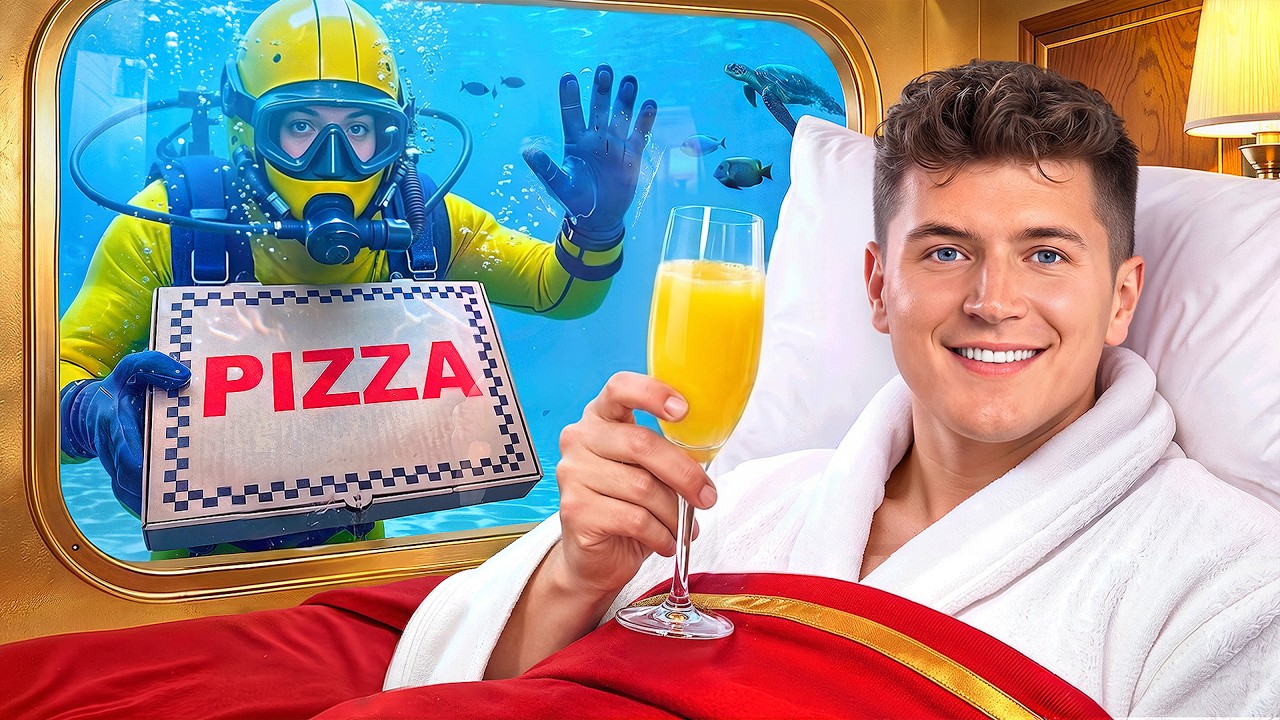
The $50,000 underwater villa in the Maldives required three flights and a seaplane to reach, with a butler named Masyh who carried a knockoff iPhone 17 Pro Max alongside DiGiovanni’s real one. Lunch happened at ITHAA, five meters below sea level in the Indian Ocean, with sharks and barracuda circling the glass ceiling. DiGiovanni and his cameraman Tim rated the yellowfin tuna tartare with salmon roe a ‘fantastic’ and an 8 respectively, then worked through crispy duck with a quail egg yolk pop, a lemongrass sorbet that tasted like Rhode Island frozen lemonade, and a Maldivian spiny lobster tail served with palm puree and fennel. DiGiovanni kept his preference for Maine lobster but admitted the cooking was impeccable. He then jumped into the open ocean to swim with the sharks, as promised.
The $100,000 finale was a superyacht called ‘This Is It,’ anchored in the Mediterranean with DiGiovanni’s three brothers: Cam, Pete, and Will. A private chef had hidden small bites around the entire vessel, truffle and cheese crostini, smoked salmon tartlets, caviar bites, and a fruit plate anchored by watermelon that DiGiovanni called one of the most beautiful he had ever seen. The five-course dinner moved through fresh Greek cheese with roasted red peppers, sea bass ceviche in a ginger herb tiger’s milk, butter-poached lobster tail with corn soup, white grouper caught the previous night with a cauliflower truffle salad, and a pavlova that Will, self-described as a serious consumer of pavlovas, called the best he had ever had. The chef runs the entire kitchen alone, which means, as he put it plainly to DiGiovanni: ‘If it’s good, it’s you. If it’s bad, it’s you.’
The truffle crostini nobody finished
Somewhere on the upper deck of the superyacht, Pete DiGiovanni discovered a truffle-burrata bite on a small plate left near his room. He stood at a window looking straight out to the water and ate it alone before dinner.
Back in the capsule hotel in Tokyo, a stranger had asked DiGiovanni to keep it down. The convenience store crunch of that dessert bar echoed through every price tier that followed, a reminder that a great bite does not always require a shark overhead or a butler with a counterfeit phone.