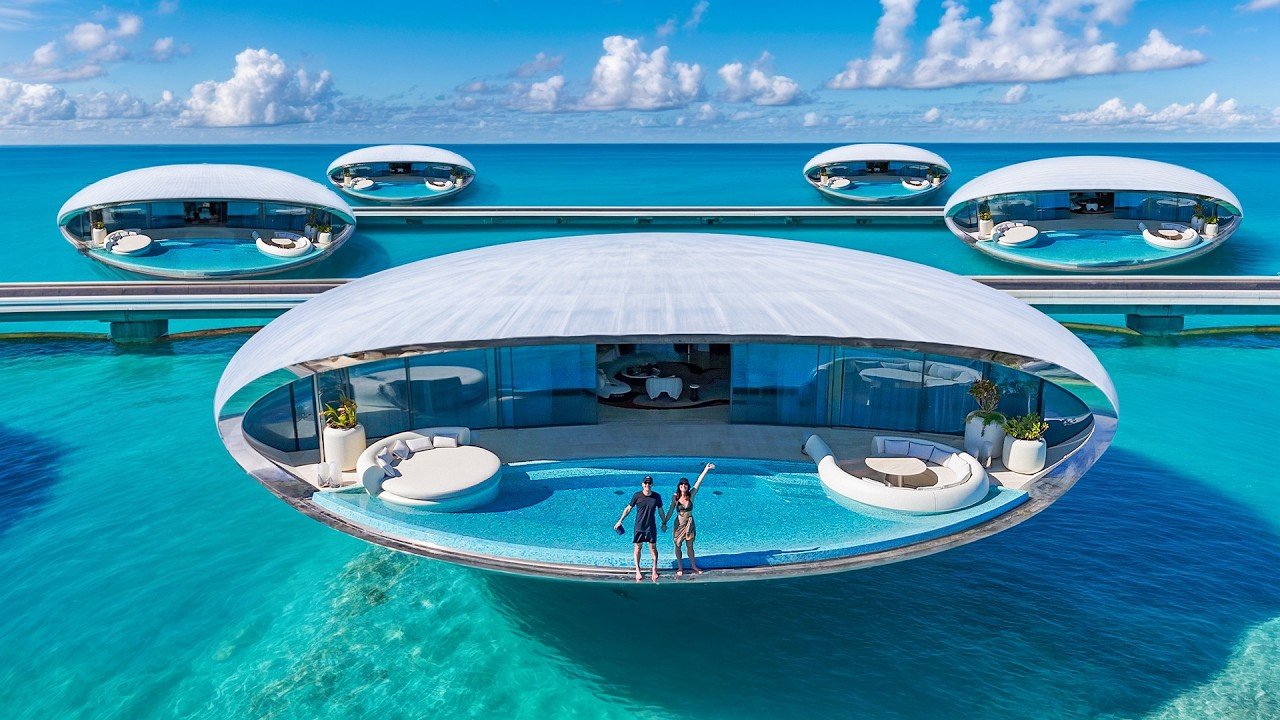
Kara and Nate stepped off the boat and stopped cold. The overwater villas rising from the Red Sea in front of them looked like something a space program would build if it pivoted to hospitality: smooth, orb-shaped pods hovering above electric-blue water, their curved surfaces catching the afternoon light in ways that made them look simultaneously ancient and impossible. For two people who have stayed at some of the most celebrated overwater villas on the planet, including properties in the Maldives and Bora Bora, that kind of genuine shock is not easy to produce. Saudi Arabia produced it on the first glimpse from the boat. The question was whether the experience inside would hold up to the spectacle outside.
A resort seven years in the making
Construction on the property began in 2017, which means the finished product represents seven years of building in one of the most ambitious tourism pushes any country has ever attempted. The orb-shaped villa structures were fabricated entirely in Dubai, loaded onto ships, and installed on-site in the Red Sea. The entire resort runs on a large solar farm, which Kara found quietly remarkable given that Saudi Arabia is the world’s second-largest oil producer. The 35 overwater villas are arranged in a long line parallel to the beach, forming one side of a massive oval-shaped property that also includes beach villas, five restaurants, two infinity pools, a spa, a dive center, a gym with a full recovery bar stocked with massage guns and vibrating foam rollers, and a future golf course still taking shape as open sand dunes. An olive tree estimated at over a thousand years old sits at the center of the main reception orb, directly across from the Italian restaurant run by a Michelin-starred chef.
The villa Kara and Nate booked was a two-bedroom unit, and the interior matched the exterior’s commitment to the unexpected. Almost no 90-degree angles exist anywhere in the space. The primary bathroom features a rainfall and waterfall shower with adjustable modes and color-changing lights wired for what Kara called a full dance party. A luxury Japanese-style toilet opens its lid automatically when a foot passes beneath the sensor, flushes without being touched, and closes itself afterward. The minibar, which opens behind a pair of dramatic doors and genuinely looks like it would charge $12 per item, turned out to be entirely complimentary after Nate confirmed it twice with staff. Below it sat a mini fridge stocked with non-alcoholic sparkling rose, non-alcoholic beers, soft drinks, and pre-mixed mocktail options. A butler door on the kitchen side allows staff to deliver breakfast to the villa without ever entering the main living space.
No alcohol, no crowds, and a small-world dinner
The pool bar is fully stocked and visually indistinguishable from a standard resort bar, complete with champagne flutes, wine glasses, and backlit shelving. Everything behind it is alcohol-free. Saudi law makes alcohol illegal, and while Kara had expected the bar to simply not exist, the bar staff instead invested in non-alcoholic alternatives across every category. One bartender at the pool bar described a house specialty: a lemon and mint drink infused for 24 hours. A matcha latte that arrived at poolside included, according to the staff member who made it, a secret ingredient he would only identify as love.
The resort had almost no other guests during the visit. Kara and Nate were alone at the Italian restaurant the first evening, alone at the pool the following morning, and alone at lunch at the poolside restaurant on the far end of the oval, where mushroom gyoza topped with flowers and fried cod in lemon tartare sauce were among the standout plates. The dinner at the Japanese restaurant included miso-glazed eggplant, three varieties of udon, and a dessert of matcha coconut strawberry that Kara described as her personal favorite of the entire trip.
The Italian dinner produced something no amount of resort design could have engineered. The restaurant manager approached their table and told them he recognized them, not from their work online, but from a real encounter. Eight years earlier he had been working at Victoria Falls Safari Lodge in Zimbabwe, and the two had met there in person. He appears in footage from that trip. Kara put it simply: ‘It was such a small world moment.’
The man who remembered them from Zimbabwe
Gus, the restaurant manager, had traveled from a lodge above a waterfall in southern Africa to the opening months of a futuristic island resort in the Red Sea. He and Kara and Nate stood in a Michelin-starred Italian restaurant shaped like a spaceship and processed the fact that the world had folded back on itself in a country none of them could have visited as tourists just nine years ago.
The reef directly in front of their villa, visible through the villa’s floor-to-ceiling front window, waited with free snorkel gear from the dive center. The water beneath the orbs, when viewed from underneath during a snorkel, reflected the curved underside of the structure in a way that looked, depending on the light, like something that had no business floating there at all.
 Wake up to Only Happy News!