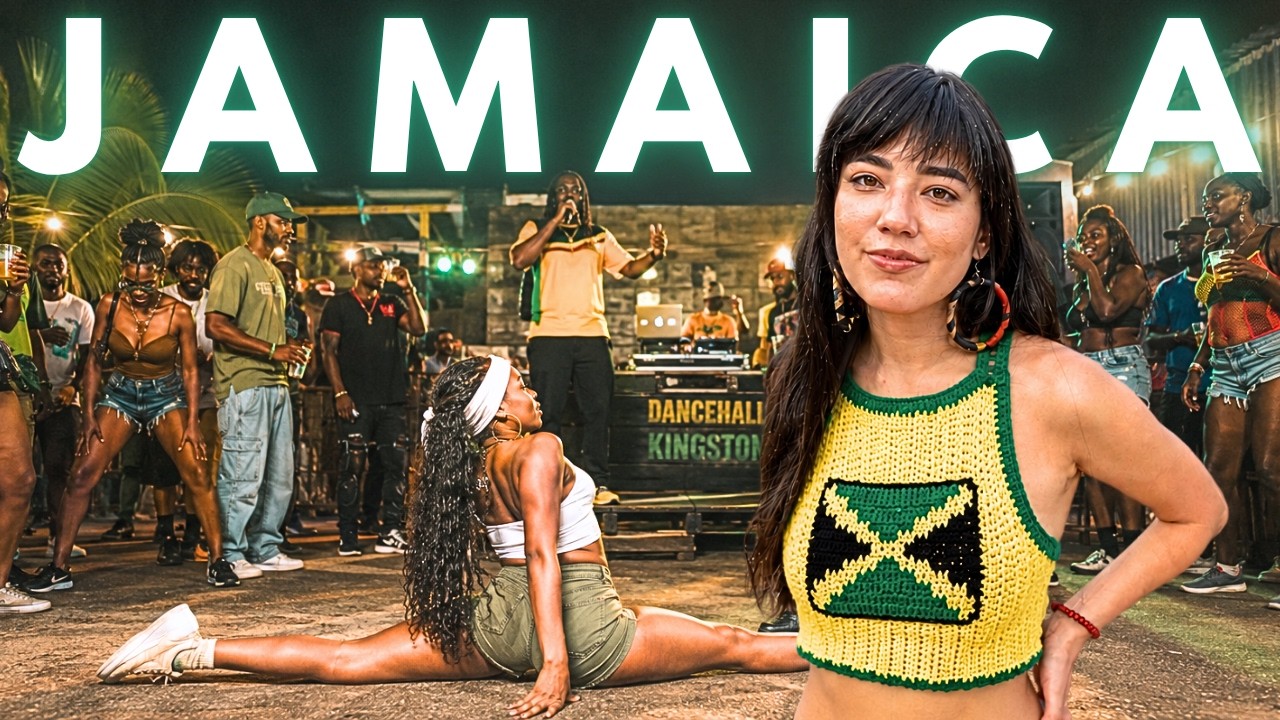
At Wetty Wetty Wednesdays, a Kingston party that does not start until midnight on a weeknight, Sashi and Chippy are nowhere to be found at 1:00 a.m. because Sashi fell asleep before he could make it. The MC is already on the mic, the dance floor is already moving, and things are, according to the crew, just starting to kick off. That tension between exhaustion and exuberance is exactly the energy that makes Kingston, Jamaica’s capital and cultural engine, so hard to explain from the outside. This is a city that has a reputation for danger, where the cost of living rivals California without the California salaries, where potholes border on legendary, and where somehow, on any given Sunday, you can find three separate parties running back to back from 10:00 p.m. straight through to 7:00 a.m.
Where dance hall became a full-time job and a language everyone already speaks
Sashi and Chippy are local dancers who grew up in Kingston’s inner city communities, the same neighborhoods that formed after Jamaica’s independence in 1962, when people arrived in search of economic opportunity and found both hope and political tension. In the 1970s, neighborhoods aligned with either the PNP or the JLP, and simply crossing into the wrong area carried consequences. At the same time, towering sound system rigs rolled into empty lots and open streets, and dance hall was born. Not just a musical genre but a dance movement, a fashion world, and, as Sashi explained plainly, a workspace. ‘We have people that earn,’ he said. ‘It’s a work space for them. People who selling the party, so every party that they go, they’re needed.’ Specific routines attach to specific songs, repeated until strangers on a dance floor can lock in together without a word exchanged. After the party ends, always abruptly at 2:00 a.m., the next move is jerk chicken from the vendors already set up outside, smoke rising from converted oil-drum grills, before the crowd heads to the next party, which runs until dawn.
Trenchtown, one single bed, and a neighborhood that changed music history
A few miles away, Trenchtown sits as arguably the most influential musical neighborhood in the world. The Trenchtown Culture Yard is the preserved government housing project built in the 1940s where Bob Marley lived as a teenager and began writing music in a shared courtyard. An elder who knew Marley personally described him not as a musician first but as ‘that person who have that spirit of wanting things to happen, changes, bringing people together.’ He died at 36, and the elder offered a quiet parallel: ‘Them tell them say Jesus die at 36.’ The single bed Marley slept on is still there. What made Trenchtown so generative, many argue, is its physical design: families in small rooms surrounding shared courtyards, close quarters where music and storytelling moved between people like heat. Reggae artist Anunnaki, who was filming a music video at Fathers United for Change, a community organization channeling young men toward music rather than violence, put the source of Jamaica’s creativity simply: ‘The struggles, the joy, the enjoyment, the culture, the food. It’s coming from our ancestors, passed down to we.’
Ital food, sacred drumming, and the parts of Rastafari that rarely travel abroad
Mojiba, a Kingston local, led the way through the deeper architecture of Rastafari, starting at Dubwise, a vegetarian food court and music venue. Her friend Brent runs the veggie stall there, serving plant-based ital cuisine rooted in a Rastafari tradition of natural, organic, earth-connected eating. The spread included quinoa, vegan mac and cheese, cauliflower wings, and barbecue circles. ‘Ital is the original vegan,’ Brent said, adding that it comes ‘with lots of love.’ The cameraman, described by the crew as a rampant Brazilian meat eater, cleaned his plate. Rastafari’s actual philosophical framework is wider than its visible symbols suggest: African pride, anticolonialism, Ethiopia as a spiritual homeland, and Babylon as shorthand for systems of oppression. At House of Dread, elders were being honored with an afternoon of community care. One elder described the ideal Rastafarian life as living ‘as a king and treat woman as queen.’ Mojiba’s father, Count Azi, was one of the key figures behind Nyahbinghi, a tradition of sacred drumming rooted in African musical traditions whose band helped lay foundations for reggae. Now Mojiba carries that legacy forward, playing Nyahbinghi every Sunday night.
The jerk chicken vendor near the American Embassy had been seasoning his chicken for five days before serving it. The marinade runs through scallion, onion, pepper, thyme, ginger, jerk seasoning, allspice, and more, smoked over charcoal reclaimed from burned wood. No sauce was needed. ‘He seasons it for so many days that the whole thing is like perfectly savory,’ the crew noted after eating it nearly every day across two weeks in Kingston. At Coronation Market, the largest produce market in Jamaica, Brent pointed out that supermarket prices in Kingston can match California’s, while market prices run half that or less. Scotch bonnet pepper is non-negotiable. As one vendor put it: ‘Don’t bother cook if you have no pepper.’
A woman walking down the street in Trenchtown
Mojiba’s father once pointed out that you can watch a woman walking down a Trenchtown street and see her moving in rhythm, because somewhere in her head there is music no one else is hearing.
At midnight on a Wednesday, when the jerk smoke hits you before the party does and a city of 2.8 million people continues to export culture that shapes the entire world, that observation does not feel like poetry. It feels like a reasonable description of what is actually happening on the street.