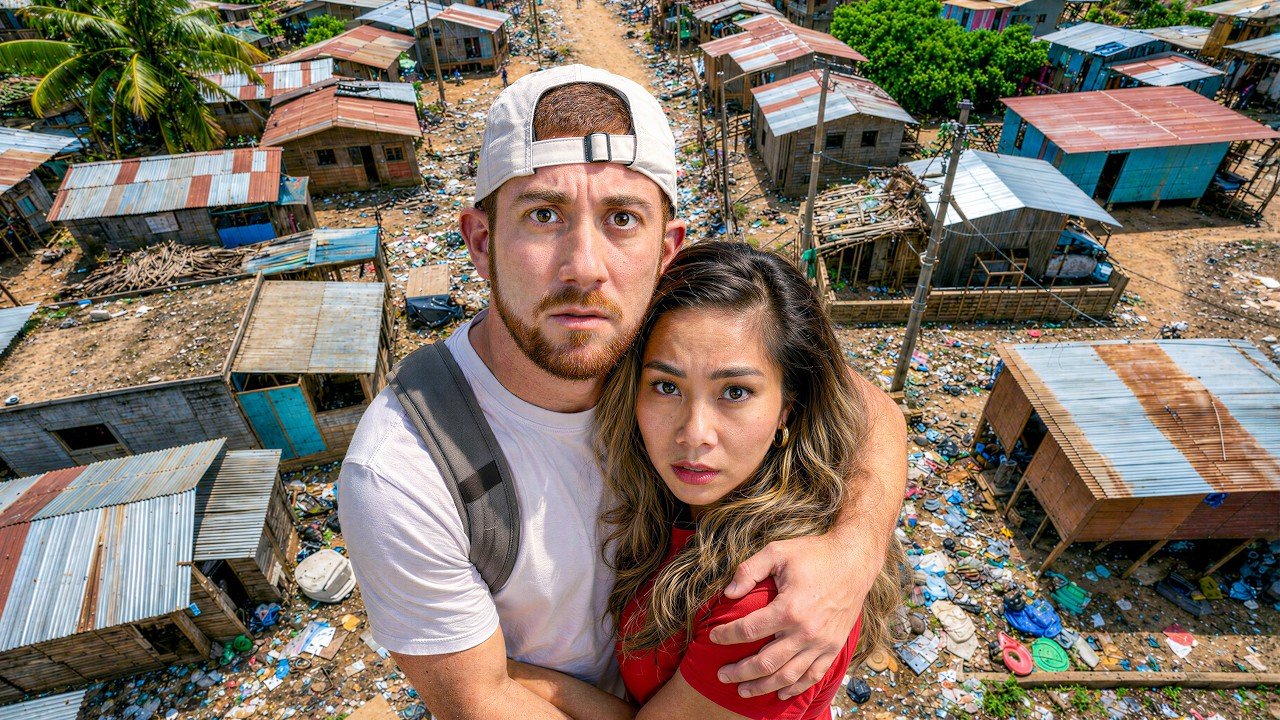
Christiano is eleven years old, speaks five languages, and has never eaten at the restaurant on the beach he works every single day. He sells magnets to French tourists in Nosy Be, Madagascar, and on the days nobody buys, he does not eat. That reality lands harder than any statistic about the world’s poorest island, and it is the reason a five-day journey through Madagascar by Drew Binsky and his wife Deanna refuses to stay in the category of ordinary travel.
The trip begins not on a beach but in the capital, Antananarivo, where the first logistical reality announces itself before the bags are even unpacked. The city loses electricity for up to five hours every single day, splitting the outage between districts, east in the morning, other quarters by afternoon. Running water arrives only between 10pm and 5am, so residents fill jerry cans at night and ration from them through the day. Their local guide, Parfait, explains both systems with a calm that makes clear this is not a complaint but a weather report of ordinary life.
A Wednesday market and a shoe that costs ten thousand ariary
Parfait leads the way into a secondhand clothing market that appears only on Wednesdays. Hundreds of shoes are piled in unorganized heaps across the ground, but a professional shoe cleaner stationed nearby makes every pair gleam like new stock. The minimum daily wage across the city runs around $2. Fiber internet at home costs roughly $50 a month, so most households simply go without. At a famous corner in the Faravohitra neighborhood, a vendor cuts slices of Koba, a dense cake made almost entirely of peanuts and sugar, pressed into a dark brown block. Deanna, who grew up in the Philippines, says the whole market reminds her of Bicol, her hometown. The faces, the energy, the chaos of commerce conducted from the street.
The deeper the pair travels into the city, the more the infrastructure story sharpens. A 150-million-euro cable car project serves only a fraction of the capital and still requires multiple bus transfers to be usable at all. Public healthcare covers a percentage of medicine costs depending on the illness, but if a patient cannot afford the remainder, surgery simply does not happen. As Parfait puts it plainly: ‘If you can’t afford it, you just have to suffer.’
In the riverside community of La Reunion Kely, a man named Harry runs a barber shop from the middle of the street. His sleeping quarters are directly above: a dark room, a single bed, a phone on charge. He pays 60,000 ariary a month in rent, about $15, and there are months where his cable and adapter sales do not cover even that. Nearby, a river cleaner lives inside a repurposed shipping container with three of his seven children. He earns around 300,000 ariary a month, roughly $80, and his biggest struggle is paying for his children’s school books and pens.
What a flight north and an Aperol Spritz in a plastic bottle reveal
Nosy Be, the northern tourist island, arrives as a sensory reset. Yellow tuk-tuks, French signage everywhere, a golf course where the only real hazard is a pile of cow dung between ball and hole. The beaches are stunning. The water is fast and warm. But Binsky is not there for the resort version.
The night Christiano appears at a beachside bar, trying to sell magnets, is the night the whole trip pivots. The next day, Binsky and Deanna take the boy shopping. He picks out a backpack, school supplies, fresh shoes. Back at his home, a wooden structure with a tin roof full of holes and close to ten people sleeping inside, Christiano stores his clothes in a small pile near the spot where he sleeps. When he is asked why he is being so quiet at the restaurant, he says: ‘Because very, very happy.’
Five languages. Five. English, Italian, French, Polish, and Malagasy, learned entirely from tourists on the beach. His stated ambition is to become a pilot.
The boy who gave a heart-shaped magnet as a gift
On their second morning together, Christiano hands Binsky a magnet shaped like a heart, unprompted, a gift from a kid whose daily work is selling exactly those objects to survive.
Out behind Christiano’s village, a communal well sits about fifteen feet deep. Residents tie a string around a bucket, lower it, and haul it back up by hand. That water is for showering, drinking, and cooking. The beach is a five-minute walk away. The tourist bars are five minutes in the other direction. The distance between those two worlds, measured in footsteps, is almost nothing. Measured in everything else, it is the whole story of Madagascar.
 Wake up to Only Happy News!