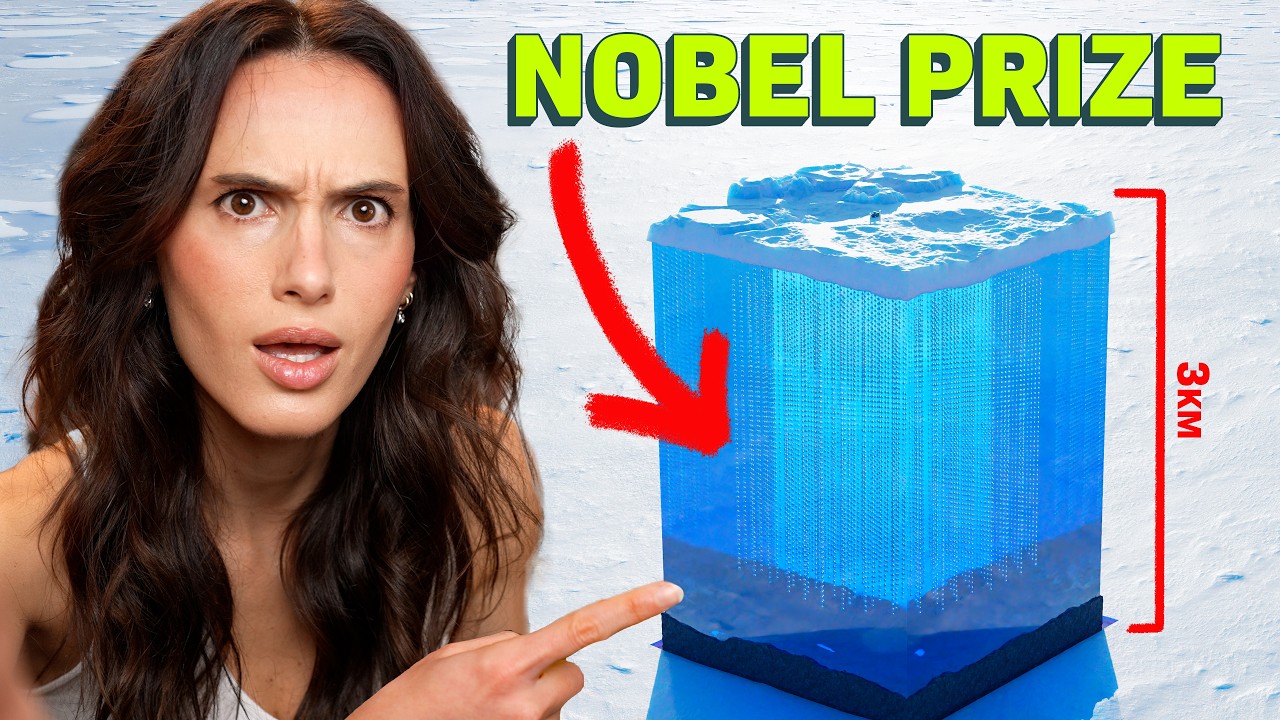
Dr. Francis Halzen was at his desk working, not watching the clock, when the call came. He had forgotten the announcement was even that day. ‘I was surprised,’ he said. ‘I wouldn’t have been surprised, but now I was because I wasn’t thinking about it.’ That absent-minded moment is a strange entry point into one of the most ambitious scientific projects in human history, a machine the size of a small mountain buried under Antarctic ice that is quietly rewriting how we see the universe. The Nobel Prize in Physics followed, and with it, a conversation about what comes next.
A kilometer of ice as the purest detector ever made
The South Pole is a desert. No penguins, no dramatic coastline, just compacted snow sitting on top of three kilometers of ancient glacier moving roughly ten meters every year. It was into that glacier that Halzen and his team drilled 86 boreholes, each one taking two days to open using a hot-water drilling technique that required building a hose two and a half kilometers long capable of carrying boiling water under pressure without collapsing. For weeks, Halzen believed the project was finished because no manufacturer thought such a hose could exist. Eventually a company near Venice said they could build anything, and they did.
Down each borehole went a cable strung with 60 sensors, each one a glass pressure vessel enclosing a photomultiplier tube: a device that does the opposite of a light bulb. When light strikes it, it generates an electric signal. In total, 5,160 of these sensors now sit frozen in Antarctic ice 1.5 kilometers below the geographic South Pole, forming IceCube, a detector sensitive to neutrinos. Those sensors communicate upward to a computing center at the surface that reconstructs every signal.
Neutrinos are particles with barely any mass and no electric charge. A million of them pass through any given surface every second without leaving a trace. Only occasionally does one collide with a nucleus in the ice, disappear, and transform into electrically charged particles that emit a brief glow. IceCube maps that glow, reconstructs where it came from, and in doing so points back to a source somewhere in the sky. Accumulate enough of those points and you get something resembling a map of the universe, drawn not in light but in particles that travel from the edge of space and time without deflection or absorption.
The critical early question was whether Antarctic ice was transparent enough to make this work. A predecessor instrument called AMANDA answered it. The ancient ice, snow that fell on Antarctica roughly 50,000 years ago and compressed into glacial perfection, turned out to allow blue light to travel 100 meters and more without scattering. The best artificially produced ice in a surface laboratory achieves about eight meters. Halzen described it plainly: ‘Nobody anticipated this. It’s like this incredible gift in Antarctica.’
The discovery that took six months of dread to publish
In 2013, while searching for a different category of neutrinos the team had theoretically predicted and even nicknamed the ‘guaranteed neutrinos,’ they found nothing of what they expected. Instead, two events appeared in the data that could not have been produced by the atmosphere. Two events is not a claim. ‘Are you going to risk your reputation on two events?’ Halzen asked. They published the two events without asserting anything, then systematically searched two years of existing data for similar signals. They found 26 more. That was enough. IceCube announced the discovery of cosmic neutrinos and was declared the physics breakthrough of the year. Halzen spent the following months quietly preparing for the next press conference, the one where he would have to admit it was all a fluke. It never came.
In 2017 a high-energy neutrino event was reconstructed and its rough coordinates transmitted via Iridium satellite phone to astronomers around the world. More than 20 telescopes turned toward the same region of sky. What they found was an active galaxy: a galaxy whose central supermassive black hole is still actively drawing in material, spinning it into a whirlpool, and accelerating particles to extraordinary energies. Those particles produce both the neutrinos IceCube detects and the cosmic rays that have rained down on Earth mysteriously for more than a century. Multi-messenger astronomy, multiple instruments and multiple signal types working in coordination, had located a source.
IceCube 2 is already in planning. It will be ten times larger by detection volume, using roughly 10,000 sensors instead of 5,160, and thanks to improved technology and a deeper understanding of the ice, the cost corrected for inflation works out to roughly the same as the original. The discovery instrument becomes the precision instrument.
The supernova nobody has seen yet
At a depth of one kilometer, before the team moved deeper, the ice was full of bubbles and useless for the original purpose. Rather than abandoning the shallow array entirely, the team realized it could detect a supernova inside the Milky Way. Not individual neutrino events but a statistical flood: a million events at once, enough to produce a detailed record of what happens inside a dying star. Halzen noted at a celebration following the Nobel announcement that Wisconsin might earn another Nobel Prize when a supernova occurs. ‘I don’t think I’m joking,’ he said. The last one visible from Earth was observed by Kepler. AMANDA and then IceCube have been watching continuously since 1994 without interruption, and nothing has happened yet in our galaxy. It will.
The model of IceCube that Cleo Abram’s team built for the conversation now belongs to Halzen. He rated it near the top of at least twenty he has received over the years, noting it has ‘an artistic side to it as well.’
Somewhere under three kilometers of Antarctic ice, more than 5,000 glass pressure vessels sit frozen in silence, waiting for the next particle to arrive from somewhere in the universe and leave its brief, faint glow in the dark.
 Wake up to Only Happy News!