
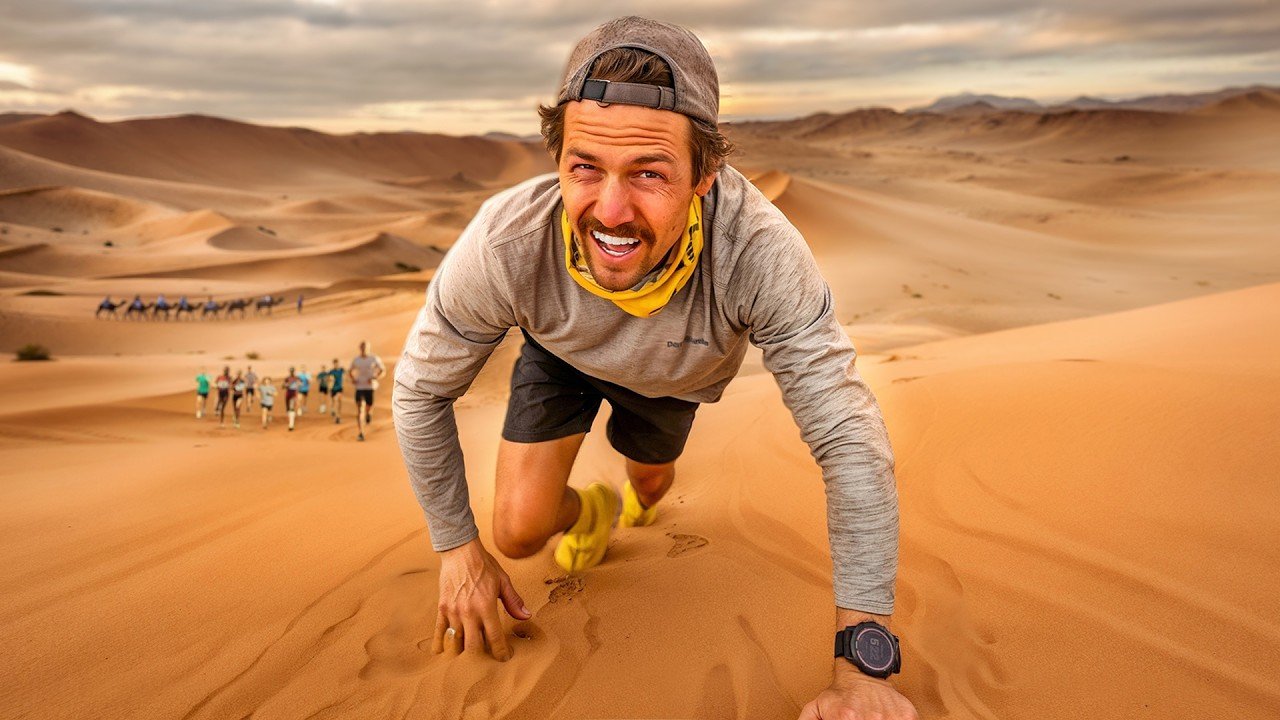
Nate packed a 7.85-pound bag, laced up gaiters for the first time, and stood at the start line of Marathon Des Sables — 155 miles across the Sahara Desert, split across six consecutive days, with every calorie, every piece of gear, and every layer of clothing on his back. Water and a tent were the only things the race provided. Everything else was his problem. The clock started at 6:00 a.m. on day one, and the cutoff for the brutal 51-mile fourth stage wouldn’t arrive until 34 hours later.
Here’s how that week broke down — the gear math, the daily grind, a knee that kept threatening to end the whole thing, and a finish line that nobody in camp was going to forget.
Days One Through Three: Desert Logic
The first stage — 20 miles over cracked hardpan, rocky flats, and early dune crossings — took Nate just under four and a half hours. His backpack felt heavier than any training run. His shoulders flagged early. An Irish tentmate named Ronin, who had talked Nate out of packing a change of clothes back at basecamp, kept him company through the middle miles. The distraction worked — Nate admitted he forgot about the heat entirely while they were talking.
Day two stretched to 25 miles with significantly more soft sand. That’s where the race stopped being a novelty. Nate’s left IT band — the same one that flared during the Leadville 100 the prior year — tightened hard around mile 12. His calorie calculations, worked out meticulously before the race with each day’s food packed in separate labeled bags, left zero margin. He’d already burned through most of that day’s food by midday, with miles still to cover. Kara, credentialed on the media team and banned by race rules from handing him so much as a water bottle, watched from checkpoints with their driver Hassan — helpless by design.
Day three added another 20 miles of near-total soft sand. Nate slept roughly two hours the night before. His left knee felt like ‘somebody was stabbing it with a knife’ at mile one — then loosened up by mile six. He’d developed a camp routine: collect the 5-liter water jug, ration 3.5 liters for camp use, fill 1.5 liters for the next morning’s start, eat the same freeze-dried dinner, watch the sunset with Kara, then separate to their respective tents. Sixty-five miles banked. Ninety left.
Stage Four: 51 Miles, One Day, One Knee
The long stage was the one Nate had been circling on the calendar since before the race began. Fifty-one miles — one mile short of two full marathons — starting at 6:00 a.m. with a 34-hour cutoff window. Some competitors planned to run through the night. Nate’s goal, quietly held until he was close enough to believe it, was to finish before dark.
His IT band was throbbing before the start gun. By mile 12 and a half — exactly the halfway point of the entire 155-mile race — he described himself as ‘in a little bit of a bad place.’ The first half took six hours and thirty minutes. By checkpoint six, race staff had set out a plate of dates and actual chairs — small luxuries that Nate described as the best things he’d experienced in days. He sat down, ate, plugged in the same high school emo pump-up playlist he’d used at Leadville, and kept moving.
He crossed the finish line at 13 hours and 10 minutes — the second half just ten minutes slower than the first. The final split: nearly identical pacing across 51 miles of Sahara sand, on a knee that had been keeping him awake at night. A sandstorm rolled into camp while other competitors were still finishing. Nate’s tent collapsed.
Days Five and Six: Racing Toward the Dunes
With the hardest stage behind him, Nate shifted strategy on day five. Rather than preserve energy, he decided to push — targeting a finish ahead of his tentmates for the first time all week. He passed them all. He nearly cried three times in the final ten miles, not from pain, but from what he described as an emotional wave he couldn’t fully explain — gratitude, momentum, or possibly, he joked, early death.
The final day was 13 miles through the Merzouga Dunes — the same sweeping sand landscape where Nate and Kara had spent a night back in 2016. The race designers saved the deepest sand for last. Lawrence, a tentmate who had been among the fastest all week, sprinted the final miles with an engagement ring on a necklace — his girlfriend was waiting at the finish line, unaware of the proposal. She said yes.
Nate crossed shortly after, 155 miles complete, 7.85-pound pack finally empty.
The Bigger Picture
Marathon Des Sables drew nearly 1,000 runners from 52 countries for this edition — 27 percent women, 147 competitors over age 55, the oldest being 76. The race’s self-supported structure means no crew, no outside nutrition, no exceptions. That design enforces a particular kind of honesty: what you packed is what you have, and what you carried in your legs going into the week is all you’re getting out. For media and crew members like Kara, the rules created a strange role — present at every checkpoint, useful for none of it.
Nate had entered Marathon Des Sables on a 7.85-pound bet that his body, his food math, and his IT band would all hold for six days in the Sahara — and when he walked across that finish line in the Merzouga Dunes, every one of those calculations, barely, came out right.