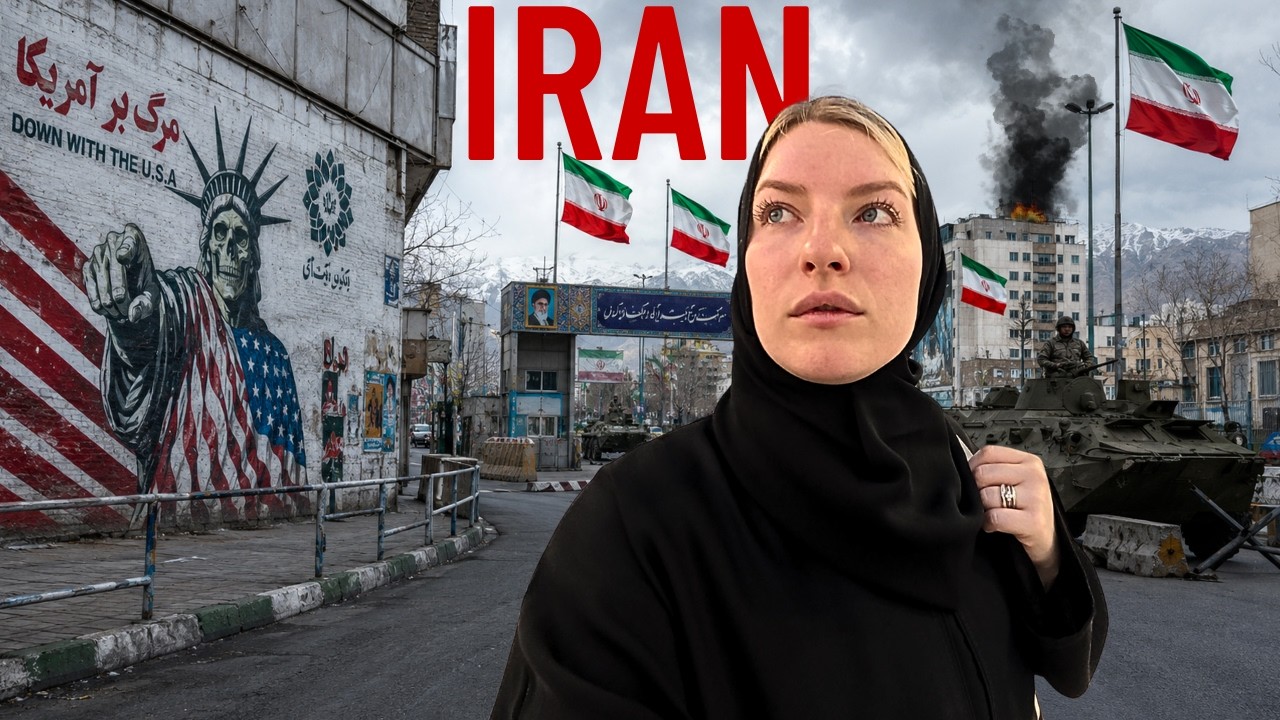
At 8:10 on a Tehran morning, the traffic is already locked solid and the heat is already punishing. Matt and Julia had crossed more than a thousand kilometers of Iran to reach this point, from the Armenian border through the Kurdish mountains and down to the Caspian Sea, and now they were standing on a pavement in a city of 12 million people watching a man try to keep his car engine from boiling over. Tehran is the place where, as they put it, if anything goes down in Iran, this is where it usually happens. And in September 2026, quite a lot was going on.
Tehran Fried Chicken and the supermarket no one expected
The first thing that hits visitors is what is missing. None of the global fast-food chains that line high streets across most of the world appear anywhere in Tehran. Sanctions imposed since the late 1970s have pushed Iran toward self-sufficiency on a scale that even Russia, currently the world’s most sanctioned country, has not matched. In Tehran, you get TFC, Tehran Fried Chicken. Their guide Amin had mentioned a similar McDonald’s stand-in back in his home city of Shiraz. Inside a small supermarket on a side street, Coca-Cola, Fanta, and Sprite were on the shelves but locally manufactured, not officially franchised since the revolution. Everything else was Iranian. There was Kit Kat, a Snickers, rice from Pakistan, Russian chocolate made in Iran, and a local chocolate bar that Julia noted looked strikingly like Roche. ‘I love how they change the name,’ she said. ‘It’s so funny.’
The metro was free. Since the war started, the underground had been opened to the public at no cost. Portraits of the Supreme Leaders lined the carriages. The service was busy, and the passengers were quiet, and the two travelers were the last people anyone expected to see there.
The former US embassy and the city’s two very different faces
A short ride across town brought them to the site that defined Iran’s relationship with the Western world for nearly half a century. The former US embassy, where 52 Americans were held for 444 days after revolutionary students stormed the compound in 1979, is now controlled by Iran’s Revolutionary Guard. Anti-American murals cover its walls. Part of it has been converted into a museum. Photography and filming inside were not permitted.
Back on the streets, Tehran revealed a contrast that no other city in Iran had shown so sharply. Hipster cafes with people on laptops sat directly beside government billboards and religious buildings. Young men and women in fashionable clothes moved through the same blocks as pro-government infrastructure. Amin, their guide, got quietly emotional sitting in a jazz cafe in what felt almost Parisian in layout, watching women inside move around without hijabs. This, Matt explained, had changed only recently. Until roughly a year before their visit, hijab rules were being enforced at the entrance of restaurants across the country. Since the start of the war, that enforcement had stopped. The change was visible and it was new.
North Tehran told a different story about a different kind of freedom. On the roof of the city, the elevated residential district where the mountains frame the skyline, properties sell at prices the pair compared to London and New York. On one street they passed Ferraris, Maseratis, and Lamborghinis in a dealership window. The import tariffs on luxury cars in Iran run to 150 percent on top of the base price, making each one a staggering multiple of what it would cost elsewhere. Julia asked the question plainly: ‘What do people do to earn that much? Can you earn such money in an honest way?’
Dinner came later at a mall restaurant: chicken liver pate, saffron orange chicken, kebab, and a South Iranian prawn curry. The bill for the whole table came to 60 dollars. A ride home on Iran’s local Uber equivalent dropped them back in the center just as the evening’s pro-government protests were getting underway, drawing small crowds and dispersing quietly.
The war, visible for the first time
It was near the airport that Tehran finally showed what the past six months of news had actually looked like on the ground. Bombed and ruined structures sat visible from the road, the first physical evidence of the conflict they had seen anywhere in Iran. In a city whose official population is 12 million, and whose real population is likely higher, that damage was easy to walk past. Most people were.
Amin, still thinking about the cafe.
He had spent the afternoon watching something he had not been certain he would see in his own country: people sitting freely, dressed how they chose, in a capital that had spent decades being defined almost entirely by what it would not allow.
 Wake up to Only Happy News!