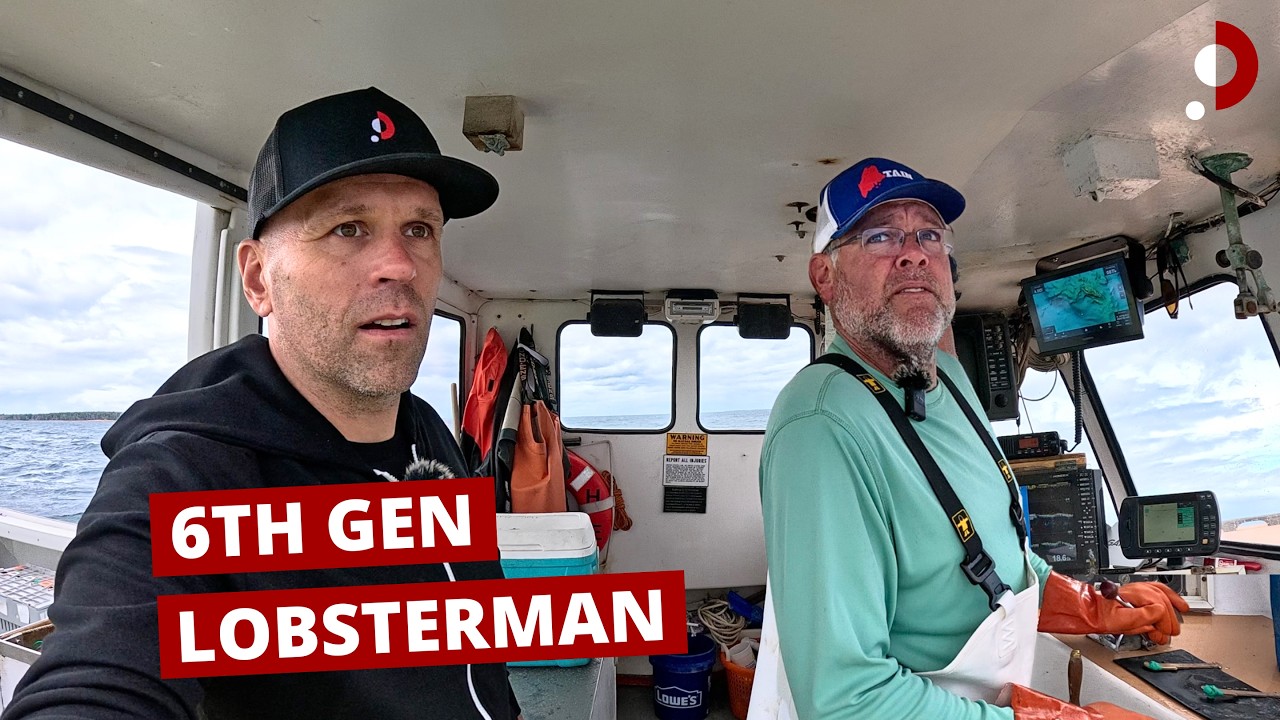
Eric Waterman stands at the edge of Eben Island, the small tree-covered patch of land his family has owned since Winslow Waterman bought it from one of Henry Knox’s war buddies generations ago, and points across the water toward a house that sold recently for roughly $4 million. The name on the nautical chart is Waterman Point. The beach down the road is Waterman’s Beach. Six generations of the same family have fished, dived, and hauled traps from this particular slice of the Maine coast, and Eric is the last man carrying the name. The story of what is happening here, to this coastline and to the families rooted in it, is playing out one sold property at a time.
[See the Full Article featuring Brett McFarland’s Story on Peter Santenello’s Documentary]
Invisible lines and a gentleman’s agreement
Lobstering in this part of Maine runs on an unwritten code older than any licensing board. Fishing grounds are divided by invisible lines, marked not on any official chart but by landmarks: line up a particular house on a point, use a range mark off a known rock, and you know the boundary. ‘All friendships end at the line,’ Eric says flatly. ‘You don’t know where the line is, keep coming, you’ll find it.’ The price at the dock sits at $5.75 a pound, with lobsters weighed out in 90-pound crates. By the time that same lobster reaches a restaurant table, a two-lobster dinner can run $50 or more. Eric sells a portion of his catch through a small side arrangement: cooler in the back of his Pontiac, a drive to the campground down the road, lobsters fresh off the boat. ‘Have a drink with them,’ he says. ‘Makes it more enjoyable.’
His 21-year-old daughter Abby got her first lobster boat around age 12, a 15-foot outboard with a small hauler her father set her up with. She upgraded in 2022 and now runs her own operation, baiting traps with pogies packed into mesh bags to slow the bait down so it lasts longer than a day or two in the water. On the day they head out together, the haul is thin: nearly every lobster short of legal size, several females carrying eggs that get notched under the tail flipper before going back, a mark that protects them from being kept even after the eggs drop. ‘This is a small lobster for having eggs,’ Eric says, holding one up. He notches it without hesitation.
Buzzy’s gardens and the things people take for granted
Down the road from the Waterman property, Arnold ‘Buzzy’ Kinney, 85 years old, keeps the gardens his late wife planted. She dealt with colon cancer for seven or eight years. Rather than place her in a facility, Buzzy stayed home and cared for her himself. She has been gone a little over six years. He maintains every bed she built, despite not being able to tell most of the plants apart. ‘Did she do it to get even with me for some reason?’ he asks, entirely serious. ‘Cuz now I’m trying to take care of it and I don’t know one from another.’ He gave up lobstering seven years ago to care for her. When asked what he misses from those simpler days, he doesn’t mention the ocean first. He mentions coming home from a day’s work and finding supper already on the table. Sitting down together. The ordinary weight of what disappears.
The last holdout on Waterman’s Beach
Eric and his three sisters still own three and a half acres of original farmland together, the last of what the Waterman family once held in this stretch of coast. The neighboring parcel, the one his grandparents lived in, went on the market when no family member moved to buy it. Someone from out of state paid roughly $4 million. Old barns sit on the Waterman land that everyone agrees are too far gone to save. ‘Everyone says, oh, it’s too bad to let them go,’ Eric says. ‘But man, we’re going to have to tear them down here at some point.’ When asked what it would take to sell the island camp, he doesn’t hesitate. ‘A lifetime supply of White Claw? No. I don’t have a price.’
Abby’s bait bag, half-tied
Out on the boat, Abby works through a pile of pogies and a stack of mesh bait bags, filling each one by hand. One bag sits open on the gunwale, half-loaded, while she reaches for another handful.
The water temperature around Eben Island runs in the low 50s even in summer, cold enough that nobody swims, warm enough that lobsters can be hauled from traps set just off the beach. Eric’s family bought the island in 1979 with money his mother had set aside for college. It has been in continuous family use since. At night when the haul is done, he drops his sternman at the dock, showers at his house up the road, packs some groceries, and motors back out. On the island, he fires up a portable speaker on the porch and people from the surrounding islands and the campground text him song requests until late. Rock and roll, mostly, whatever they want. Island DJ, he calls it.
[See the Full Article featuring Brett McFarland’s Story on Peter Santenello’s Documentary]