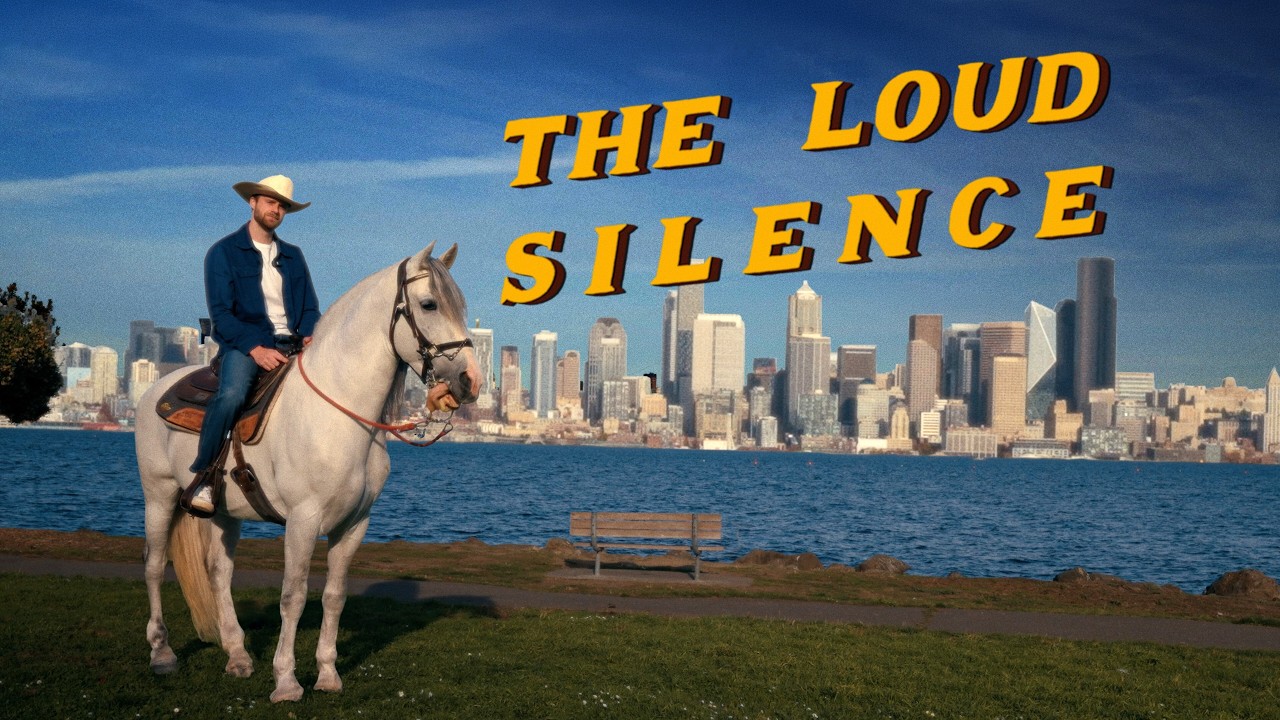
On a clear summer morning on Lake Washington, one of Seattle’s most coveted stretches of shoreline, the dock sat completely empty. Not briefly, not unusually. Every single day, the people renting the house on the water found themselves alone out there, surrounded by five-bedroom homes averaging 1.8 residents each. That arithmetic is at the heart of something most people can feel but struggle to name: a creeping, structural quiet that has settled over American life, and Michael MacKelvie spent a full lap around Seattle trying to understand exactly where it comes from.
Too many rooms, not enough people to fill them
The numbers behind that empty dock are genuinely startling. In 1970, the United States had roughly 17 million spare bedrooms. Today that figure stands at 98 million, more empty bedrooms in the country than there are people. In Seattle alone, the count of what MacKelvie calls emptiness-nest homes, households with no children where a couple or a single person lives alone, rose from 158,000 in the year 2000 to 243,000 today, a 54% jump in two decades, with 420,000 bedrooms sitting unused inside them.
A significant driver is the lock-in effect on longtime owners. Baby boomers hold 35% of homes with three or more bedrooms, and people over 50 own 40% of that stock. Millennial families with children own just 16%, despite there being more millennials than boomers in the country. Many of those older owners would prefer to downsize, but a low locked-in interest rate means trading their current home for a smaller one at a higher rate, paying more for less. So the big houses stay occupied by small households, and everyone downstream waits.
The neighbor MacKelvie finally met next door was not a retiree content with one property. The man mentioned vacation homes in the Hamptons, Aspen, Lake Tahoe, Sun Valley, and the French Riviera. Seattle, he explained, was the domicile, useful partly as a shelter from state income and capital gains taxes. MacKelvie put it plainly: ‘Less people owning more space, sometimes a lot more.’
Schools going quiet, cities splitting into two
The consequences land hardest on public schools. Laurelhurst Elementary, serving the neighborhood where the average home is worth around two million dollars, enrolled 53 kids in 2009. Sixteen years later it has roughly half that, around 272. John Hay Elementary near the Space Needle had over 500 children not long ago, so many the district was reassigning students to other schools. Today it holds about 260. The number of children under five in downtown Seattle has declined by 54%, a drop that far outpaces both the national birth-rate decline and the suburban flight of the 1960s. From 2019 to 2024, Seattle public schools lost about one in every eleven students, yet costs did not fall with enrollment, and spending per remaining student rose. A proposal to close schools and save around 5.5 million was withdrawn after criticism, leaving a district facing a 94-million-dollar shortfall with few clean options.
Meanwhile, the city’s office market compounded the problem. A building a Blackstone-owned company purchased in 2019 for 612 million dollars sold recently for 280 million, a 54% decrease in roughly five years. Seattle lost 18,000 jobs last year, and inbound commuter foot traffic ran 38% below pre-pandemic levels. As commercial tax revenue shrinks, that burden shifts toward residential homeowners.
Across Lake Washington, Bellevue tells the mirror story. Home prices there have risen more than double Seattle’s gains since 2019. Tech employment in Seattle fell 15% as 42,000 jobs disappeared; in Bellevue over the same stretch it rose by over 27%. Bellevue households have roughly twice as many children per home as Seattle.
Author Greg Bullard frames the underlying tension simply: the more friction we remove from human experience, the less human those experiences become. Door Dash, remote work, streaming at home, each genuine convenience quietly reduces the chance of bumping into another person. Three out of four meals in America last year were eaten off-site. Running 15 minutes a day has been shown to add three years of life; MacKelvie suspects future research will find that regular socializing carries a comparable return, but the infrastructure for accidental connection is thinning fast.
The one text worth sending this week
MacKelvie is not arguing against convenience or individual choice. He points out, with clear affection, that Seattle’s World Cup crowds were the happiest and fullest he had ever seen the city. That is not incidental. The challenge, as he frames it, is that wealth, convenience, and fear are all pushing in the same direction, further apart, and the structural results are visible in empty docks, half-full schools, and ghost kitchens masquerading as cheese steak joints in the back of an IHOP.
His answer is deliberately small-scale: host a dinner party. Send a few texts. If your friends decline, propose a different night. If that fails, knock on a neighbor’s door.
A building that used to be a school
Queen Anne High, over a hundred years old and structurally beautiful, still stands across the street from John Hay Elementary. Its halls have not held a student in decades. The entry price today runs between 400,000 and 800,000 dollars, with monthly dues around 800 dollars, because it is condominiums now.
The quiet that settled over Seattle’s most desirable shoreline is the same quiet that emptied those hallways, the same arithmetic of more space, fewer people, and the slow removal of every inconvenience that used to force strangers into the same room.
 Wake up to Only Happy News!