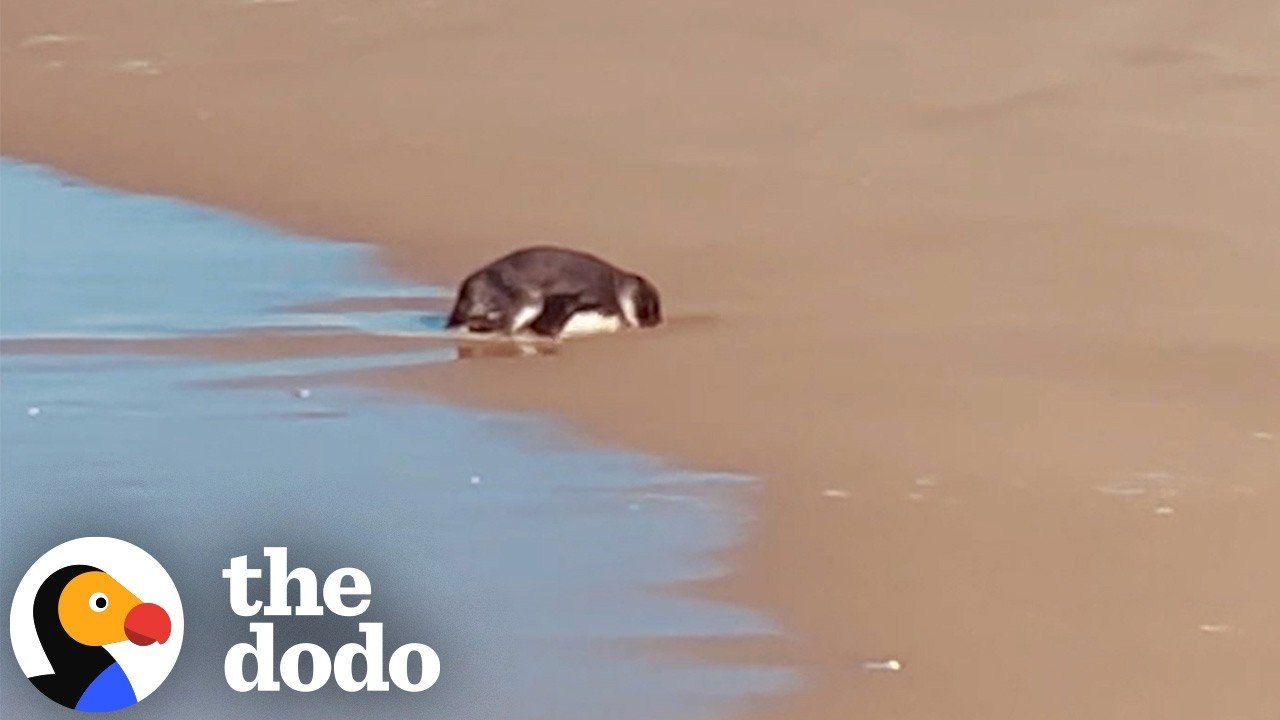
A jogger running along a Cape Town beach made a discovery that triggered an emergency wildlife response: a small African penguin with his head buried deep in the sand, motionless and stranded. The Dodo documented the rescue through wildlife veterinarian Catherine, who rushed to the scene alongside a first aid responder after the jogger raised the alarm.
Catherine Reaches the Penguin
Catherine and a first aid colleague arrived at the beach to find the penguin nearly face-down, his head pressed into the sand. The moment Catherine approached, the bird lifted his head and drew breath – a response that told her something critical immediately. ‘He put his head up and he could breathe,’ Catherine recalled. ‘I could see that he wasn’t too sick.’ More importantly, Catherine assessed on the spot that the penguin was not chronically ill, ruling out long-term systemic disease and indicating that a full recovery was possible with prompt intervention.
Catherine and the first aid responder wrapped the penguin carefully in a towel and placed him into a transport box. He was then taken directly to a veterinary clinic for a full evaluation.
At the Clinic: Weight, Wound, and Recovery Plan
At the clinic, Catherine conducted a thorough intake assessment. The penguin’s weight registered within a normal range – a strong indicator of baseline health. A small wound was identified on his abdomen, but Catherine confirmed the injury was superficial only, with no signs of deep tissue damage or infection. ‘Overall, he seemed to be going well,’ Catherine reported. The penguin was entered into a rehabilitation program, which Catherine explained typically spans several weeks. During that window, rescued African penguins are stabilized, fed, and monitored until they reach peak health before being returned to the wild.
The beach where the penguin was found is located near one of Cape Town’s most celebrated wildlife sites – a stretch of coastline where African penguins are a well-known natural attraction, drawing visitors from around the world specifically to observe the colony at close range.
A Species Under Pressure
Catherine did not shy away from the broader conservation reality surrounding this rescue. The African penguin – the species this small bird belongs to – is currently classified as critically endangered. Their population has collapsed by more than 97 percent from historical highs, with fewer than 10,000 breeding pairs estimated to remain along the southern African coastline today. Overfishing, oil spills, climate-driven shifts in fish stocks, and coastal development have all contributed to their steep decline. Each individual rescue – like the one Catherine and her first aid colleague carried out on that Cape Town beach – contributes directly to the survival of a species now fighting against extinction one bird at a time.
When the jogger first spotted the penguin, the odds of a clean recovery appearing from that frozen, sand-buried posture seemed uncertain. But Catherine’s immediate field assessment, the swift transport, and the superficial nature of the abdominal wound placed this bird on a trajectory back to the ocean – the same Cape Town shoreline where he was found, and where African penguins still gather in numbers that give conservationists reason to keep working.
 Wake up to Only Happy News!