At 25, skipping the better apartment, the reliable car, and the trips that form lasting memories in order to max out a savings account feels responsible. It feels like exactly what the adults told you to do. But according to Ben Felix, chief investment officer at PWL Capital, that sacrifice may be the single most expensive mistake a young person makes, and the economics to back that up have been settled for decades. The myths people treat as personal finance bedrock, save everything young, follow economic growth into winning stocks, collect dividends for safety, are not just incomplete. They steer ordinary people toward objectively worse outcomes, often for a lifetime.
Why saving as much as possible when you’re young is the wrong goal
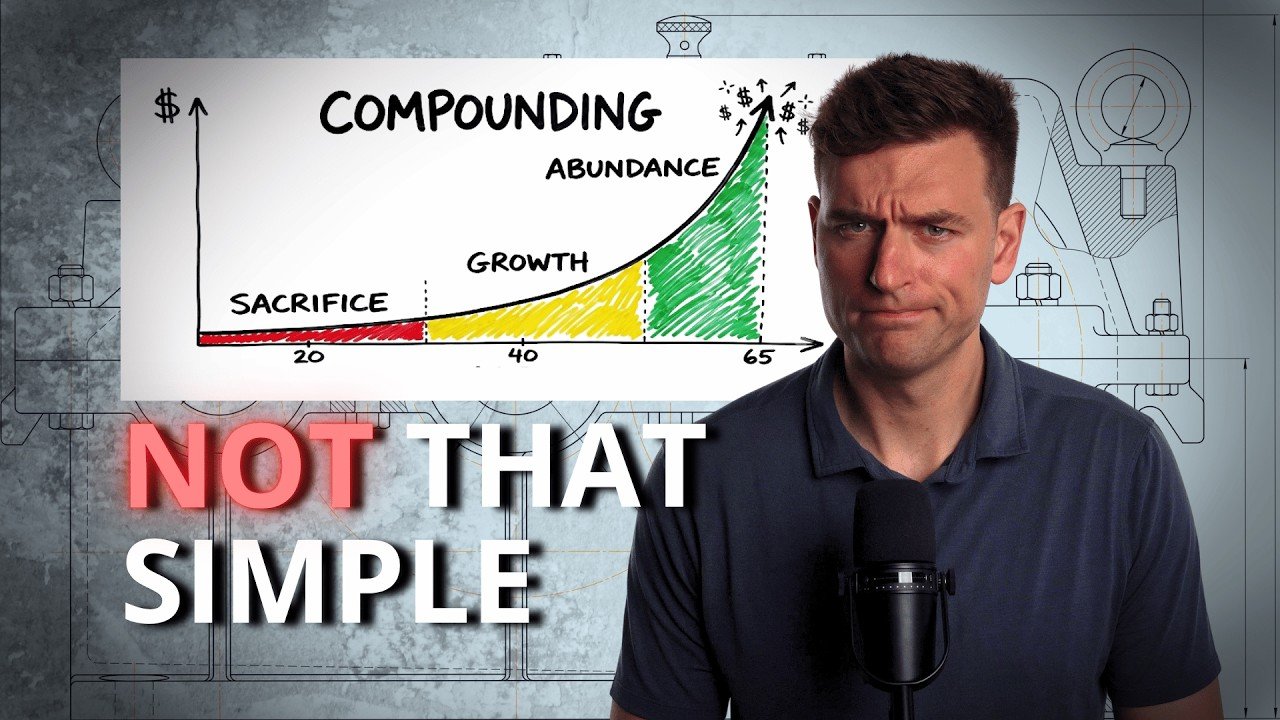
The most counterintuitive myth Felix unpacks is the foundational one: that aggressive early saving is always correct because of compounding. The life cycle hypothesis, one of the best-supported models in economics, says something more nuanced. Income is almost always lowest when you are young and rises steadily through a career before tapering near retirement. That means the marginal utility of a dollar spent improving your standard of living is highest in your twenties, not your fifties.
An extra $5,000 at 25 might mean living in a safer neighborhood, eating better food, or building experiences you carry for life. At 45, Felix argues, that same $5,000, even accounting for investment growth in the interim, yields a much smaller jump in quality of life. The practical implication is that ruthless early sacrifice is ‘effectively robbing from the poor, your current relatively low-income self, and giving to the rich, your future higher-income self.’ The better framework is consumption smoothing: save what you can without crushing your standard of living, then increase contributions as income rises.
This connects to a second myth: that all debt is bad. A 2013 paper in the Journal of Portfolio Management titled Diversification Across Time argues that people with high and stable future human capital and low financial assets today should consider a leveraged life cycle strategy, starting with a leveraged stock allocation and reducing it gradually toward retirement. The authors claim this approach can produce the same mean wealth accumulation with a 21% smaller standard deviation, because it diversifies investment risk across time rather than concentrating it in later decades.
The myths investors keep paying for in the stock market
On investing, Felix dismantles several ideas that feel rigorous but fall apart under data. Economic growth, for instance, does not predict strong stock returns. Countries with the highest economic growth have historically produced slightly lower average stock returns. By the time a growth story is obvious enough to appear in headlines, it is already priced in.
The dividend myth gets a sharper treatment. The claim that dividends explain 40% of historical stock market returns ‘gets causation completely backwards,’ Felix says. When a company pays a dividend, the capital value of the stock drops by roughly the same amount. The investor ends up with less capital and a payment to make up the difference. What actually drives returns are the underlying fundamental characteristics of companies. As a concrete illustration, a buyback-focused ETF with similar factor exposures to a dividend-focused ETF has outperformed it, despite carrying a lower dividend yield.
On index funds, the data from the 20 years ending December 2025 shows the asset-weighted average actively managed US equity mutual fund returned an annualized 9.41%, trailing a US equity index ETF by well over one percentage point. That index ETF return would have placed it in the top quartile of all active funds. The catch: 0% of top-quartile active funds remain top quartile five years later. Index funds keep delivering.
The Shiller CAPE ratio above 40 warning, gold as an inflation hedge, and renting as throwing money away each get similar treatment. Gold has held its real value across 2,000 years, which Felix acknowledges is a striking observation, but gold has also been far more volatile than inflation in any normal human time horizon, making it an unreliable hedge. As for renting versus owning, once property taxes, maintenance, depreciation, and opportunity cost of tied-up equity are fully accounted for, ‘both logically and empirically using historical data, renting and owning are approximately financially equivalent.’
On Warren Buffett, the record is clear and instructive: Buffett did not beat the market or a Vanguard US stock market index ETF for more than 20 years leading up to his retirement as CEO of Berkshire Hathaway in January 2026. In his own 2016 letter to shareholders, Buffett estimated he had identified only 10 or so professionals across his lifetime who were highly likely to outperform the S&P 500 over long stretches.
The quiet risk inside the ‘safe’ portfolio
The bonds-and-cash safety myth may carry the highest practical cost for retirees. A 2025 paper titled Beyond the Status Quo: A Critical Assessment of Life Cycle Investment Advice simulated 1 million investor life cycles using historical data from 39 developed countries spanning more than 2,600 years of country-month return data. The authors found an optimal portfolio of approximately 33% domestic stocks and 67% international stocks outperformed bills, balanced 60/40 portfolios, and target date funds across every measure tested: wealth at retirement, income replacement rate, probability of ruin under a 4% spending rule, and wealth at death. Bonds feel safe because their value is stable day to day. But for long-term investors, that stability opens a different and likely more damaging risk: running out of money.
The $5,000 that never moved
Somewhere, a 25-year-old is staring at a trade-off: the better neighborhood or the brokerage account. The economics say both matter. The sequencing of when you prioritize which one is the part nobody talks about.
The myths Felix dismantles are not obscure edge cases. They are the exact framework most people inherit from parents, podcasts, and financial news, treated as settled truth. The life cycle model has been settled in economics for decades. It just has not made it into the advice.
 Wake up to Only Happy News!