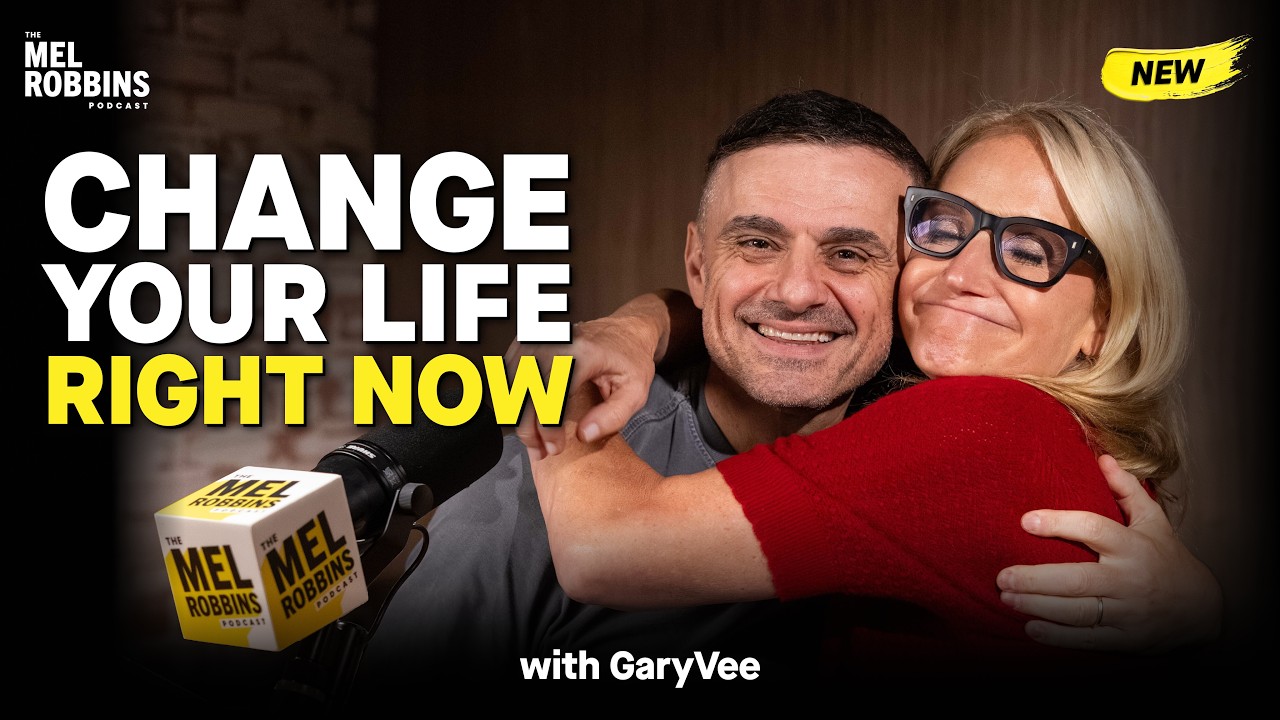
Gary Vaynerchuk walked into the Mel Robbins studio carrying twelve years of unfinished conversation. Robbins had told her team of nearly 50 people beforehand that this was the person who first pushed her to put herself out there online, the man she credits with shaping the way she thinks about her own life. For anyone who has ever stood at the edge of a decision they cannot bring themselves to make, what followed was less a podcast and more an intervention delivered at full volume.
The stakes are not abstract. Vaynerchuk argues that the real emergency is not failure but the slow accumulation of a life lived inside someone else’s opinion. Most people, he says, are spending so much energy managing how they look that they have no energy left to actually move. The cost is paid at the end, not now, and by then there is no one left to blame.
Vaynerchuk arrived in the United States from the Soviet Union unable to speak English, struggled through school, and spent his early twenties being told, repeatedly, that the things he wanted to do in his father’s liquor store would ruin the business. Every one of those calls turned out to be wrong. By 25, he says, he had enough evidence that outside opinion was an unreliable compass that he simply stopped consulting it. He is careful to frame that not as superiority but as luck of a particular kind: the serendipity of getting the lesson early.
What the algorithm is actually showing you
One of the sharpest moments in the conversation arrives when Vaynerchuk addresses the people who blame their feeds for their mood. His prescription is blunt and specific: open Instagram or TikTok, tap the top-right corner on Instagram or the bottom-right on TikTok, mark everything political, negative, or draining as ‘not interested,’ and spend one day doing it relentlessly. Then search ‘joy.’ Like five or six things. Search ‘happy.’ Follow a few accounts. ‘The algorithm did not change you,’ he said. ‘The algorithm exposed you.’ The point is not the platform. The point is that the feed is a mirror, and most people are angry at the mirror.
The 400 trillion to one argument against moping
Vaynerchuk builds his case for action on a number he pulls from what he calls modern scientists way above his pay grade: the odds of being born as the specific human you are sit at 400 trillion to one. He is upfront that he got Fs in school and is no scientist, but the math lands anyway. If you have already won the most statistically improbable lottery in the universe, he argues, moping around about what Jocelyn from the school run thinks of your TikTok shop is a spectacular misuse of the prize.
The conversation gets practical fast. Robbins asks about building a cheering section when the physical world around you is full of negative Nellies and cynical cats. Vaynerchuk’s answer skips the motivational abstraction entirely: go to Robbins’s Instagram, find a comment from someone named Kristen that resonates, reply to Kristen, click her profile, tell her the dog is cute. ‘Strangers become acquaintances, acquaintances become friends, and friends become family,’ he said. The community nobody around you can provide is sitting in somebody else’s comment section right now.
For the person frozen on the sideline, whether the line is a real estate exam, a TikTok shop, a career change, or a relationship they need to leave, Vaynerchuk offers a single tactic borrowed from the last scene of the film 8 Mile. Make a video and tell the world exactly what you are bad at. Own it before anyone else can use it. ‘Your embarrassment is your advantage,’ he told Robbins. ‘It’s your uniqueness. It’s your snowflake.’ The thing you are most afraid to say is the thing that is currently running your life from the inside.
His parting line to everyone listening required no translation: ‘None of the stuff you are worried about is going to actually matter in the end. If that is true, and everyone knows I am right, then why not start living your life that way right this second?’
The cab window and the woman who wanted motivation
Robbins brought up a moment she had watched years earlier: Vaynerchuk in a cab, window down at a stoplight, a woman running over asking for motivation. He looked at her and said, ‘You are going to die.’ The point was not darkness. The point was that the clock is running and the people you love can still walk into the room right now.
At 50, Vaynerchuk says the number one thing he actually has is not the businesses or the following count. It is peace of mind. That is what he wants for the person listening, not a blue check, not a million followers, not a top-five podcast. Just the quiet that comes from knowing who you are and not needing Jocelyn to confirm it.
Twelve years after Robbins first found his content and let it change the way she saw herself, the two of them sat in the same room and made the same argument in different keys: you are not stuck as this version of yourself, the hesitation is normal, and the ‘just’ in ‘just do it’ is doing all the real work.
 Wake up to Only Happy News!