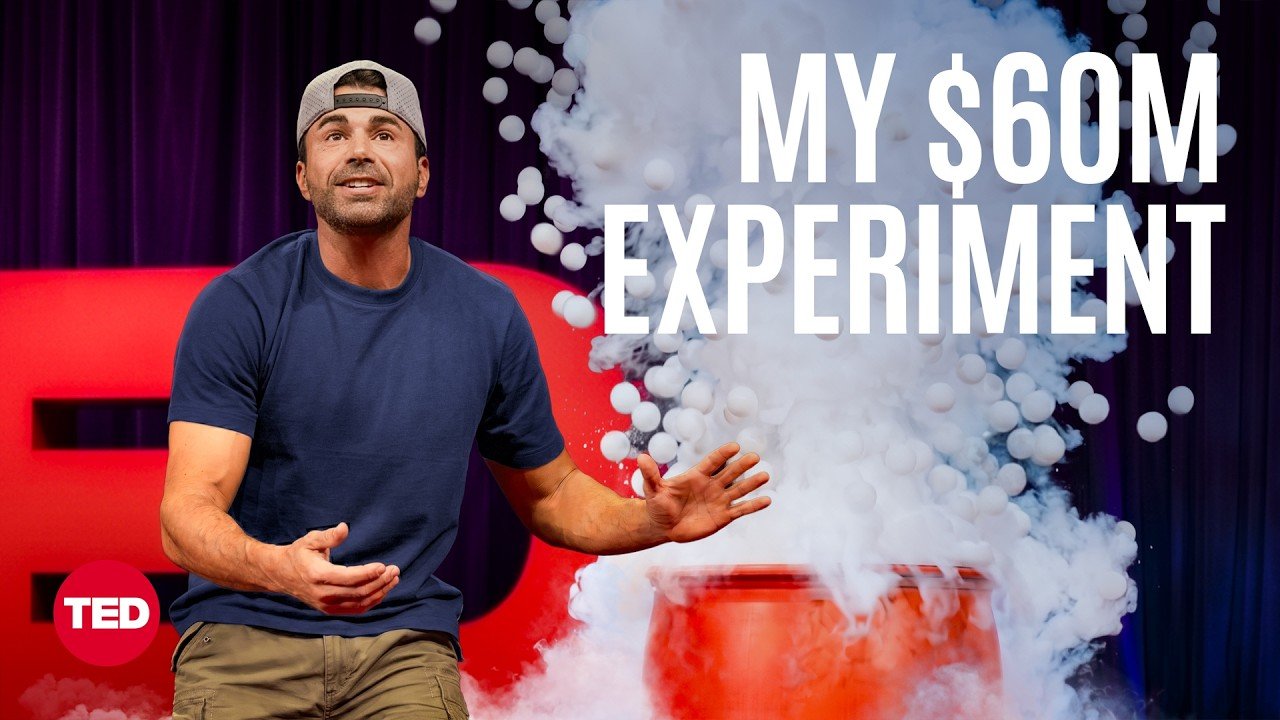
Mark Rober walked onto the TED stage, screwed a lid onto a two-liter bottle half-filled with liquid nitrogen at negative 320 degrees Fahrenheit, and launched a cloud of ping-pong balls into the front row – all to make a single point: if you can make someone feel something, they will remember it. That same philosophy now powers a $60 million science curriculum that Rober and a team of approximately 50 educators have been secretly building for two and a half years, and every lesson will cost teachers exactly zero dollars, permanently.
The Architecture of ‘Hiding the Vegetables’
Rober, a former NASA engineer who spent years working to land rovers on Mars before becoming a science YouTuber with 75 million subscribers and 16 billion views, describes his teaching method as ‘hiding the vegetables.’ The principle is straightforward: wrap a rigorous scientific concept inside an experience so visceral that curiosity ignites before the student realizes learning has begun. His backyard squirrel Ninja Warrior obstacle course – an eight-part gauntlet designed to demonstrate terminal velocity using squirrels, which are among the only mammals capable of surviving a fall from any height at their terminal velocity – became a viral lesson in physics. His glitter bomb bait package, built to catch porch pirates and starring Macaulay Culkin as the collaborating ‘thief,’ became what Rober describes as a modern homage to ‘Home Alone’ and a real-world microcontroller engineering tutorial that held a global audience’s undivided attention at the exact moment the lid was lifted.
The curriculum is built to serve grades three through eight and exceeds all state science standards. It includes high-production videos that Rober says students will beg to rewatch, ready-to-teach classroom slide decks, and hands-on science demonstrations designed so teachers can execute them using materials already present in a standard classroom. A wrench dropped into an MRI machine serves as the entry point for lessons on invisible magnetic fields. The teacher, in Rober’s design, is always positioned as the hero of the classroom.
95 Percent of Pilot Teachers Want the Full Curriculum
TED documented the first concrete performance data from the project: of all teachers assigned to teach the pilot lessons to their students, 95 percent reported that they would want the program to become their full science curriculum. The announcement marks the first time Rober has publicly disclosed the initiative, which was developed alongside some of the country’s best science teachers over 30 months of private development. Mr. MrBeast and Kristen Bell both appear in the curriculum’s promotional footage alongside Rober.
Rober credited his own high school statistics teacher, Mr. Malloy, as the foundational influence behind his philosophy – specifically for teaching students to use statistical analysis to predict where their rival soccer team would aim penalty kicks. That marriage of emotion and equation, Rober argues, is precisely what standardized science education has failed to replicate at scale for decades.
The $60 million price tag places this initiative among the largest privately funded K-8 science education projects in recent American history. The Bill and Melinda Gates Foundation, widely considered the most prominent force in education philanthropy, has spent billions over 20 years on curriculum reform – and completion rates and engagement scores in science have remained stubbornly flat. Rober’s bet is that 15 years of cracking the science motivation gap for a YouTube audience of 75 million is the specific credential that classroom reform has been missing. Every lesson plan, every teacher training module, and every original class demonstration will be released free as development continues over the next four years, with a portion of the library already live and accessible to teachers now.