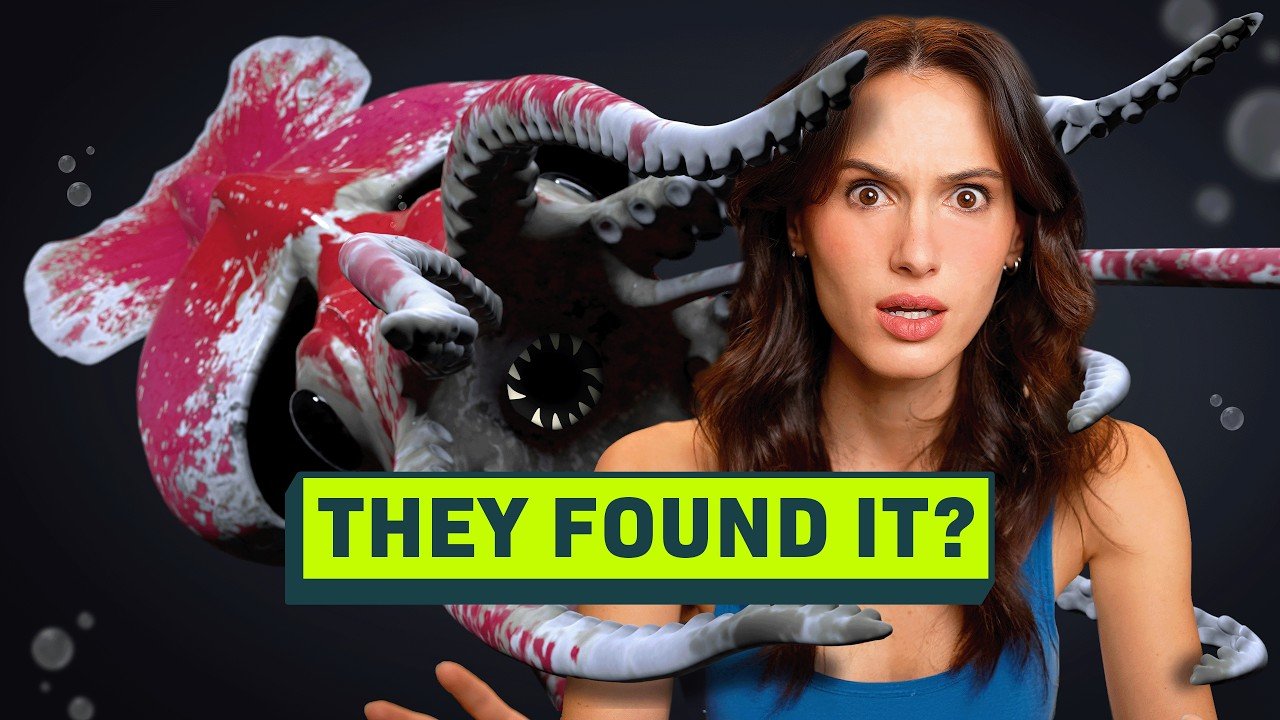
In 2025, a century after humanity first realized the colossal squid existed, researchers captured footage of a live juvenile colossal squid entirely by accident. It was the kind of lucky break that has defined deep-sea discovery for generations. But a quiet revolution happening in labs and on research vessels around the world is about to change that – and all it requires is a syringe of water.
The Accidental Discoveries That Defined Deep-Sea Science
For most of modern science, glimpsing the giants of the deep ocean has depended almost entirely on being in the right place at the right time. Footage of an oarfish, a terrifying close-up of a bigfin squid filmed by oil rig operators, and now a young colossal squid caught on camera – each of these landmark moments arrived without planning. The colossal squid itself, a creature scientists believe makes up roughly 80% of a sperm whale’s diet, remains one of the most elusive animals on Earth. Adults can exceed 9 meters in length, yet no researcher has ever filmed one alive in its natural habitat. The deep ocean – pitch black, crushingly pressurized, and vast beyond most people’s intuition – makes finding even a house-sized animal feel like searching for a housefly in a darkened arena using only a phone flashlight in bad weather.
The 2012 filming of a giant squid in its natural environment – not to be confused with the colossal squid, which is a separate and even larger species – required red LED lights invisible to deep-sea animals, the removal of all motors to reduce noise, a bioluminescent lure mimicking a specific jellyfish, over 100 dives, 20 years of data collected from sperm whale behavior, and hundreds of hours of waiting. The result was a few minutes of footage. Extraordinary footage, yes – but a staggering investment for such a brief glimpse.
Environmental DNA Is Rewriting the Rules of Ocean Exploration
The new tool changing everything is called environmental DNA, or eDNA. Every living creature in the ocean sheds biological material constantly – mucus, feces, scales, tissue particles, the marine snow that drifts through the water column like a perpetual blizzard of biological signals. By collecting water samples and filtering out those microscopic traces, scientists can extract and sequence DNA from hundreds of species at once without ever seeing a single animal.
The method works in two powerful ways. The first is targeted searching. Using short single-stranded DNA sequences as molecular magnets, researchers can scan a water sample for one specific species – like finding a single letter in a bowl of alphabet soup. This approach already rescued the angel shark from presumed local extinction. Scientists found spikes of angel shark DNA in waters where the species had not been spotted in years, dispatched divers directly to those coordinates, and confirmed the sharks were very much still there. The same technique is now being actively used to protect multiple critically endangered species and to intercept invasive species at ports before they establish a foothold.
The second application is the one that has researchers genuinely thrilled. A New Zealand research team is currently collecting eDNA samples in Antarctic waters specifically to detect colossal squid. Rather than waiting decades for a lucky visual encounter, eDNA sampling can tell scientists whether a colossal squid was present in a given location a day or two prior. With enough sampling over time, researchers could build heat maps of the colossal squid’s range – something that would have seemed like science fiction just years ago. As one researcher put it, this approach lets scientists “look backwards in time” in a way no submersible ever could.
But the most staggering discovery came when researchers first sampled the abyssal plain using eDNA analysis. Ninety percent of the DNA that came back was unknown. Scientists call this dark taxa – genetic material that cannot be matched to any documented species in existing databases. Estimates suggest there are over 2 million marine species in Earth’s oceans, and humanity has formally documented fewer than 10% of them. The deep ocean, it turns out, is not an empty desert. It is one of the most biologically crowded places on the planet, and almost none of its residents have ever been introduced to science.
Researchers are now deploying machine learning and artificial intelligence to help make sense of dark taxa – grouping unknown genetic sequences alongside similar known species to begin building a picture of what might be lurking in the darkness. A water sample from the Hudson River, collected with the same basic syringe kit used by deep-sea researchers, carries traces of thousands of organisms. Scale that methodology to the entire global ocean, preserve the samples, and run them again years later with updated databases, and the scope of what becomes discoverable is almost limitless.
The World’s Largest Nightly Migration Nobody Talks About
One of eDNA’s most immediately practical applications involves one of the ocean’s most astonishing and underappreciated phenomena. During World War II, sailors noticed a mysterious shadow on sonar that appeared to be a second seafloor rising toward their ships every night and retreating every day. What they had detected was the largest migration on Earth – billions of tons of animals ascending from the deep twilight zone to feed on phytoplankton at the surface each night, then descending again at dawn. This migration moves more biomass than the great wildebeest migration in Africa, every single night, all over the world.
This migration also plays a critical role in planetary health. Phytoplankton at the surface absorb carbon dioxide. The billions of animals that rise to eat them carry that carbon waste back into the deep when they descend, accelerating its removal from the atmosphere. Scientists have been studying this process using sound waves for decades, but sound alone cannot identify which species are moving, when, or why. eDNA changes that. By collecting water samples from the surface and twilight zone during both day and night and comparing the genetic signatures present at each time, researchers are for the first time building a detailed portrait of exactly who is making that journey and when.
Context
The colossal squid was first identified by science in 1925, meaning humanity spent the entire 20th century aware of this animal’s existence without ever seeing one alive in the wild. The creature is thought to inhabit the deep Southern Ocean around Antarctica, dwelling at depths where pressure, darkness, and cold converge to make exploration extraordinarily difficult and expensive. Traditional deep-sea research tools – remotely operated vehicles, autonomous underwater robots, specialized trawling nets – are powerful but limited. Many deep-sea animals avoid light and noise, their soft bodies disintegrate in nets, and the sheer scale of the ocean makes any targeted search an exercise in long odds. The eDNA approach does not replace those tools but transforms what is possible alongside them. Samples can be preserved and re-analyzed as genomic databases grow. Costs are a fraction of deep submersible operations. Coverage can be global rather than limited to wherever a ship happens to be positioned. And crucially, eDNA works whether or not a scientist is lucky enough to be in the right place at the right moment.
That baseline data matters for more than just discovery. As Cleo Abram‘s deep dive into this emerging science makes clear, eDNA also functions as a health monitor for the ocean itself – a new kind of environmental diagnostic that can reveal shifts in biodiversity before they become crises. The planet’s largest and least understood ecosystem is changing faster than traditional science can track it. But with drops of water, genomic sequencing, and a growing library of ocean life, the hunt for the colossal squid – and the 90% of ocean species that remain invisible to us – has never looked more hopeful.