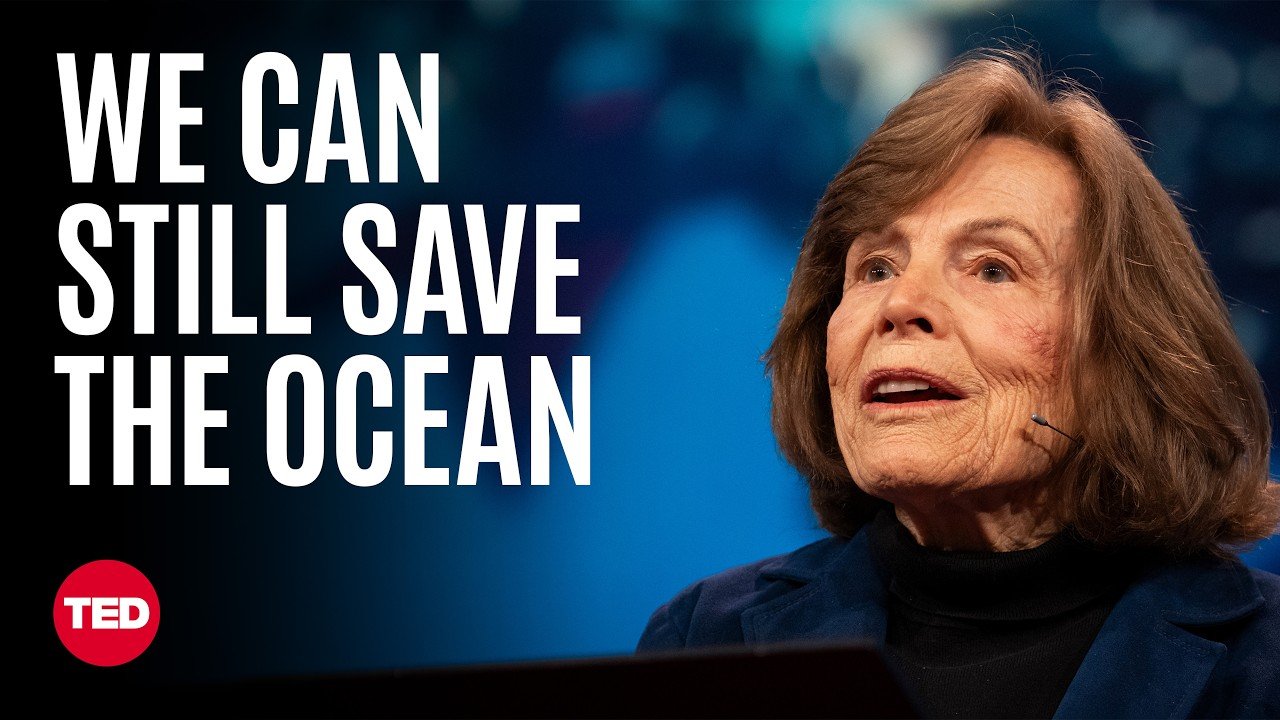
The moment Sylvia Earle returned to the TED stage, she played a clip of herself from 2009 – standing in the same room, making a wish. Not a policy proposal, not a funding ask. A wish: build a global network of marine protected areas large enough to save the ocean. That wish, delivered when 99 percent of the world’s ocean was open to industrial exploitation, set off a chain of events that now spans 116 countries and 169 places on a map where people are actively doing something about it.
The number that stays with you is the contrast. In 2009, 99 percent of the ocean was open for exploitation. Today, that figure has moved to 97 percent. Two percentage points in roughly fifteen years. Earle does not dress that up. The scale of the problem has not been solved. But what has changed is the infrastructure of people working on it – scientists gathering data in Shinnecock Bay, coral growers in Nusa Penida, fur seal monitors off the coast of Chile, turtle nest wardens in French Polynesia.
Juan Fernández Fur Seals and What One Animal Found Off Chile Actually Meant
When Earle first visited Chile’s offshore Hope Spots – among Mission Blue’s earliest designated sites – researchers found a single Juan Fernández fur seal. One. The species was considered functionally gone. That single animal, it turned out, was not a final sighting but a starting point. With protection in place, the population has since grown to more than 100,000. Chile has since committed to protecting more than half of its total ocean area, and the fur seal recovery is part of the evidence base that made the political case.
The Shinnecock Bay Hope Spot, sitting in the shadow of New York City, tells a different kind of story. For generations, the bay supported both people and wildlife. Twentieth-century commercial seafood markets stripped it of the oysters and clams that once filtered the water, and the bay became known instead for brown tides and disappearing seagrasses. Marine scientist Ellen Pikitch at Stony Brook University calculated that restoring water clarity would require 53 million clams – one dollar each, $53 million total. Without that budget, her team bought what they could, planted them, and let the biology work. The clams filtered. The water cleared. Seagrasses returned. The wildlife that depended on seagrass followed.
Tetiaroa Hope Spot Where Tourism Revenue Is Paying for Coral Science
In French Polynesia, Richard and Mary Bailey have been running what Earle describes as a science-based tourism operation with a conservation structure built into its business model. At the Tetiaroa Hope Spot, turtle nests are actively protected. A few years ago there were very few turtles at the site. There are now hundreds. The revenue generated by visitors funds research and conservation rather than competing with it. A new class of submersibles is being built to take scientists, tourists, and children into the twilight zone of French Polynesia’s ocean column – the deep, cold, high-pressure layer where, as Earle puts it, most of life on Earth actually exists but almost no one ever looks.
That submersible program connects with a longer tradition. Mission Blue has partnered with Polynesian navigator Nainoa Thompson and the crew of the Hōkūleʻa, a traditional voyaging canoe traveling ancient Pacific routes. Thompson’s network of Pacific islands and communities maps like an octopus, with the head in French Polynesia and arms extending outward to Hope Spots across the ocean. A three-year expedition is currently underway linking those communities through shared values of ocean stewardship, with the new subs allowing people to see, for the first time, what lives directly beneath their traditional sailing routes.
What Earle’s 169-Spot Network Proves About Conservation at Scale
The Hope Spots model works not because it centralizes authority but because it decentralizes action. Each of the 169 sites is driven by people on the ground – or in the water. Mangroves are being restored in 15 of them. Seagrasses in 12. Turtles monitored in 26. Sharks and rays tracked in 30. Townsville AI is now mapping all of them against global data sets covering ocean temperature, chemistry, fishing pressure, and wildlife migration, giving each local effort a frame of reference against the whole system. The data infrastructure that supports a clam planting project in New York is the same one that tracks polar bear trade routes in the Arctic or krill populations near Antarctica. The scale is genuinely planetary. The entry point is local.
Earle spent decades underwater before she ever stood on a stage making wishes. She used more than 30 types of submarines. She served as chief scientist of NOAA in 1990, was nicknamed the Sturgeon General for raising alarms about industrial fishing, and was told not to worry. She watched shark populations drop by more than half over the course of her diving career – not through catastrophe but through the ordinary, relentless efficiency of commercial harvest. The wish she made in 2009 was not naive optimism. It came from someone who had watched the baseline shift for fifty years and decided that documentation alone was not enough.
 Wake up to Only Happy News!