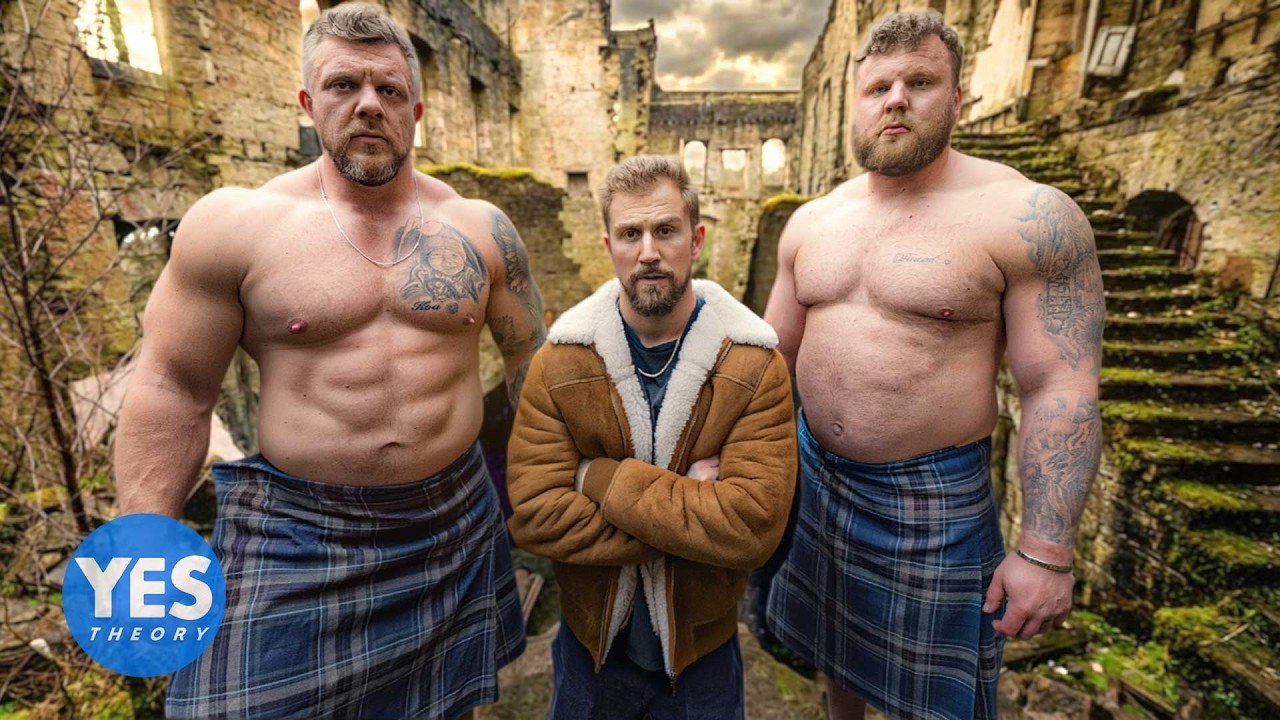
Three-time World’s Strongest Man Tom Stoltman and Britain’s Strongest Man Luke Stoltman are crammed into a van rolling through the Scottish Highlands, and the Yes Theory crew has two days, three abandoned castles, and one 100 kg Atlas stone to deal with. That’s the trip on paper – what actually unfolds is something harder to plan for.
From the Atlas stone challenge to castle ruins swallowed by centuries of overgrowth, here’s how the two-day Scottish road trip played out, who showed up, and why the final castle visit hit differently than anyone expected.
Three Castles, One Van, and Brothers Who Barely Fit
The original squad – Yes Theory‘s Thomas and Stefan – picked up Stefan’s brother Patrick in Amsterdam before flying to Scotland, where the Stoltman brothers were already waiting. Tom, at 130 kilos, tested the structural integrity of every doorway in the country. The crew’s first stop was an unnamed moss-covered ruin accessible via a flooded access road, where Scotland’s Land Reform Act – granting the public legal right to roam most land – settled the trespassing debate quickly. Tom ducked through archways, Luke led the way through gaps in crumbling walls, and the group moved through rooms that once hosted banquets and now host silence.
Castle number two was Buchanan Castle, completed in 1852 and carrying one of the more unlikely footnotes in World War II history. In 1941, Rudolf Hess – Hitler’s deputy – flew solo from Nazi Germany to Scotland, parachuted into a field outside Glasgow, and was brought to Buchanan Castle for interrogation. British officials determined he had no authority from Hitler and no real negotiating power. Hess was imprisoned for the rest of his life. The castle survived the war but not peacetime economics – partially demolished, then gutted by fire in 1981, it has sat open to the sky ever since. Nature has moved back in thoroughly: tree roots splitting stone floors, entire wings consumed by ivy, one tunnel running beneath the structure that the group navigated by phone light.
The third castle arrived with an unexpected complication – Tom spotted a figure standing motionless in an upper window, staring down at the approaching van. It turned out to be a film crew mid-production, which explained the figure but did nothing to reduce the atmosphere of the place. A fire in 2008 had taken most of the structure, leaving skeletal walls and open sky where rooflines once ran.
The Atlas Stone, the AA Meeting, and What Brotherhood Actually Looks Like
Before the castles, Thomas had unfinished business. In 2021 on a previous visit, he failed to lift a 100 kg Atlas stone – a strongman competition staple – and described carrying that failure for years. This trip, coached through the technique by Luke and Tom, he got it up. ‘When it was on my hips, I was like, how am I going to get this up?’ he said. ‘And then I heard you guys scream.’
The stone attempt framed the trip’s deeper current. At the final castle, with the cameras still rolling, Patrick took his own attempt at the stone. He came close – twice – before Luke pulled him back from the edge of quitting: ‘You can change the story, mate.’ Patrick lifted it on the final attempt and described it in plain terms: ‘I’m not only surviving, I’m living.’
One week before the trip, Patrick had attended his first AA meeting for severe addiction. Tom, who has spoken openly about living with autism and spending months locked in his room at 16 – barely speaking to anyone except Luke – recognized what Patrick was pushing through. Luke, for his part, knocked on Tom’s door at 16 and said, simply, come to the gym. Tom credits that moment with changing the direction of his life entirely.
Stefan had his own version of the same story: years spent in front of a screen, afraid to step outside, before Yes Theory became the vehicle that carried him out of it.
The Bigger Picture
Scotland’s castle density – an estimated 1,500 structures with physical remains still standing out of a peak of roughly 3,000 – has turned the country into an accidental archive. Most fell not to war but to economics: too remote, too expensive, too large for post-feudal life. What the Yes Theory crew documented across two days is what happens when that decay becomes slow enough that the human stories embedded in the stone survive longer than the stone itself. Exploration content at this scale works precisely because ruins require interpretation – and interpretation requires people willing to stand inside them and ask what happened here.
Patrick arrived in Scotland having just taken one of the harder steps of his adult life. He left having lifted a 100 kg stone off the ground inside the ruins of a country he called his favorite place on earth – the same country he once called Stefan from, crying in an alley, a decade ago.
 Wake up to Only Happy News!