The vaporetto pulls away from the dock in Venice and the city does something unexpected – it gets quieter. No engines, no honking. Just the slap of canal water against palazzo walls and the occasional creak of a mooring rope. It is the first hint that Italy, across its full length, operates on its own terms.
Venice opens the itinerary the way it has opened travelers’ eyes for centuries. The roughly 100 islands linked by several hundred bridges form a car-free maze that rewards disorientation. The advice given here is blunt: walk until you run out of island. Worst case, you stop for a drink and study the map. The Piazza San Marco anchors the city’s history – the Doge’s Palace in its Venetian Gothic lace, the Basilica of St. Mark shimmering inside with gold mosaic work, its golden altarpiece featuring 250 painted enamels arranged around a central Christ figure. The Grand Canal, surveyed by vaporetto, reads like a slow-moving history of Venetian ambition.
What the Oltrarno Side of Florence Keeps to Itself
Two hours south by train, Florence arrives with the weight of the Italian Renaissance on its shoulders. The Uffizi Gallery lays out Italian painting from the 12th through the 17th century on a single floor – Botticelli’s ‘Birth of Venus’ stops most people cold. The goddess emerging from seafoam, hair loose in the wind, flowers tumbling in slow motion around her. Then the Accademia, where Michelangelo’s David stands at the end of a long hall. The shepherd boy’s expression is calculated, not triumphant – sizing something up before committing.
But the city across the Arno moves differently. A local named Tomaso leads the way over the Ponte Vecchio – lined with gold and silver shops in a tradition stretching back before the Renaissance – and into the Oltrarno district. Artisan workshops sit open to the street. Leather, paper, stone. The standing instruction for entering: greet the proprietor first. The Italian word is ‘posso,’ meaning ‘may I.’ A small courtesy that tends to change the whole conversation.
From Florence, the route bends toward the coast. The Cinque Terre – five villages tucked into a ten-kilometer stretch of the Ligurian coastline – operates at a different frequency entirely. Vernazza offers the closest thing to a natural harbor among the five towns. The old castle above it no longer warns ships away. It functions now as a restaurant and lookout. On its lowest deck, over a glass of the local sweet wine Sciacchetrà served with biscotti for dunking, the arrangement of terraced hillside, fishing boats, and excursion crowds makes a kind of improbable sense.
A Bruschetta Made the Way a Grandfather Made It
Inland from the coast, Tuscany and Umbria deliver the hilltowns – Siena with its medieval square, Assisi behind its intact walls, San Gimignano with its surviving medieval towers standing against the sky. And then Civita di Bagnoregio, perched on an eroding pinnacle above a canyon, reached by a single footbridge. Under a 12th-century arch, the main lane narrows. A local named Maurizio runs a restaurant built around the olive mill his grandfather once operated. He demonstrates the bruschetta: bread toasted over coals, rubbed with garlic, topped with tomatoes, finished with extra-virgin olive oil. Nothing complicated. The mill equipment behind him is original.
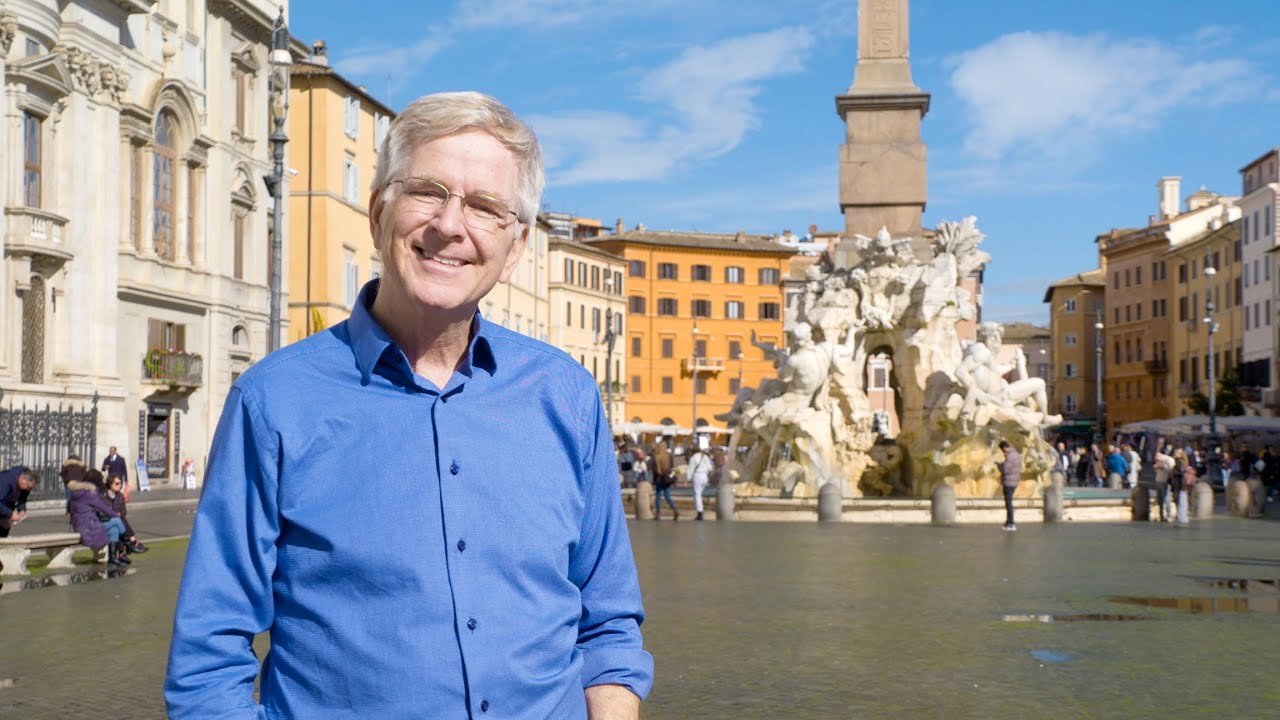
Rome absorbs the next section of the journey. The Colosseum, Trajan’s Column, the Pantheon with its open oculus – 2,000 years of construction layered so densely that ancient foundations sit beneath Baroque churches, which sit beneath modern apartments. The Vatican occupies its own corner of the city: St. Peter’s Basilica at 600 feet long, the Vatican Museums threading through miles of decorated hallways before delivering visitors to the Sistine Chapel. At Campo de’ Fiori in May, the morning market runs on punterella, asparagus, and artichokes. After dark, the same square turns social. The Piazza Navona, shaped by a long-demolished Roman stadium, hosts its Bernini fountain under lights. The Trevi Fountain draws crowds for the coin toss – a ritual that, by all available evidence, keeps working.
South of Rome, the intensity increases. Naples doesn’t ease anyone in. Kids claim sidewalk corners as soccer fields. Grandmothers lower plastic buckets from upper windows for deliveries. Fast food is a folded pizza, eaten standing. From Sorrento, the Amalfi Coast road heads south along cliffs where hotels and villas appear to be held to the rock face by something other than physics. The Mediterranean below genuinely twinkles.
The Singing Fishmonger in Palermo’s Market on a Tuesday Morning
Sicily ends the journey – and earns its own category. Two and a half millennia of successive rulers (Greeks, Romans, Arabs, Normans, Spanish) have left an architecture that refuses to resolve into a single style. Agrigento’s ridge of Greek temples represents one of the most complete ancient religious ensembles anywhere; the Temple of Concordia stands in better condition than most buildings put up in the last few centuries. The coastal town of Cefalù folds its past into a crescent beach below a fortress rock, streets aligned to catch the prevailing wind – a design decision from the town’s founding that still keeps laundry moving on the lines. In Palermo’s street markets, vendors sing their inventory. Whether or not the words land, the performance is complete.
Back on that vaporetto dock in Venice, the boat was already pulling in before anyone on the platform had finished deciding. That is roughly how Italy operates across its full length – the next thing arrives before the last one has settled. The canal water still slaps the same walls it has been slapping for a thousand years, indifferent to the schedule.