The roll was smiling. That was the first real sign that something unusual was happening at Terry’s Cafe in London – a bacon and scallop roll so overstuffed, so deliberately constructed, that it seemed to be making eye contact. The scallops had come in that morning from Billingsgate Market. The butter was Terry’s own seasoned blend. When it compressed between the fingers, a little butter squeezed out the sides.
Todd, the London-based food guide known online as Eating with Tod, had arranged the whole day around a simple premise: British food is not what most people think it is. Starting here, at one of the last great traditional cafes in the city, made the argument immediately. Terry’s Cafe still produces two versions of the full English – the classic, and a Billingsgate seafood edition that replaces the standard protein logic entirely. Deep-fried eggs, the way they’ve always been done in these places. Sourdough. Scallops in their shells with pooled seasoned butter. Black pudding used almost as a sauce, keeping everything juicy. The tinned tomatoes arrive straight from the can, elevated only by Worcestershire sauce and a hit of Tabasco. ‘You see the seasoning, the vinegariness, the spice,’ Todd said. ‘It’s like a tomato soup in your mouth.’
The Sandwich That Required Two Hands and No First Dates
A thirty-minute cab ride across the city – past a London taxi inexplicably painted with Taiwan branding – delivered the group to Max’s Sandwich Shop, which is not a sandwich shop in any conventional sense. Max, who described the place himself as ‘a surprisingly serious restaurant masquerading as a stupid sandwich shop,’ makes his own bread daily without putting up a sign about it. His sandwich philosophy runs on three contrasts: hot and cold, sweet and sour, crunchy and soft. The signature, the Ham Hock and Chips, arrived piled with shoestring fries, slicked with piccalilli – ‘a chutney that met mustard and had a romantic engagement’ – and built on bread so soft it compressed like a pillow without collapsing.
The off-menu creation was something else entirely. Max brined a whole fillet of cod for eight minutes, fried it until it filled the entire fryer basket, and built a fish and chip sandwich around it with homemade sauce gribiche – capers, dill, hard-boiled egg, pickled silverskin onions, malt vinegar, parsley – and a layer of fresh-mint mushy peas blended from frozen. The thing was enormous. Structural integrity became an issue immediately. ‘My hand is hurting,’ someone noted. ‘My arm is hurting. It feels like I’m going to the gym.’ The cod flaked apart. Shoestring fries were used to cover the damage. The dill punched. The parsley lingered. There was mayonnaise in at least one person’s nose.
From Max’s, the route ran to the Temple Prince, a classic English pub operating on the Desi Pub model – a format born after World War II, when South Asian migrants settled into London’s pub culture and began cooking for the regulars. The kitchen sent out okra fries in masala batter, onion bhajis made from loose shards of onion rather than the dense cakey version common elsewhere, and lamb chops marinated so deeply that the yogurt-and-spice blend had worked its way to the center of the meat. The paneer butter masala arrived thick enough that a piece of hand-clapped roti went over the edge of the bowl like an infinity pool. ‘It’s like a hug from your Indian grandfather you never realized you actually had,’ Todd said.
The Yellow Shop on Brick Lane and Why London Cabbies Just Shout Colors
Brick Lane presented a specific logistical debate. Two beigel shops stand nearly side by side – one with a bright yellow facade claiming to be the original, one with a large white sign making the same claim. Neither has conclusively won. London cab drivers, apparently, have reduced the whole argument to a single syllable: yellow or white. Todd had run a taste test and gone yellow. The group went yellow.
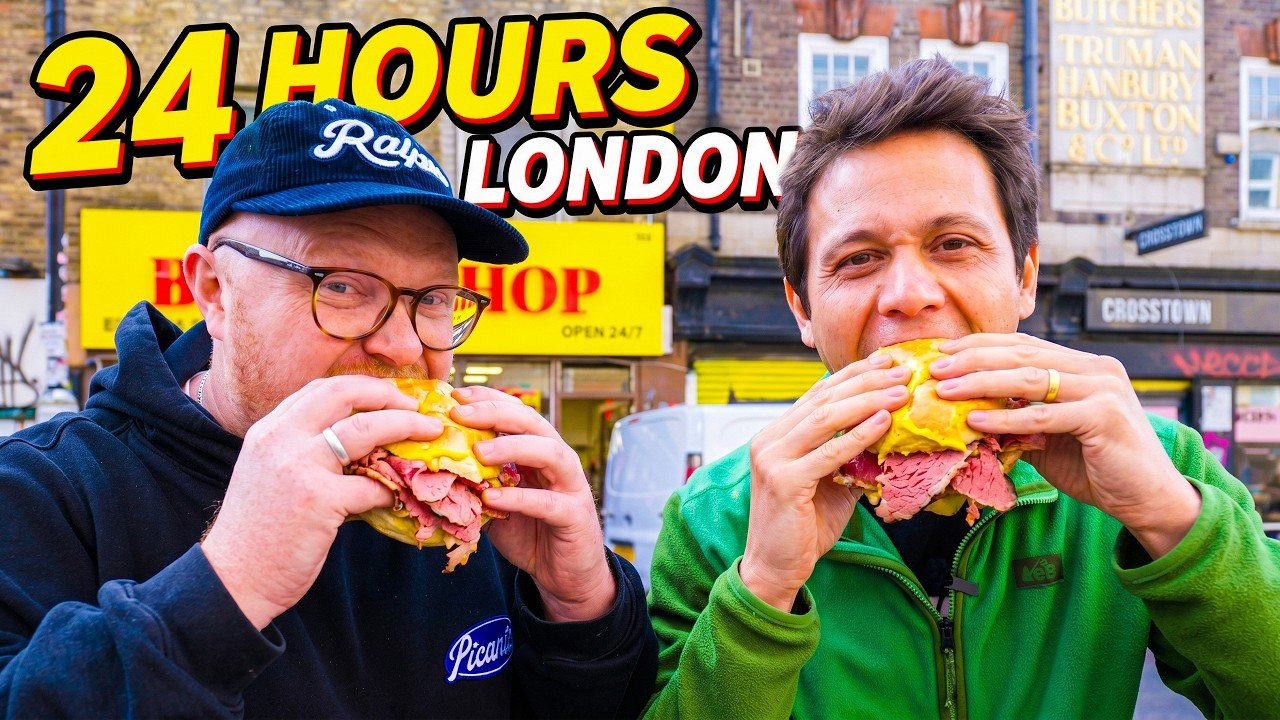
Inside, the operation runs at a scale that makes hand-rolling impractical. Around 5,000 beigels on an average weekday, up to 10,000 on busier days, from an American-made dividing machine that produces a consistent ring every time. They boil, cold-shock, seed, and bake in two stages – flipped at the five-minute mark. The salt beef simmers for three hours at a stretch, seasoned with cloves, spices, onion, carrot, and something else the staff declined to name. The finished beigel arrives wrapped in a bag: plain beigel, salt beef, English mustard, gherkins. Heavy. Dense. The mustard builds in the mouth well after the bite. ‘The combination has withstood the test of time,’ Todd said, and that seemed like the plainest and most accurate thing anyone said all day.
The final stop was Bentley’s Oyster Bar and Grill, which has been operating since 1916 in the same location. A dozen oysters arrived from five different origins – Atlantic Edge in Pembrokeshire, Jersey Island, Achill Island off the west coast of Ireland, and native Loch Ryan flat oysters from Scotland, plus Connemara. The natives, up to five years old and shaped more like coins than cups, carried a stronger mineral depth, a creaminess, a faint scallop note in the center. ‘Get me a sleeping bag,’ someone said. ‘I’m happy to just let that coat my mouth for the rest of the night.’
The seafood platter that followed carried the full weight of the setup: dressed crab in the colors of the Irish flag – brown meat, white meat, grated egg yolk – a dish Bentley’s invented and has served for over a century. Razor clams loaded with shallot vinegar, slid down whole. Rooftop-smoked salmon on blinis. Whelks in garlic butter with croutons. Langoustine cocktail. Dover sole deboned tableside with two forks, zipped apart like a fastener, then dressed with olive oil and lemon. And the fish pie – a hundred years on the menu, topped not with pastry but with a béchamel cheese crust, three types of fish underneath, occasionally crowned with lobster for one week each year.
The Remaining Third of the Fish Pie on the Table at Bentley’s
The fish pie sat between two people who had, by that point, eaten a seafood English breakfast, two enormous sandwiches, a full spread of Desi Pub snacks, a salt beef beigel, twelve oysters, and most of a seafood platter. There was still a significant portion left. The cheese crust had held its crisp. The juices at the bottom of the dish were still moving slightly when the spoon went in.
Back on Brick Lane that morning, the roll at Terry’s had butter squeezed out the sides when it compressed. By the time the fish pie arrived at Bentley’s, that same quality – something generous happening at the edges – had repeated itself across every dish of the day. London, it turns out, does not skimp on the filling.