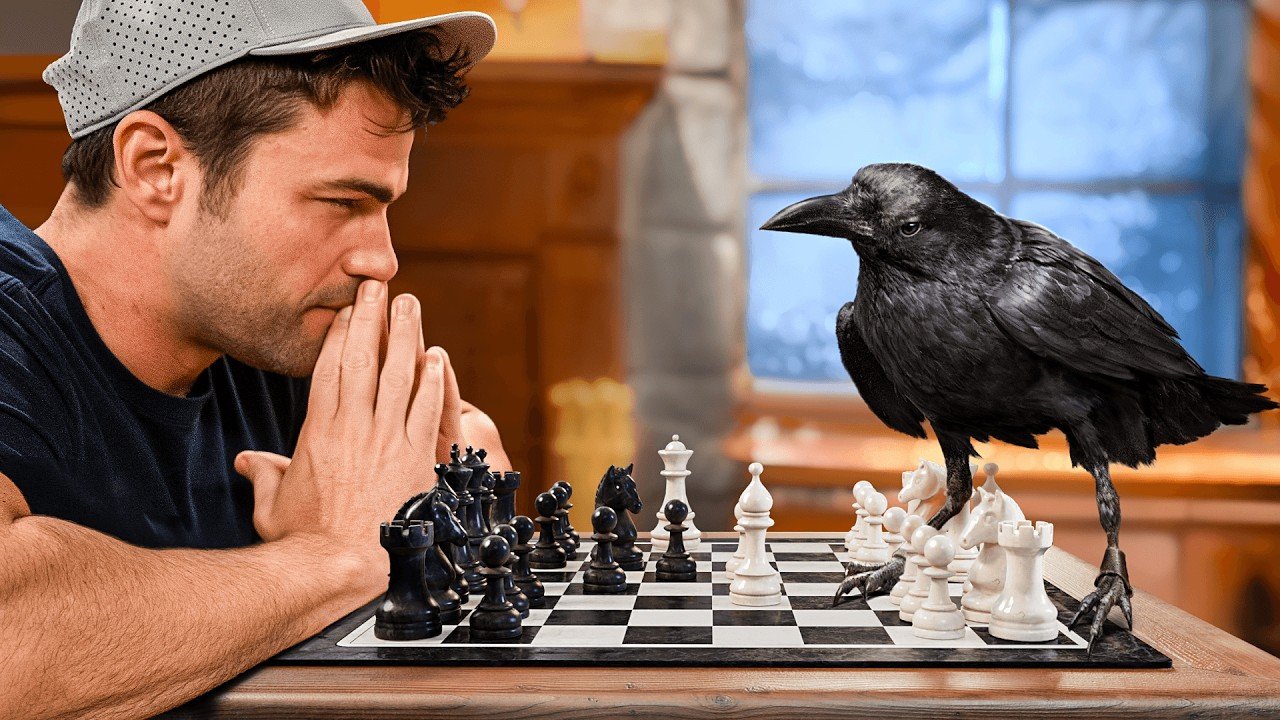
It started on a porch in suburban California, with a DoorDash driver pulling up and a crow already waiting. The crow had worked out the pattern: a car arrives, a bag appears, dinner is served. For months, the arrangement ran smoothly – right up until the crow knocked over a drink, grabbed the nuggets anyway, and flew off without looking back.
That was the origin point. Not a science project, not a viral video concept – a personal grudge against a bird that had figured out a man’s food delivery schedule and exploited it with what could only be described as confidence.
Nine Puzzles, One Crow, and a Reverse Bird Cage
The response was an elaborate nine-stage escape room built around a custom reverse bird cage – designed not to trap a bird inside, but to keep one out. Placed at the center of the room was the prize: a combo meal built around those same juicy chicken nuggets. The cage would only open autonomously once all nine puzzles were solved in sequence, each triggering the next via a network of sensors, Arduino microcontrollers, servo motors, and strain gauges.
The subject: Cheryl, a crow living at a bird rescue sanctuary, chosen to represent her species in a formal test of cognitive ability. Months of observation preceded the gauntlet. Researchers watched her interact with objects in her enclosure – a wooden ball she returned to repeatedly, cause-and-effect relationships she seemed to map out in real time – before settling on puzzle designs calibrated to what she already understood and what she did not.
Puzzle one was drawn from a documented crow behavior: dropping rocks into a water-filled cylinder to raise the level and retrieve a floating object. The table was stocked with decoys – cork, cotton balls, objects that would float rather than displace water. Cheryl surveyed the table, moved past the decoys, and reached for the rocks. Then she dropped the first one into the cork dish, paused, seemed to register that something was off, and corrected herself. A few rocks later, she used the ball’s natural bobbing motion to save herself additional drops. The sensor tripped. Puzzle two lit up.
The scales of justice came next – a balance beam requiring enough weight on one side to trigger a limit switch. Cheryl tried to force the switch by hand first. When that failed, she went back to conventional methods, adding coins from the table. She was selective. At one point, she retrieved her favorite wooden ball from the cylinder puzzle and attempted to use it as ballast, apparently untroubled by the significant density gap between wood and metal. One more coin and a minor assist later, the light moved on.
Puzzle three was portrait roulette – a rotating set of framed faces including a backyard scientist, a man from a lemon battery video, and the person whose nuggets had been stolen a year prior. Back in her home enclosure, Cheryl had been conditioned to pull the leather strap beneath one specific face in exchange for a treat. Here, she identified that face immediately, rang the bell, and a dollar bill fluttered down from the ceiling. She needed to do it correctly three times before moving forward, which required patience on both sides as the portrait wheel rotated and Cheryl navigated the intervals between attempts.
The cash grab asked her to collect three NFC-chipped dollar bills and deposit them into a collection box fitted with an NFC reader. One mid-air catch during a falling bill – the kind of grab that takes timing and spatial judgment – was among the cleaner moments. Once all three bills registered, a servo motor opened a compartment and a tool dropped out.
The fishing hole required her to first notice the tool was necessary, retrieve it, and then bend its tip into a hook shape before using it to fish a cup out of a cylindrical container. She tried wedging the cup first. When that failed, she set about hammering the wire end against the edge of the table – methodically, repeatedly – until it bent into a workable hook. Then she dropped it in and pulled the cup out. The strain gauge registered the weight change. The next puzzle activated.
The cup stack followed: Cheryl had to stack cups in the correct order, completing a copper-tape circuit as they nested together. The trick was that the final cup needed was the one she had just fished out of the previous puzzle. She stacked the first two without much difficulty, then realized nothing was happening. She looked at the setup, retrieved the cup from the fishing hole, completed the stack, and the tourist trap lit up.
The Shipwreck, Then Gravity
The tourist trap was the designed break in the sequence – a photo-booth moment where Cheryl stuck her head through a hole, triggered a camera, and received a partial serving of nuggets as an intermission snack. She took the photo. She ate the nuggets.
The shipwreck puzzle asked her to pull a cork free with her beak and then continue pulling a string upward with her beak while pinning the slack under her foot – a coordination task that relied on simultaneous beak and talon work. She pulled the cork, pinned the string, and the miniature ship tipped backward. The tilt switch fired. One puzzle remained.
The egg drop was drawn from a documented behavior: crows in urban Japan dropping walnuts onto crosswalks, waiting for cars to crack them, then walking out during the pedestrian signal to collect the pieces. The version here replaced the walnut with a plastic egg containing an infrared emitter and replaced the cars with gravity. Cheryl picked up the egg, assessed the room, walked to the edge of the elevated surface, and dropped it. The IR emitter inside hit the sensor at the base of the table. The cage lifted.
Before finishing the meal she had spent the better part of an afternoon earning, Cheryl picked up one nugget, dipped it in sauce, and extended it outward – toward no one in particular, but in a direction that read unmistakably as an offering.
One Nugget, Extended Toward No One in Particular
The dipping sauce clung to the nugget as Cheryl held it out. There was no recipient. The gesture resolved nothing and explained nothing. She had just solved nine consecutive engineering puzzles for a meal that had been taken from a porch without permission to begin with, and here she was, apparently offering a share of it back.
Back on that same porch where a crow once knocked over a drink and flew away laughing – or at whatever speed approximates a laugh in crow – a side of nuggets now gets left out with every delivery. The math of the original theft has not changed. The nuggets still get taken. The difference now is they are placed there on purpose, as something between a tribute and a precaution, by someone who watched a bird bend a wire into a hook with nothing but patience and a table edge.