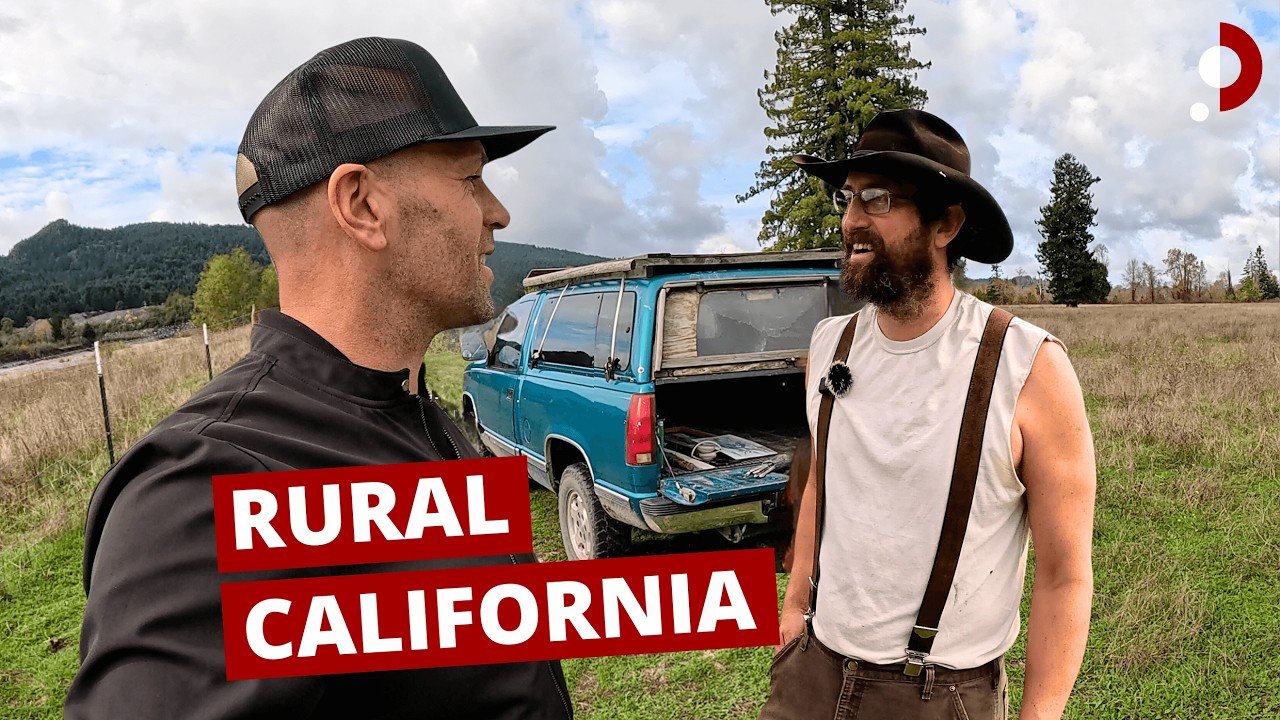
Brett McFarland was pressing apple juice from an 1800s cider press on his birthday when he pulled out a box of drawings he had made in a federal prison in 2014. Stick figures on paper. A barn, a pond, a woman, a child, a man on stage singing to a crowd. A decade later, standing on Crazy River Ranch in Humboldt County, California, the barn was built, the pond was dug, and the date written on one of those sketches read ‘So be it… 2024.’ What unfolds across this far-northern stretch of California is not the state most people picture. It is something older, stranger, and considerably more alive. Peter Santenello’s take on The California Nobody Knows – See the Full Article about Brett McFarland’s Folk Song “About Losing the Country You Grew Up In Is Striking a Nerve Right Now“
Where the summer of love went when it ran out of room
Humboldt County sits well north of San Francisco, bordered by wilderness ranges that stack into each other: the Trinity Alps, then the Marble Mountains, then the Russian territory the fur trappers once worked. Brett, a singer-songwriter and grass-fed beef and cider farmer, traces the cultural DNA of the place back to 1967. When the energy of the Haight-Ashbury summer of love had nowhere left to go, it moved north into the Emerald Triangle, which covers Humboldt, Trinity, and Mendocino counties. Hard-working ranchers and loggers who had been there for generations found themselves neighbors to artists, back-to-the-landers, and people who wanted to grow things in the dark, wet soil. Brett puts it plainly in the song he plays that evening around a fire: ‘that’s when a redneck made love with a hippie, they had themselves a child and they named her Gypsy.’ The result is a county where people with genuinely opposing politics still show up when things go wrong.
That dynamic is not theoretical. When federal agents raided Brett’s home over an allegation involving a few pounds of cannabis sold years earlier, his elderly neighbor Fred got a call, drove over with his friend Elmer, and quietly moved every piece of borrowed equipment off the property to protect it. Fred’s explanation when Brett thanked him: ‘The feds have been coming to Humboldt for a long time making a big deal out of nothing.’ Brett eventually accepted a guilty plea to a five-year mandatory minimum rather than become an informant. He was released in 2017 to a halfway house in Oakland, walked outside, and found a line stretching around the block. A new cannabis dispensary had opened. Legalization had arrived while he was inside.
What gets built when you have nothing but time and a box of pencils
The farm Brett returned to was still half-finished. The barn he had started with neighbors using round timber poles from a community pole-stripping party was only partially standing. The apple orchard, planted tree by tree with many grafted by hand, had not matured. The cider he now ferments from heirloom varieties like Ashmead’s Kernel, an English apple from the 1700s, was still years away from being a product. What Brett had instead were those drawings from a prison program that taught manifestation and what participants called ‘future now’ thinking: speaking goals in the present tense, even when nothing supported them.
The Humboldt County he came back to holds more than one version of this kind of deep-rootedness. At the Arcata Saturday farmers market, running every Saturday all year, a sixth-generation dairy farmer whose family has worked the same Humboldt land across multiple generations brought her cattle to be butchered with Brett’s help and runs a farm-to-scoop ice cream shop called Jersey Scoops in Lolita. Nearby, Eric Hollenbach, who started Blue Ox Mills with his wife Viviana 51 years ago, runs a workshop powered in part by a pedal-powered jigsaw from 1870, doing work like the 220 feet of wooden rain gutters recently completed for Emily Dickinson’s house in Massachusetts. A cross section from a redwood called the Fieldbrook Giant, taken 70 feet off the ground, shows the tree measured 15 feet in diameter at that height. The base was 35 feet across. It was cut in 1901. A pine needle stuck in the ring marks when the United States signed the Declaration of Independence.
The artist who hikes six miles to paint one
Brett’s neighbor Ken, who has been painting for 45 years, is known in the area as a mountain man in the specific sense: in winter he straps on snowshoes, hikes into the Trinity Alps Wilderness with three separate packs, shuttles them one at a time so that every mile of travel costs him six miles of walking, digs a snow cave, and stays there to paint the full moon on the redwoods in the dark.
The front porch that started as a burned-out motel
The property Brett converted into a small inn called the Front Porch Inn in Arcata was a blighted, burned-out motel nobody wanted when he began renovating it before his prison sentence. Julia kept the work going while he was away. One room features Ken’s painting across an entire wall and a cross section of a 1,500-year-old redwood trunk set into the decor. Brett built the sauna himself after returning from prison. He describes the construction as part of his healing process. He got the stonework to a certain point before his daughter was born, and his friends finished it.
Late in the afternoon, deep in a stand of old-growth redwood still holding trees that were alive when California’s rivers heard the first Native people moving through them, Brett stops walking and says it directly: everything seen that day, the farm, the inn, the music, the barn, the family, was drawn in a prison cell in 2014 as a stick figure on paper. ‘I dreamed this up in prison,’ he says, standing inside a hollow redwood that survived a fire that burned through its center. ‘And now I’m looking around like this is what it actually looks like?’
The drawing that still had a date on it
One sketch Brett pulled from the prison box showed a stick figure of himself on stage, singing to a crowd. Written at the bottom: ‘So be it… 2024.’
On the night of his birthday, with a fire going and a German couple who had parked their camper truck in the field joining neighbors, Brett McFarland played that song about Humboldt County he had written, the one about rednecks and hippies and old-growth redwoods and the particular pride of a place that never made the postcard. The cider in the glasses had been pressed that morning from Ashmead’s Kernel apples on press number 959, a pre-prohibition machine that had been making juice since before anyone at that fire was born.