⚠️ A note before you press play: this is George Carlin at his most uncensored. Expect strong language and adult themes; that was his art. The performance below is shared as satire and social commentary, and the views are Carlin’s own. Viewer discretion advised. We feature it because beneath the profanity is a profound, often hopeful argument about how we treat each other, exactly the kind of truth Only Happy News exists to surface.
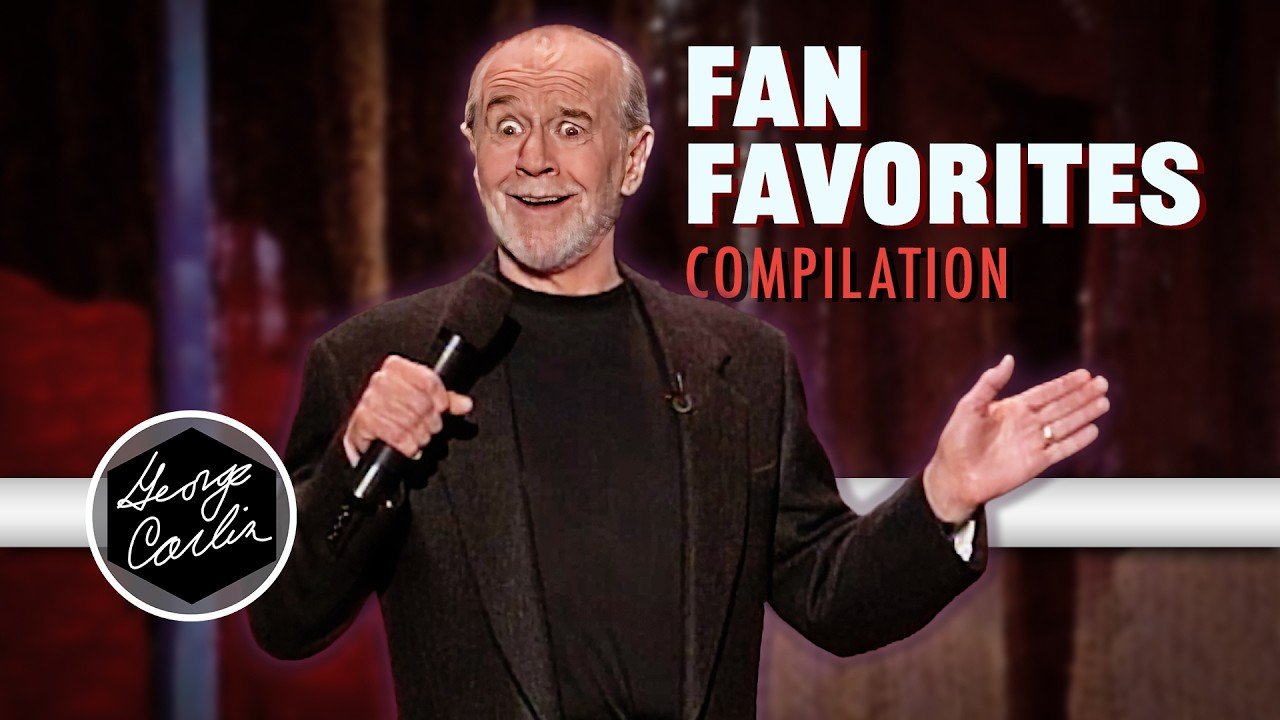
George Carlin walked to the center of a stage, took a sip of water, and proceeded to dismantle the invisible architecture of everyday American life, piece by piece, without a single prop beyond the microphone in his hand. For anyone who has ever squinted at a boarding announcement, rolled their eyes at a motivational book, or wondered why the most powerful being in the universe perpetually needs a cash infusion, Carlin’s comedy is less a performance than a long-overdue exhale. These compiled routines span decades of work, and what binds them is not anger but precision: the comedian as a man who paid very close attention and could not stop himself from reporting what he found.
The sun, Joe Pesci, and a 50% answer rate
Carlin opens the religion sequence with a premise so structurally clean it almost sounds like a math proof. He catalogues the logical friction inside conventional faith, then announces he has traded it in for something he can actually see. ‘Overnight I became a sun worshiper,’ he tells the crowd. ‘Well, not overnight. You can’t see the sun at night. But first thing the next morning.’ From there the bit pivots to his prayer practice, which, it turns out, is addressed not to any deity but to actor Joe Pesci. The reasoning is practical: Pesci looks like a guy who can get things done. After roughly a year of this arrangement, Carlin reports that his prayers are being answered at approximately a 50% rate, which he notes is identical to his old results with God, and also identical to the four-leaf clover, the horseshoe, the wishing well, and, as he puts it, ‘the voodoo lady who tells you your fortune by squeezing the goat’s testicles.’ The point lands not as nihilism but as an invitation to examine what people actually believe versus what they tell themselves they believe.
The free-floating hostility section that follows is catalogued as 24 minor cultural grievances, and the targets accumulate fast: people who make air quotes, the phrase ‘bad hair day,’ personal water bottles, hyphenated surnames, motivation tapes, camcorders carried by men who believe they are Federico Fellini, and the backwards baseball hat as a failed bid for credibility. The airline language sequence is built with the same architectural care. Carlin locates the phantom word ‘process’ hiding inside ‘boarding process’ and pulls on it until the whole sentence unravels. ‘Pre-board’ gets the same treatment: you get on before you get on. The oxygen mask safety demonstration, delivered to a plane full of partially educated adults, is the piece’s centerpiece, building through seat belt mechanics, emergency exit route planning, and a water landing that he observes sounds ‘somewhat similar to crashing into the ocean.’
The club, the owners, and the American dream you have to be asleep to believe
The longest and densest stretch arrives in the segment on education and political power. The argument moves in tight, nested steps: politicians come from the public, the public is shaped by an education system that is deliberately underfunded, and the system is underfunded because the real owners of the country, the large business interests that have purchased the Senate, the Congress, and the major media, require obedient workers rather than citizens capable of critical thinking. Carlin calls it plainly: ‘It’s a big club, and you ain’t in it.’ The bit closes on the American dream, which he describes as something ‘you have to be asleep to believe.’
In a later interview segment, the interviewer notes that Carlin’s engagement with language has always resembled a musician’s relationship to rhythm. Carlin agrees without romanticizing it. He describes his grandfather, a New York policeman at the turn of the century, who spent his adult life copying out the complete works of Shakespeare by hand, ‘because of the joy it gave him.’ Carlin connects that obsession directly to his own, acknowledging that his father won what he called ‘the mahogany gavel’ over more than 800 other public speakers at a Dale Carnegie event in 1935. Neither man raised him. Both, he suggests, showed up anyway in the genetic toolkit.
The mahogany gavel sitting in the family history
The mahogany gavel, awarded to George Carlin’s father in 1935 by the Dale Carnegie Public Speaking Institute, after beating out more than 800 other competitors, sits somewhere in the family timeline that Carlin never personally touched. His father was gone before he could know him. His mother approved of his career only after the nuns from Corpus Christi school told her the language was being used ‘for other purposes.’
When the interviewer asks why Carlin still cares enough to keep going, to fly out every Friday and come home every Monday, three cities and three nights in between, he reaches for the only answer that makes complete sense given everything he has just spent two hours demonstrating. ‘An artist has an obligation to be on route, to be going somewhere,’ he says. ‘There’s a journey involved here and you don’t know where it is and that’s the fun.’ The mahogany gavel stays in 1935. The journey, apparently, does not stop.