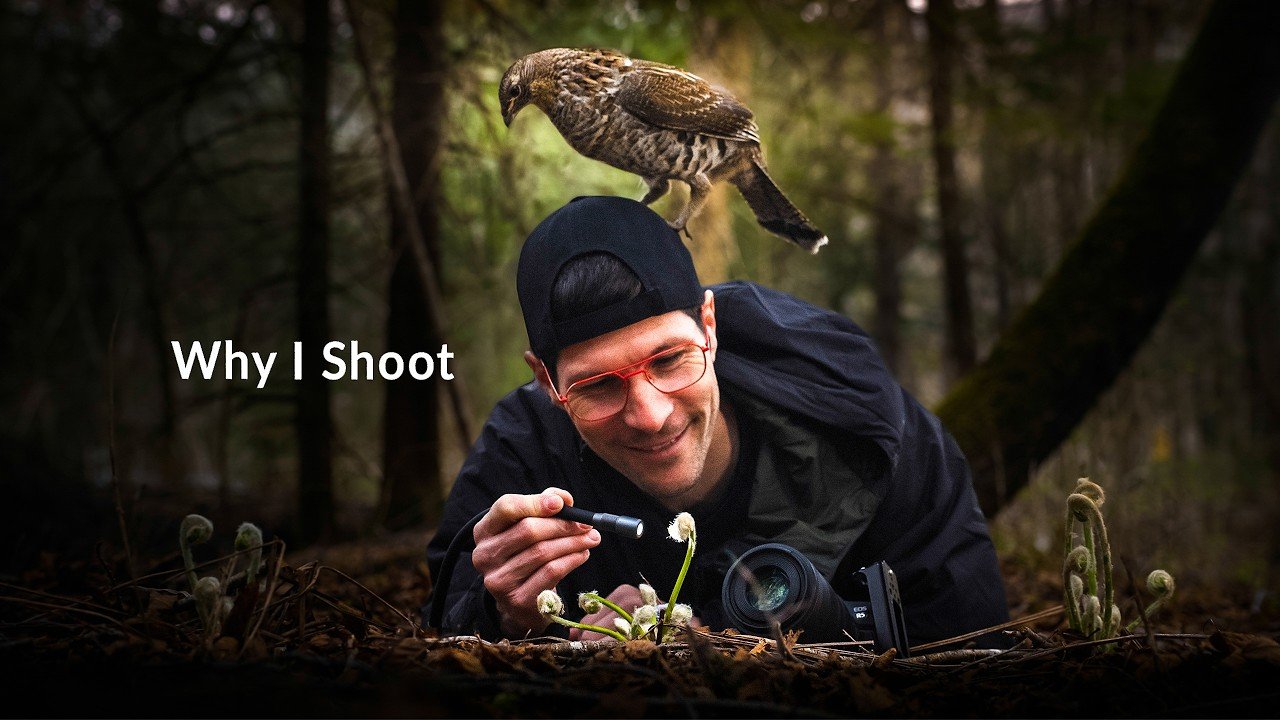
A small bird lands briefly in the frame, then moves on, and the photographer barely reacts. It was never the point. What actually holds attention in the forest that day is a patch of moss, a sliver of bark, and a handheld light being slowly swept across surfaces that most people walk past without a second glance. Macro photography, it turns out, is less a technical discipline than a deliberate act of slowing down, and the results of that patience are images that feel like they came from another world entirely.
How a shot starts before the camera ever comes out
The process begins with a small portable light held in hand, swept across different surfaces to reveal texture. Walking through a forest this way, with attention tuned to light and shape and tiny detail, means the composition is already forming in the mind before the camera bag even opens. Once something genuinely interesting appears, the camera comes out first handheld, used to explore different compositions loosely until one starts to feel right. Only then does the tripod come out for the fine-tuning phase.
At that stage, the primary concern shifts to the relationship between the subject and the background. The goal is to simplify: remove visual noise, clarify what matters, and then begin building the light. One key technical discipline happens here before a single artificial light is switched on. The camera is deliberately underexposed by about two to three stops. The reason is straightforward: adding artificial lighting later will push brightness up, and if the base exposure is already at the limit, the highlights will blow out. Leaving room in the exposure before lighting begins protects the final image.
Lighting with purpose, one source at a time
The lighting approach is methodical and spare. The first light goes on the left side, partly because of the natural left-to-right reading pattern of the eye, and partly because the shadow it casts on the right side creates the sense of depth and dimension that gives a flat subject a three-dimensional quality. The bottom of the frame is deliberately left dark, pulling the viewer’s attention upward. A second light adds a small halo around the subject, just enough to separate it visually from the background. A third handles a specific edge.
On the question of how much light is enough, the philosophy is blunt: ‘Lit with purpose, one light at a time, and if you don’t know if you need one more light, you probably don’t.’
A small piece of moss is placed in the bottom of the frame in real time, its effect visible immediately in the live view. Moving things around, adding or removing elements, is treated as completely acceptable. The goal is not to document the scene exactly as it exists but to build an image that works.
The final step is focus bracketing: taking a sequence of shots where the camera shifts its focal plane incrementally between each frame, with each slice overlapping the last just enough that post-processing software can stack them into a single sharp image. The focus increment setting controls how far the camera moves between slices, and the advice is simple: always take slightly more frames than seem necessary, because excess frames can be discarded in editing but missing focus data cannot be recovered. A two-second shutter timer eliminates any camera shake from the act of pressing the trigger.
The moment a bird nearly ended the session
With the lighting locked, the composition confirmed, and the focus brackets set, a small bird reappears near the setup. The photographer watches it, waits, and then, apparently having reconsidered its presence entirely, delivers a flat verdict: ‘I’m not okay with that. No, I’m not okay with that.’ The bird moves on.
The moss is still there, holding its position in the bottom corner of the frame exactly where it was placed, doing its quiet work of anchoring the shot.
The forest does not clear dramatically or shift into better light. The setup just sits there, patient and deliberate, ready for the shutter to fire, which is more or less the entire point of macro photography in the first place.