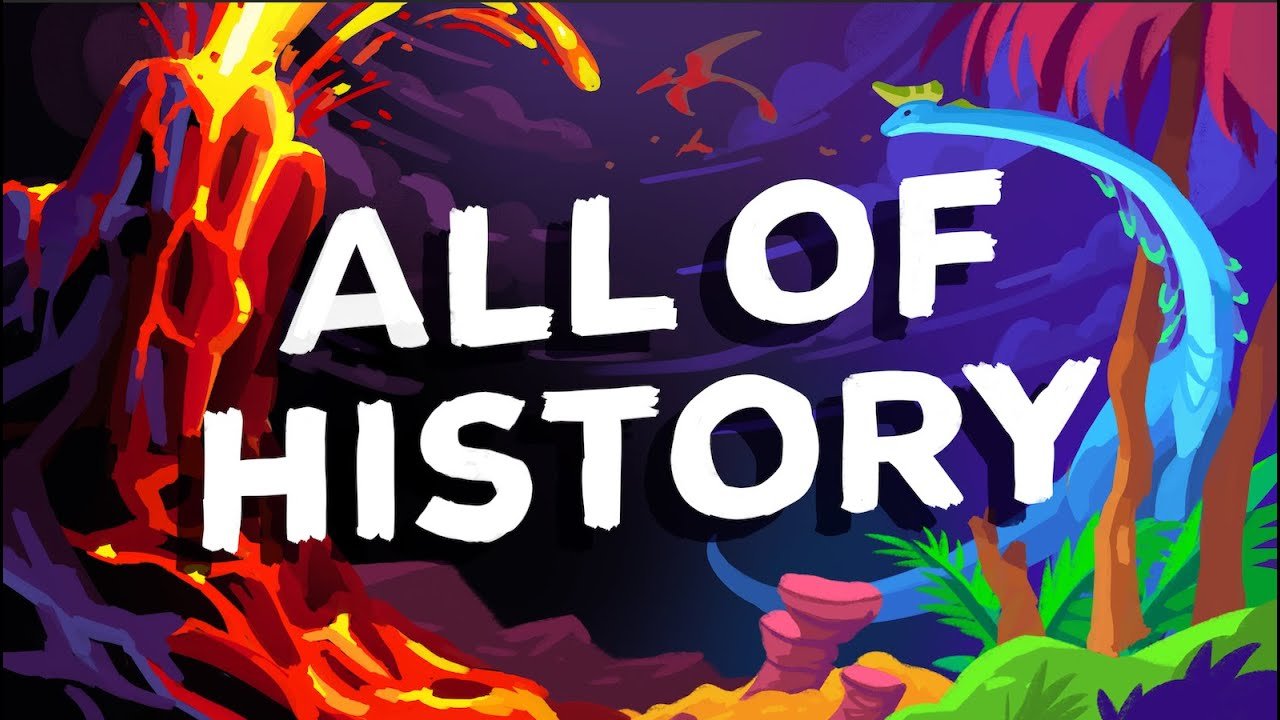
At the very beginning, Earth is a hell of lava. No oceans, no oxygen, no life. Just a molten planet freshly born 4.5 billion years ago, sitting in a solar system that hammers it with asteroids for hundreds of millions of years straight. Kurzgesagt built a one-hour journey through that entire history, collapsing every 1.5 million years into a single second, and the result makes the brain do something almanacs and textbooks never quite manage: it makes the vastness feel real. The team worked on this project on and off since 2019, finishing it in time for their tenth anniversary.
A train ride through time, one second at a time
The conceit is simple and the execution is staggering. Viewers ride what the narration calls a musical train, looking out the window as eons roll past. The Hadean eon opens on a lava floor and a CO2-thick atmosphere, with a sun 30 percent less bright than today but a greenhouse effect hot enough to kill any visitor instantly. Roughly 90 million years in, zircon minerals hint that water may already exist somewhere in the chaos.
The first cells appear only a few hundred million years after Earth’s formation, near hydrothermal vents where hot minerals push up through the ocean floor. The oceans themselves are still forming, and the planet is cooling under millions of years of rain. Stromatolites, the sedimentary rocks built by microorganisms, survive from around the one-billion-year mark, making them among the oldest physical evidence of life on Earth.
By 3.2 billion years ago, the oceans have warmed to over 40 degrees Celsius, the temperature of a hot tub. Tectonic plates are crushing into each other for the first time, pulling material deep into the earth and laying the foundations of every continent that exists today. There is still no oxygen in the atmosphere.
The moments that quietly changed everything
The Great Oxidation Event arrives at 2.5 billion years ago, when cyanobacteria begin releasing oxygen in large quantities. That oxygen reacts with atmospheric methane, rapidly cools the planet, and triggers what may be the first global freeze in Earth’s history. At 1.8 billion years ago, scattered uranium deposits in the ground spontaneously form a self-sustaining natural nuclear reactor. At 1.6 billion years ago, a eukaryotic cell, one with a nucleus, emerges when two simpler cells merge. It is, the narration notes dryly, ‘one of the most important moments in the history of life,’ and it looks like absolutely nothing.
Around 1.2 billion years ago, an alga called Bangiomorpha pubescens may have invented sexual reproduction. At 720 million years ago, Earth freezes over again, for reasons still not fully understood. Then, at 635 million years ago, multicellular life spreads suddenly and the pace of change becomes visible: the Cambrian explosion at 539 million years ago fills the oceans with ancestors of nearly every major animal group alive today.
The rest accelerates almost uncomfortably. Forests. Fish. The first vertebrates trying land. The Carboniferous marshes that become the coal humanity burns today. The Permian mass extinction that kills the majority of all species. Dinosaurs. An asteroid. Mammals.
A still moment 252 million years in
The Permian-Triassic boundary, where the largest mass extinction in history erases the majority of all species on Earth, sits quietly inside the hour, marked only by a note about volcanoes.
From the first lava field to the last flicker of human history, everything fits inside sixty minutes. The narration closes with a line that earns its weight: ‘Earth is ancient. We are new. So new.’
All of recorded human civilization, every war and invention and city, does not even register as a visible mark on the timeline. The train does not slow down for any of it.