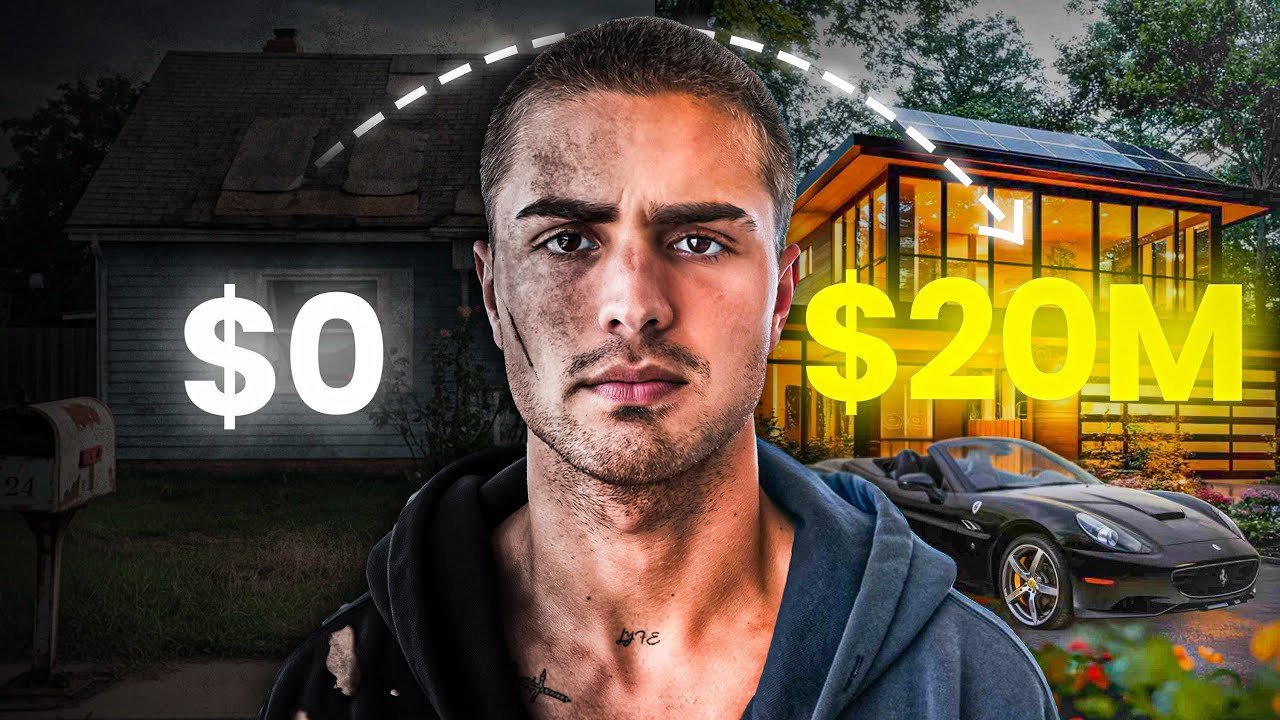
The last order of every Door Dash shift, Tyler did not deliver. He drove it home and ate it. That was dinner. Some nights he pulled up to a front door with his gas light on, waited for the customer to answer, and asked them directly for a physical dollar bill tip so he could fill his tank enough to get back. He was 19, alone in a college dorm, his bank account sitting at negative $2,000, and the only people texting him were his parents asking what the hell was happening to their son. That gap between what everyone else saw and what he knew he was going to become is the whole story.
Tyler, known online as TJR, is 23 years old and worth over $20 million today. His path from broke college freshman to that number is not a straight line. It is a series of crashes, each one harder than the last, and understanding why he kept getting back up is more useful than any trade strategy he has ever posted.
The years nobody counted
It started in high school with jailbroken iPhones, Supreme bots running on the school library computer, and a first crypto bull run that briefly made him real money before he spent all of it on sneakers and bots chasing the next thing. By junior year he had found day trading through the same pipeline most young traders find it: YouTube influencers with watches and sports cars. He lost consistently for a year and a half, then kept losing into his freshman year of college, when his family pulled back, his social world collapsed entirely, and the recurring subscription charge that pushed his account into the negative became the line he could not argue his way past anymore.
He started Door Dashing and put his AirPods in. Audiobooks. Money podcasts. Anything. The crypto he had quietly kept holding started to climb at the same time his debt was finally shrinking, and when those two things met, something shifted in how he approached the charts. ‘I no longer necessarily need to make money from trading,’ he recalled thinking. ‘I just need to be good at the skill of trading.’ That reframe, from desperation to craft, is what he credits for finally making the numbers move the right direction.
The second crash nobody expected
The part of the story TJR pauses on longest is not the broke years. It is the period after the money arrived. He had a lot of it, from crypto and from scaling his trading accounts into six-figure single days, and he started drinking at 20 in a college town where that was the easiest way to find friends. The version of himself he had built around discipline and ambition dissolved quickly. He describes sitting with wealth on paper and genuinely hating himself, and he is direct about the fact that there were multiple attempts to end his life during that stretch. ‘Happiness is not just something that you get and get to keep forever,’ he said. ‘It is something that you have to constantly work on.’ That recognition, not the money, was the actual turning point.
He moved from Utah to a small city in Puerto Rico called Dorado, bought a $2 million house in cash, and rebuilt his identity from scratch in a place where no one had any prior version of him filed away. The trading boot camp he launched there pulled 2 million views on its first installment. The social media presence that had started as a way for a self-described introvert to talk about a nerdy obsession without anxiety became the community that, by his own account, convinced him he was actually someone worth knowing.
A $300,000 car and the point of telling you
He owns a $300,000 car in cash. He spent $700,000 cash remodeling his backyard. He lists these figures not as destinations but as coordinates: here is where the road from negative $2,000 can actually go, if you accept that the losses are part of the accumulation, not interruptions to it. He is specific about the coins that went to zero while he was crying because that was his food money for the day, because those are the data points people skip when they call someone lucky.
The last Door Dash order he kept
Somewhere on Tyler’s phone, apparently still sitting in his messages, are texts from his parents, near-daily notifications forwarded from a bank account that kept hitting zero. He has not deleted them.
The first thing he did after every shift was eat whatever he had brought home. By the next delivery, he was already listening to the next chapter.