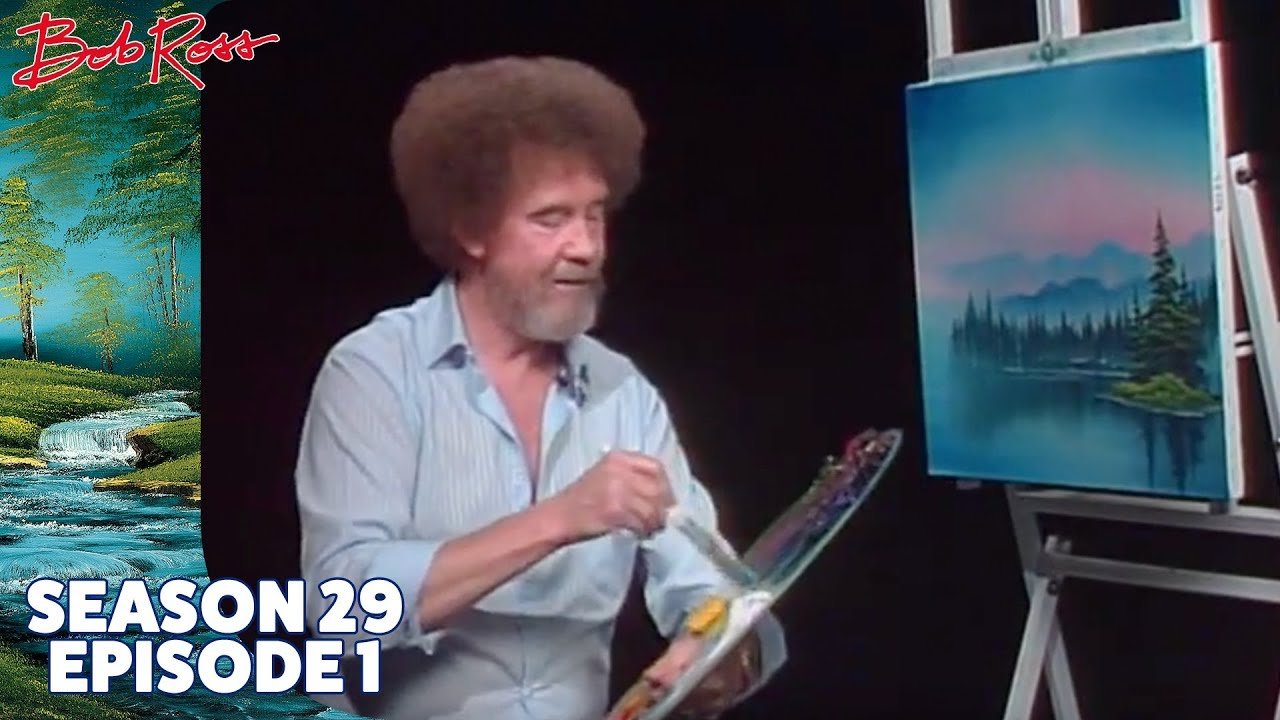
Bob Ross picks up a two-inch brush, taps a touch of alizarin crimson into the bristles, and begins laying little X’s across a wet canvas covered in liquid white. The resulting pink warmth in the sky takes about thirty seconds to appear. That is the point: anyone watching can do exactly this, right now, with paints and a canvas they already have. The 29th Joy of Painting series opens not with a complicated scene but with an invitation, and Ross makes clear from the first stroke that the whole session is designed around one idea: painting is easier than people believe.
A sky, some water, and the mist in between
The canvas starts with a thin coat of liquid white, which Ross explains keeps the surface slick so colors blend directly on the canvas rather than fighting each other. Phthalo blue goes in over the pink sky with the same two-inch brush, no cleaning required, and Ross warns gently that the blue is many times stronger than the pink underneath. A few taps of the corner of that brush produce what he calls a happy little cloud, a stringer of soft white that settles into the sky almost by accident. Still water goes in next, pulled from the outside edges inward so the surface reads as level. Prussian blue darkens the corners. Then the brush gets washed in odorless paint thinner, beaten firmly against the palette to shake the excess, and Ross grins at the sound: ‘That’s really the most fun part of it.’ A clean, relatively dry brush blends the sky and the water together in one quiet pass.
Distance comes from layers of dark-mixed color pulled downward with the corner of the brush to suggest trees far back in the mist. A second, slightly darker layer adds depth. The misty separation between layers, Ross says, is caused by the difference in color and value, and he means it when he calls that hazy space your very best friend. Reflections form by pulling the same tree color straight down into the water and then drawing the brush lightly across: instant mirror image, no special technique required.
The trees, the path, and the fish that needs a band-aid
A fan brush loaded with a dark mix of black, Prussian blue, phthalo green, and crimson builds the middle-ground evergreens. Ross works from the center outward on each tree, keeping the trunk zone darkest because leaves sit on both sides of it. A lady in one of his classes once told him the stroke looked like making the letter Z, and he adopted her description: Z trees, she called them, and he thought that was as good an analogy as any.
The foreground fills with a large deciduous tree built up in layers, first the dark background color, then individual bushes separated by name (one of them he calls Clyde), then highlights pulled through cadmium yellow and yellow ochre. A bare, skeletal tree goes in near the path with thin paint almost at ink consistency, its light trunk visible against the darker foliage behind it. Rocks appear as quick oval-brush indications, then get settled into the painting by the surrounding bush color so they stop looking placed and start looking found. A narrow dirt path of van Dyke brown winds back toward the water because, Ross explains, you would need a way in if you were going to catch that big trout or bass. He adds that he does catch fish occasionally, removes the hook carefully, applies what he describes as a little CPR, pats the fish on its way, and releases it to be caught again another day.
The painting Ross signs at the end
A small bare tree at the edge of the path, with arms still hanging out like a skeleton, sits next to a bush with tiny red flowers at its tips that Ross slips in almost without mentioning them.
He loads a little bright red onto the brush, mixes it thin with paint thinner, and signs the canvas in the lower corner. The finished scene holds a pink-edged sky, a still lake with evergreen reflections, a winding path into the trees, and one naked tree standing at the edge of it all, having a good time and looking out over the water.