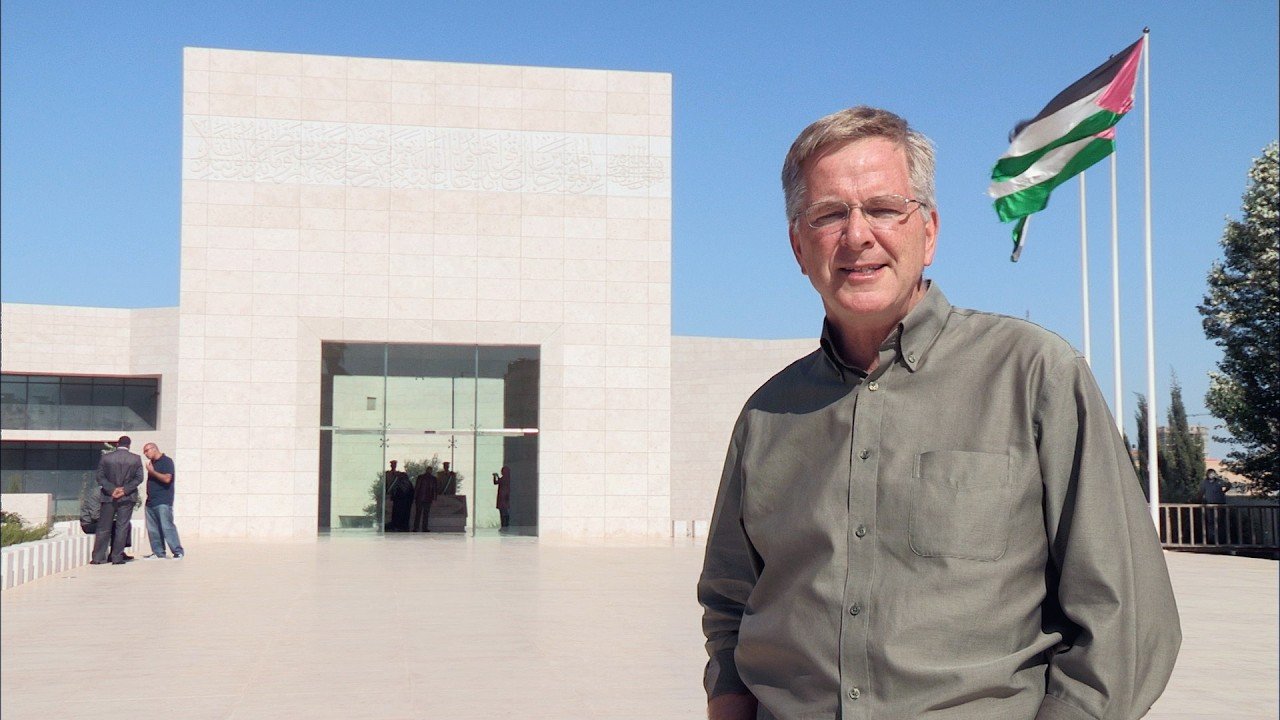
In a back alley of Jerusalem’s Muslim Quarter, a falafel vendor waves Rick Steves over with an enthusiasm that stops the street cold. ‘All on the sudden, you’re welcome in Jerusalem,’ the man says, pressing a sample into his hand before the traveler can even ask. That moment of unscripted hospitality is exactly why this journey through the West Bank exists: not to settle the region’s oldest arguments, but to walk alongside the people who live inside them. Steves, a longtime travel writer who has spent decades humanizing unfamiliar corners of the world for American audiences, frames the trip as a route through Palestinian daily life, from the Church of the Nativity in Bethlehem to the universities of Ramallah, covering a territory roughly 30 miles wide by 80 miles long.
Where a basketball coach sets the table
In Bethlehem, the journey anchors itself to Kamal Mukarker, a local guide who also coaches a girls basketball team whose players include both Christians and Muslims. After cheering the team to a win, Steves joins Kamal’s family for dinner in the multigenerational household his mother keeps. She serves a tajine layered with potatoes, zucchini, aubergine, and beef, and the table rule is firm: leave food on your plate, or she will refill it on the assumption you are still hungry. Kamal explains the toast that closes every meal. ‘Sahtain,’ he says, translating it as ‘cheers to your health, twice.’ Kamal also explains that across the square from the Church of the Nativity, a mosque has stood for over a thousand years, and that in the Quran an entire chapter carries the name of Mary, which is why the site draws Muslim pilgrims alongside Christian ones. A century ago roughly 20 percent of all Palestinians were Christian; today that figure is below 2 percent, with most of that community concentrated in Bethlehem.
Just outside town, a hike through Battir Natural Park moves among terraces that a local guide says are more than 2,000 years old, carved by ancestors into the hillsides as the only way to farm the mountains. In the West Bank, 60 percent of all trees are olive trees. Families pull children out of school for the October harvest, and nearby villages run communal presses where crews in oil-soaked shirts press rounds of olive paste into golden liquid, filtered and poured into jugs to go home with the families who brought the fruit.
The weight the cities carry
Hebron, with more than 200,000 people and close to a third of the entire West Bank economy, hums with street commerce that spills beyond any storefront. But the city also holds the Tomb of Abraham, sacred to both Jewish and Muslim worshipers, and the tension is architectural: a wire net stretched above the Arab market catches the refuse that falls from a Jewish settlement built on the high ground directly above it. Inside the tomb structure, which functions simultaneously as a synagogue and a mosque, the two communities are separated by a pane of bulletproof glass. On one side, Jewish worshippers sing and pray among the tombs of their patriarchs. On the other, Muslims face the same ancestor with an imam’s pulpit beside them, a carved wooden minbar from the 12th century assembled without a single nail.
The route then drops into the Judean Desert, past the monastery of St. George anchored in a ravine where pilgrims have hiked for 15 centuries, and down into Jericho, one of the oldest continuously inhabited cities on Earth, sitting nearly 1,000 feet below sea level. The altitude makes the dates sold in the main square famously sweet, a vendor confirming the reputation with a sample and two words: ‘Jericho dates. Famous.’ Further east, at the Dead Sea, the water runs roughly one-third minerals, six times saltier than the ocean, and Palestinian families who can afford the admission visit Israeli resorts along a shoreline the border was drawn to keep entirely on the Israeli side.
Ramallah, the de facto capital, carries a different energy. At Birzeit University, 10,000 students move across a well-kept campus. A small group of young women, when asked about their hopes, answer without hesitation: peace, the freedom to travel, and family nearby. One adds, simply, ‘Inshallah.’
The minbar that has stood since the 12th century
In the divided interior of Abraham’s Tomb in Hebron, the mosque side holds a pulpit assembled from inlaid wood with no nails, unchanged since the 1100s, still in use.
Steves closes the journey the way he opened it, standing somewhere unexpected and finding a stranger ready to talk. The falafel vendor’s greeting in Jerusalem’s Muslim Quarter was not staged for a traveler passing through. It was, as Steves put it, just what happens when you actually show up.
 Wake up to Only Happy News!