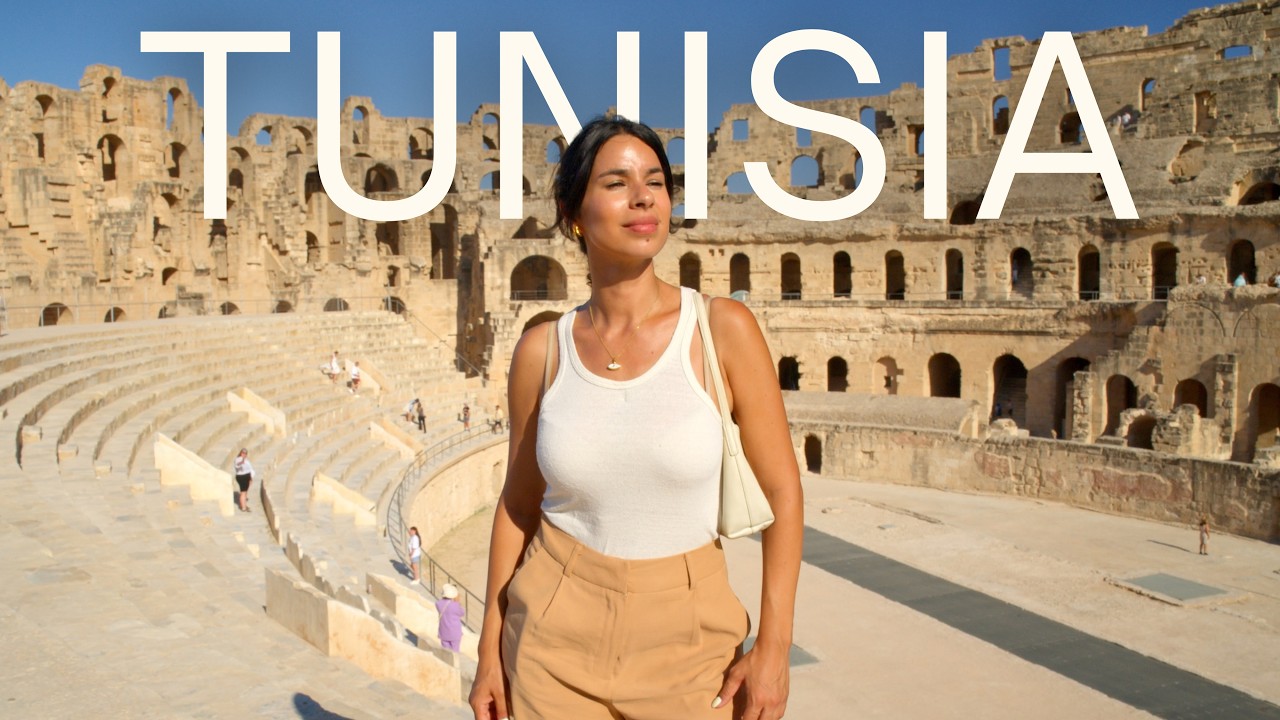
In the unremarkable market streets of El Jem, a small Tunisian town where locals go about their day around a central mosque, something enormous rises without warning. The third-largest Roman amphitheater in the world, built in the 3rd century AD, emerges from the middle of an ordinary Tuesday as if the town simply forgot to mention it was there. That dissonance, between what Tunisia looks like on the surface and what it is hiding underneath, is the real story of a country that has spent centuries accumulating layers of civilization most travelers have never thought to look for.
Tunisia sits between the Mediterranean and the Sahara, shaped by Phoenician settlers, Roman emperors, Islamic dynasties, and Berber communities whose descendants still carve their homes into the earth today. Malini Angelica traveled the country from its northern coast to its southern desert, and what she found was a place that keeps delivering surprises long after the guidebook version of it runs out.
Where Rome built its biggest bath outside of Italy
The journey begins at Carthage, just outside the capital Tunis, where the Antonine Baths stand along the Mediterranean coastline. These were the largest bath complex ever built on the African continent, and the largest outside Rome itself. What visitors walk through today is the ground floor of a structure whose actual bathing rooms sat above on arched supports, giving bathers a direct view of the sea. The whole arrangement, as Angelica put it, ‘was like a second century luxury resort.’
Down the coast, the ribat at Monastir adds another layer. Built in the 8th century AD to defend against Byzantine naval attacks, the fortress was expanded by successive Islamic dynasties over centuries. From its tower, a white cemetery stretches against the blue of the sea below. Across from the ribat sits the tomb of Habib Bourguiba, born in Monastir, who led Tunisia’s independence movement against French colonial rule and became the country’s first president in 1956.
Moving inland, Kairouan carries the weight of being considered the fourth holiest city in Islam, built around the Great Mosque, the oldest surviving mosque in North Africa, constructed in the 7th century AD. Its columns were salvaged from the ruins of ancient Carthage and Byzantine sites, creating an architecture that blends Islamic design with repurposed Roman stonework. The medina surrounding it is known for hand-woven carpets, with artisans still working traditional looms in their workshops. Kairouan is also where the makroudh was born: a semolina pastry filled with dates, soaked in syrup, and sold from the Barrouta souk, where Angelica tried an assortment and described them as ‘incredibly sweet, absolutely delicious.’
Underground homes and a Star Wars planet in the desert south
The further south the road goes, the stranger and more specific Tunisia becomes. The troglodyte villages of the Amazigh people, dug at least ten meters into the earth around a central courtyard, are not a relic. Some families still live in them. The underground temperature stays regulated year-round because the earth itself acts as an insulator, a practical engineering solution that has kept these homes functional for generations. In one such home, a resident named Alma demonstrated the traditional grain-grinding method with a stone mill, hard work that required both arms and produced results slowly. A chameleon appeared in the courtyard, unannounced, and drew more reaction than most of the ancient ruins had.
Further south, in the region around a town whose name George Lucas borrowed for his fictional desert planet, the ghorfas appear: thick mud-brick fortified structures built by Berber communities to store the season’s grain harvest. The walls are dense, the doors made of heavy palm wood, and the views from the upper floors stretch across a rocky landscape that genuinely looks like somewhere outside this solar system. It was discovered by Hollywood for exactly that reason.
The cat asleep in the storage room
In one of the troglodyte homes in the region, a group of cats and kittens had claimed a cool storage room for themselves, curled up in a space that still smelled strongly of olive oil from years of use.
El Jem’s amphitheater holds one detail the Colosseum in Rome does not offer: visitors can go underground, into the tunnels where animals and gladiators were held in cages before being lifted by pulley systems directly into the arena floor. Standing in those tunnels, looking up at the open sky of the arena, the capacity of 35,000 spectators becomes something you feel rather than read.
 Wake up to Only Happy News!