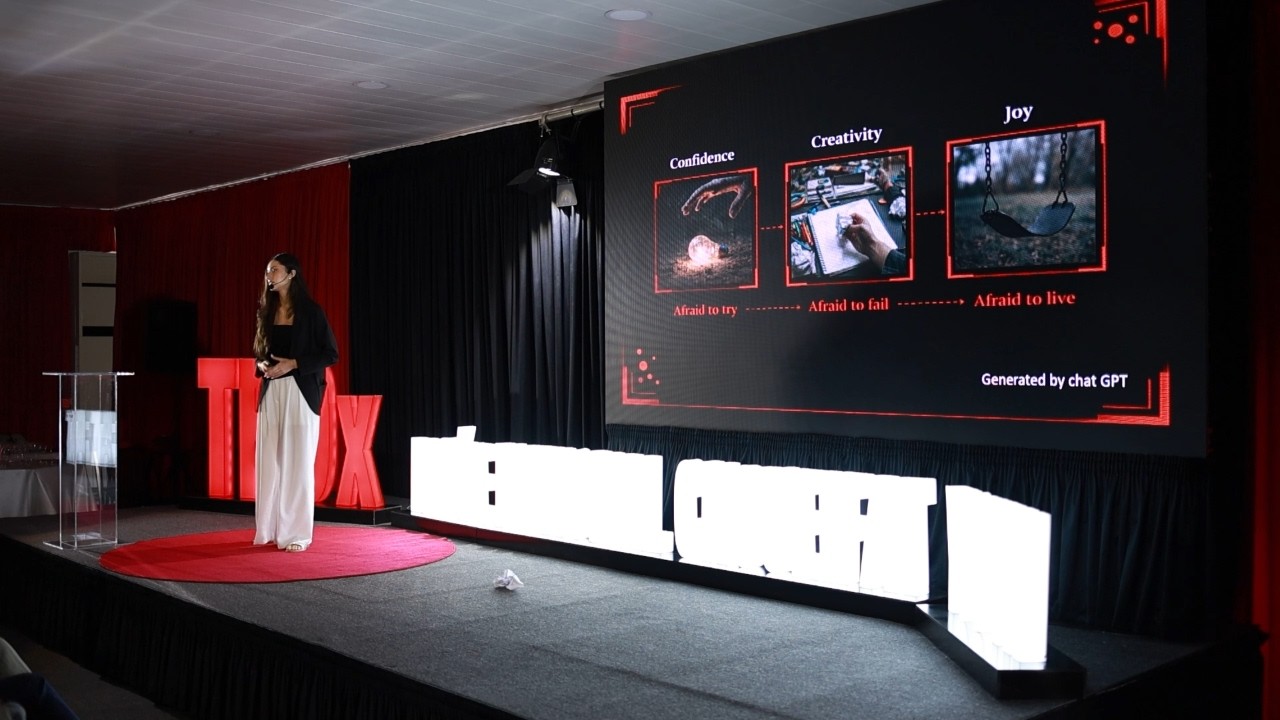
Elena Mehio held up a single sheet of paper in front of a live audience and called it perfect. Smooth, untouched, without a single fold. Then she crumpled it. What she did next, and what she said about the crumpled page still having the ability to hold words, deliver a message, and carry a story, drew applause from a room full of young people who had clearly been waiting for someone to say it out loud. The talk cuts straight to something most high-achieving students carry quietly: the suspicion that a single mistake cancels everything they got right.
Mehio, speaking at TEDxLycee National Choueifat Youth, built her entire argument around one physical prop and one honest memory. She described sitting with a graded exam in her hands, a score that was almost perfect, and feeling nothing but the pull of that one red circle on the page. Everyone around her was celebrating. She was not. ‘If I can’t get it completely right, am I even enough?’ she asked the audience, repeating the exact thought that had run through her head that day.
What perfection quietly takes from you
Mehio’s argument is not that mistakes are fine. It is that chasing a flawless result shrinks the person chasing it. Perfection, she told the audience, makes people afraid to try, afraid to fail, and afraid to live. It steals confidence, creativity, and joy, and it does it gradually, one red circle at a time. She pointed to the obvious places where the pressure shows up: skin, test scores, social media lives that she noted flatly ‘don’t even exist.’ But her sharper observation was about the internal cost, the weight of constantly hiding what she called ‘the folds in your soul.’
The crumpled page on the stage was her answer to that cost. A folded page, she argued, does not lose its function. It can still hold words. It still has meaning. It just holds more now, because it has been somewhere.
The shift from performing to showing up
The clearest turn in the talk comes when Mehio describes stopping. Not improving, not optimizing, but stopping the performance of flawlessness entirely. She said she stopped trying to be perfect and started trying to be real. Her case for that shift was relational rather than personal: perfection does not connect people to each other. Vulnerability does. Pain does. The moment someone admits they have been torn and folded but are still standing, she said, is the moment other people actually see them.
The talk closed with the image she opened with, the crumpled page, now reframed. A smooth page is easy to forget. A page folded and unfolded a hundred times carries a story no one forgets.
A prop that stayed on the stage
The crumpled sheet of paper Mehio used throughout the talk was still there when she finished speaking, sitting on the stage in front of an audience that had just heard it described as the most valuable version of itself.
Mehio walked offstage to applause and cheering. The page stayed where it was.
 Wake up to Only Happy News!