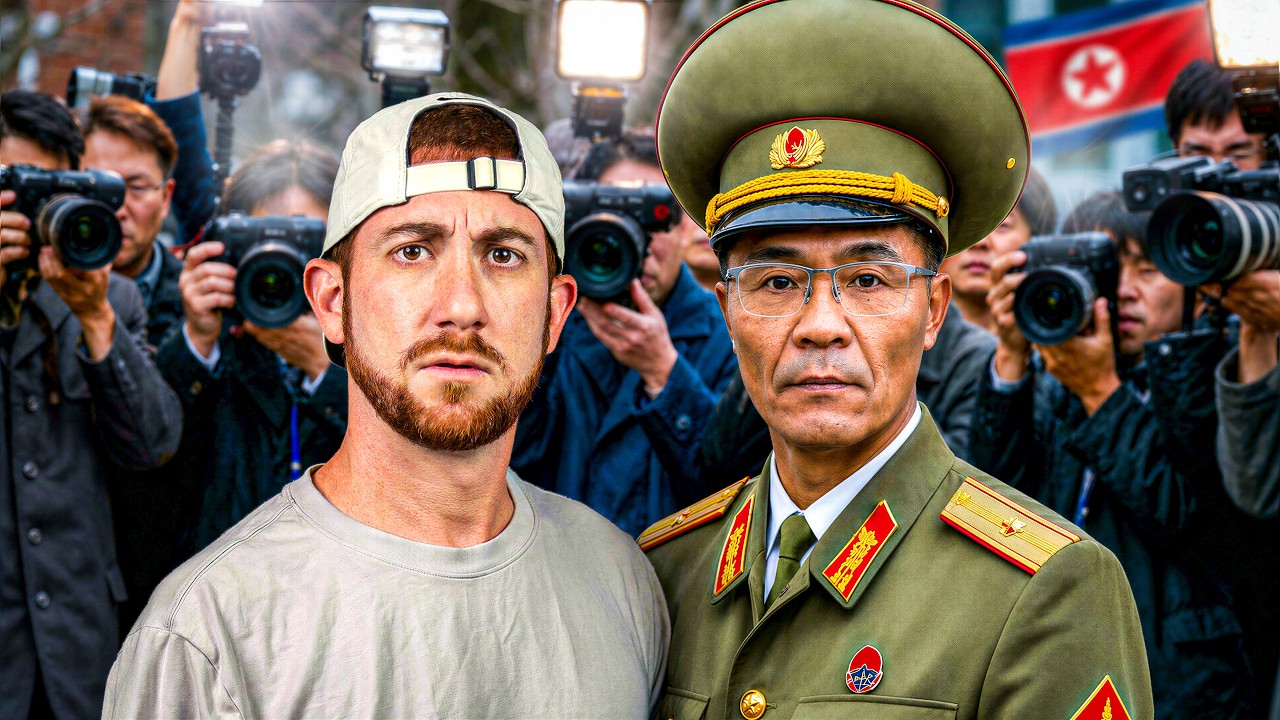
Kang spent thirteen years standing ten to twenty meters away from Kim Jong-il, always facing the opposite direction, his back to the man he believed was greater than any god. Now he is standing at a Seoul fish market, watching live octopus writhe on a plate, tasting freedom one bite at a time. For anyone who has ever wondered what actually happens inside the world’s most sealed regime, Kang’s account is not a diplomatic briefing or a think-tank estimate. It is a ground-level testimony from someone who cleaned the villa, drilled with guns, and stood guard outside the banquets until two or three in the morning. Drew Binsky spent a full day with him across Seoul, from the fish market to a bar in Itaewon, drawing out details that no public record has ever carried.
Before he learned to say ‘Mom,’ he learned to say ‘Thank you, Generalissimo’
Kang grew up in Hyesan, in the Ryanggang Province near the Chinese border, in a family he describes as relatively comfortable by North Korean standards. But comfortable meant surviving on government rations and never running a private business. By age three, children were taught to thank Kim Il-sung and Kim Jong-il before they could reliably say their own parents’ names. At eight, Kang was wearing a Children’s Union necktie and moving exactly as the organization instructed. Television arrived in the nineteen eighties, but every channel was pure state propaganda. He never recognized it as propaganda until he reached South Korea. ‘I never saw it as propaganda,’ he said, ‘not until South Korea showed me our life was truly hell.’
Selection for the elite bodyguard unit began at fifteen, when authorities spent two or three years reviewing an entire family’s loyalty history. Kang joined the military at seventeen and was discharged at thirty-one. His first sight of Kim Jong-il left him overwhelmed, not because the man radiated any particular aura or scent, but because years of conditioning had fused the leader’s image with the entire meaning of existence. Bodyguards were required to face away from Kim Jong-il at all times, a defensive posture, so that no approaching threat could come from behind undetected. Daily life at the villa began with cleaning the grounds at five in summer and six in winter, followed by two hours of what Kang calls a lecture: learning that Kim Jong-il is the sun, and that without the sun, no victory is imaginable. Then shooting practice. Then meal preparation drills. Then escort tactics. No bulletproof vests were issued. The body, they were told, is its own bulletproof vest.
The Pleasure Squad, the photo draws, and the garbage bins outside the party walls
Kang was stationed outside the banquets, never inside, so he experienced the parties only through their aftermath: leftover food thrown into garbage areas in the morning, cars moving until two and three in the morning. What he describes from conversations on the inside is stark. Young women recruited into what the regime called the Pleasure Squad were tested for sexually transmitted diseases at seventeen and entered the villa management system permanently, unable to leave until twenty-five. Women Kim Jong-il favored personally became, in Kang’s words, ‘his absolute property,’ with no path back into ordinary society. When officers in the guard unit reached thirty and were eligible for marriage, the party organized it by laying ten face-down photographs on a desk at a central cultural facility. Each man drew one. If he found the woman undesirable after spending the night with her, she was barred from marrying for a full year. The women in this system were referred to as ‘assigned goods.’ They did not appear in the North Korean census.
For thirteen years of this service, Kang received total wages equivalent to twenty-three kilograms of rice.
His decision to defect came after his discharge, when he lifted the lid on the cooking pot at home and found his parents, both in their seventies, eating grass porridge. His wife had died four years into their marriage. He had been watching smuggled South Korean dramas and could not reconcile what he saw on screen with what he had been taught about a ‘rotten capitalist society.’ He crossed the Yalu River in winter, breaking through ice in the afternoon as workers were getting off their shifts. Guards fired blank rounds from behind and ordered him to stop. He turned around, raised his fist, shouted at them, and kept going. A crowd of bystanders watched him defect in broad daylight.
The moment the live octopus stuck to his tongue
Back at the fish market table, the octopus was still moving when it arrived. Kang had never eaten it before. He took a large piece and reported that it stuck to his tongue while chewing. He found it genuinely good. It was his first time.
Later that evening, Binsky brought Kang and a second defector, also named Kang, who had escaped via Vietnam and had not spoken to his own parents in ten years, to an American bar in Itaewon. A rib platter arrived, Southern-style barbecue, the first either man had seen in person. Kang studied it, chose the tangy sauce, and ate methodically. ‘I’m eating a meal together with an American,’ he said. ‘It’s incredible.’
Asked what message he would leave for anyone watching, Kang paused, then answered without hesitation: ‘Freedom is absolutely never free.’
Binsky later said it was one of the best answers he had received in his entire career of asking that question.
The rib platter, untouched for a moment
Before the first bite, the rack of ribs sat on the table between three men who, by every framework their governments had given them, were supposed to be enemies. Two barbecue sauces in small dishes. One sweet, one tangy.
Seoul traffic moved outside. Kang’s North Korean accent, the one that still makes people go quiet when they hear it at work, was fully audible in the bar. He picked up a rib with both hands.