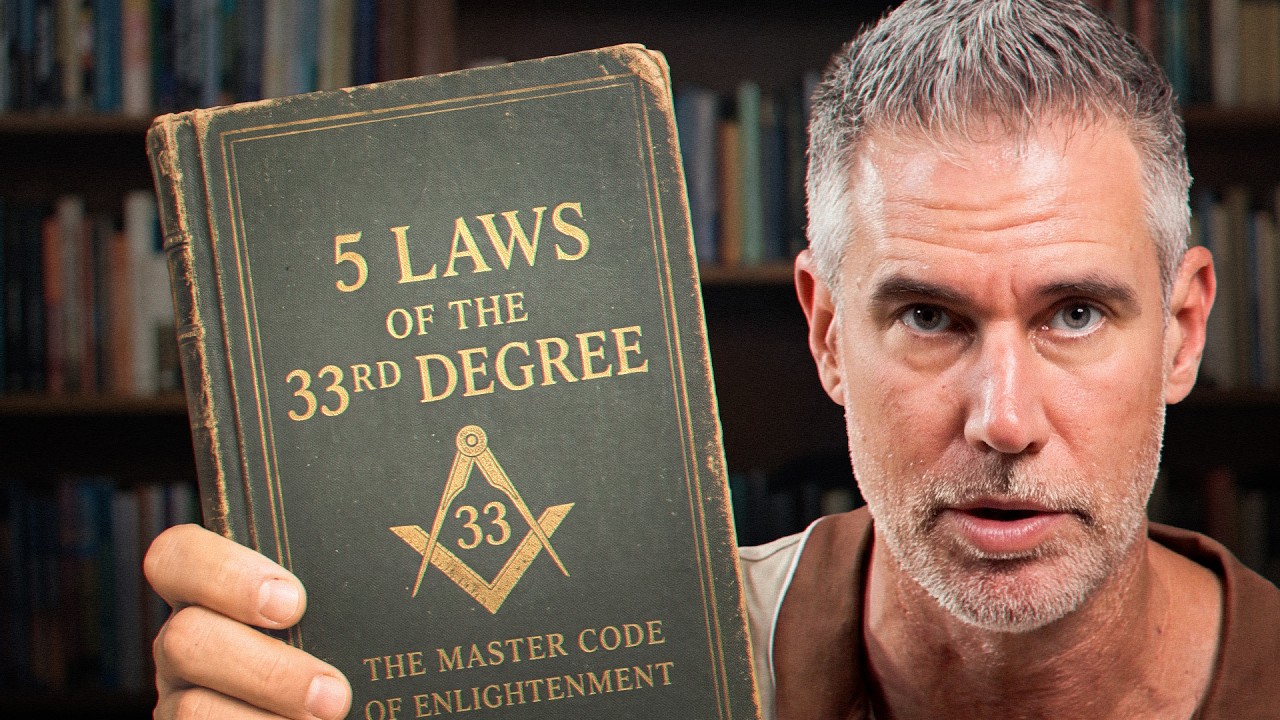
For thousands of years, the most influential secret societies in human history were not teaching people how to accumulate wealth or seize power. They were teaching something far stranger and, according to mindset teacher David Bayer, far more practical: how to govern reality itself. Ancient Egyptian mystery schools, Greek hermetic traditions, early Christian mysticism, and the Freemasons’ 33-degree system all kept arriving at the same conclusion across centuries of independent development. When you change the person, reality changes. Bayer argues that none of this knowledge is actually secret anymore, and he has distilled it into five core principles anyone can use.
The framework the Masons spent 33 degrees building
Bayer opens with a clarification that shapes everything that follows: this is not a conspiracy theory exercise. His interest is in the pattern. Across cultures separated by centuries, independent traditions kept converging on the same insights about attention, belief, identity, and self-mastery. The Freemasons built a 33-level system representing moral and philosophical development. The Egyptian schools taught that man was asleep and could awaken. The Greek hermetics anchored everything to ‘know thyself.’ Early Christian mysticism located the kingdom of heaven within. Different languages, same map.
The first law is the power of decision. Bayer draws a distinction that cuts against most popular belief-change advice: beliefs are not mysterious forces to be managed like clouds. They are decisions, most of them made unconsciously in early childhood, and they can be consciously overridden. He points to neuroscience here, noting that the brain’s reticular activating system filters roughly 88 percent of daily experience into the subconscious, leaving only 12 percent reaching conscious awareness. That 12 percent is determined entirely by what you have already decided is true. Change the decision, and you literally change which slice of reality you perceive.
The second law is the law of identity. Bayer cites a line from Joe Dispenza: ‘Your personality creates your personal reality.’ The practical exercise is to identify a goal, then ask how you would think, feel, and carry yourself if that goal were already achieved. Someone who has already achieved financial security, he notes, tends to feel calm and relaxed. The invitation is to cultivate that calm now, not as a reward for the outcome, but as the internal state that generates it.
The third law is the echo effect, which Bayer calls the most misunderstood obstacle in personal transformation. Today’s reality is an echo of past thoughts and decisions, sometimes delayed by weeks or months. When someone shifts their thinking on a Monday and nothing has changed by Tuesday, they abandon the new belief and snap back into old patterns, generating another echo of the same result. He puts it plainly: ‘Your present moment is old news. So why pay so much attention to it?’
The fourth law is the mastermind principle. Napoleon Hill named it, but Bayer traces it through scripture (‘where two or three gather’) and through the documented habits of industrialists who gathered specifically to access what Hill called a third mind, a supercharged collective intelligence beyond what any individual could reach alone.
The mirror that changes when you stop looking at it
The fifth law is the mirror principle, captured in the hermetic saying ‘as is above, so is below.’ Whatever is expressing itself in the external world has its root cause internally. Yogic traditions built an embodiment practice around this: hold an uncomfortable posture, breathe through the impulse to react, and let the anger or fear arise and subside without being acted on. The external changes only after the internal reaction to it has been transformed.
The man who stopped reacting long enough to notice
At some point in his own teaching career, Bayer stopped treating these five principles as interesting historical parallels and started treating them as a single unified operating system, one that shows up whether you approach it through spirituality, philosophy, psychology, or neuroscience.
He keeps returning to the divided mind. ‘A divided mind creates divided results,’ he says. ‘A unified mind becomes extraordinarily creative.’ The Freemasons didn’t build 33 degrees of initiation to protect a handshake. They built them because becoming the kind of person who does not doubt, apparently, takes work.