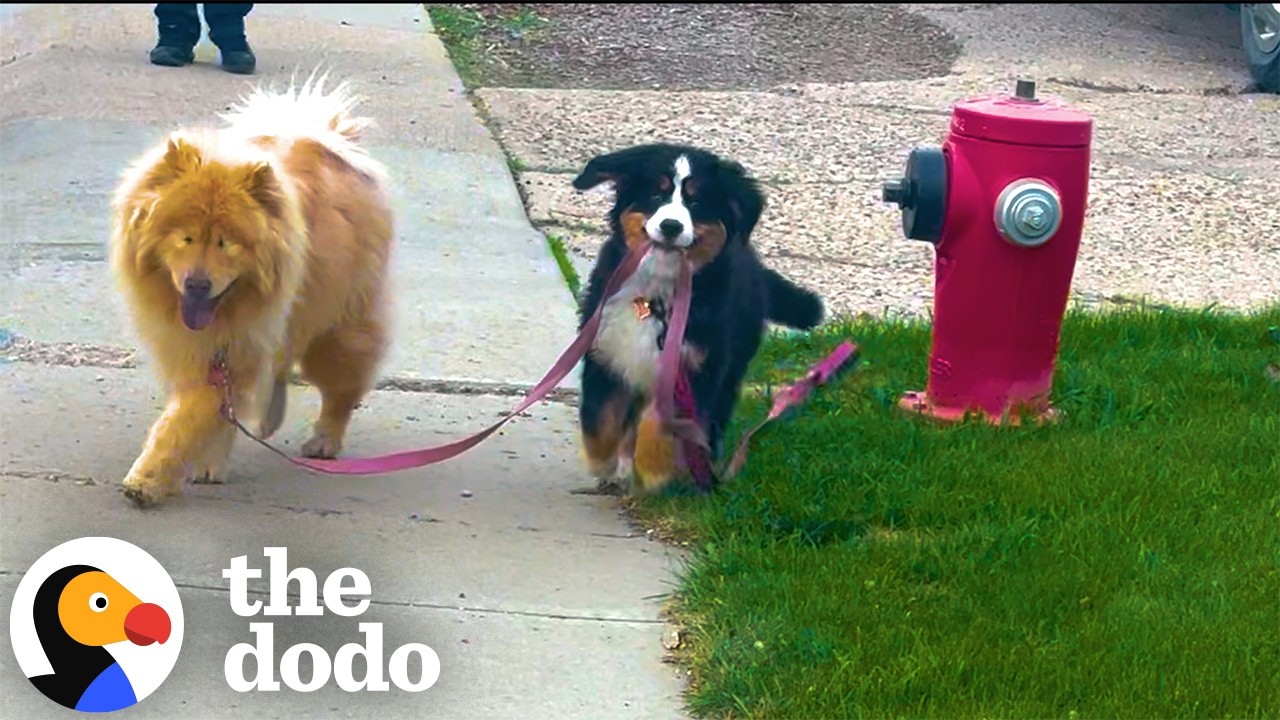
The moment Willow picked up Misha’s dropped leash and started walking beside her, nobody had asked her to do it. The family watched, and nobody said a word for a second. That small, self-appointed act turned a household with one blind dog and one new puppy into something that looked a lot like a partnership, the kind that cannot be trained into existence.
When a dog decided her sister needed a guide
Misha had been healthy for the first six years her family had her. Then came the rubbing at her eyes, the small collisions with furniture, the moment she walked into the couch and her owners looked across the room at their daughters and saw tears. Glaucoma had taken her sight, and the vet delivered news that felt impossible: removing both eyes was the only path to a pain-free life.
After the surgery, something shifted. ‘She started to smile,’ her owner recalled. ‘She was a younger dog again.’ That renewed energy was what the family held onto when their daughter brought up the idea of a second dog. They decided Misha might actually benefit from a companion, and that is how Willow arrived.
Willow came in wanting to be everybody’s best friend. She followed Misha everywhere as a puppy, barking and jumping to announce walks, tucking in close on the couch, never leaving her behind. When a walk began and Misha’s leash was dropped, Willow went and grabbed it. She kept doing it. ‘Misha really didn’t need the help,’ her owner said, ‘but I think Willow really wanted to give it to her.’
A three-legged puppy who refused to slow down
Elsewhere in this story lives Matilda, born on a night when a phone call came through that a litter had just arrived and one puppy had lost both front legs and part of a back leg at birth. A rescuer with roughly ten years of experience in animal rescue transported her immediately and went straight to the vet, with low expectations and an open question about whether Matilda would survive at all.
She kept answering that question. ‘She had the most spirited will to live I have ever seen in a newborn puppy,’ her rescuer said. A local company 3D-printed a cart for her. Matilda hated it, as her rescuer put it, ‘with every fiber of her being.’ So the cart went away, and Matilda kept moving on her own, a full-body bunny hop that now carries her from room to room in a house that has been completely padded and matted to protect her on landing. Every surface she might hit has been made thick enough to absorb the impact of how she moves.
She is, by all accounts, entirely unbothered by any of it. Visitors who come through the door are greeted by a puppy bouncing toward them, tucking her head to the side, putting her little rear in the air, demanding belly rubs.
The interview she interrupted
Matilda, barking from the next room because she was annoyed at being left out.
She was brought in and sat for the rest of the conversation, because, as her rescuer noted plainly, she is obnoxious. The padding is thick underfoot. The house is hers to move through. She has no idea she only has one leg.
 Wake up to Only Happy News!