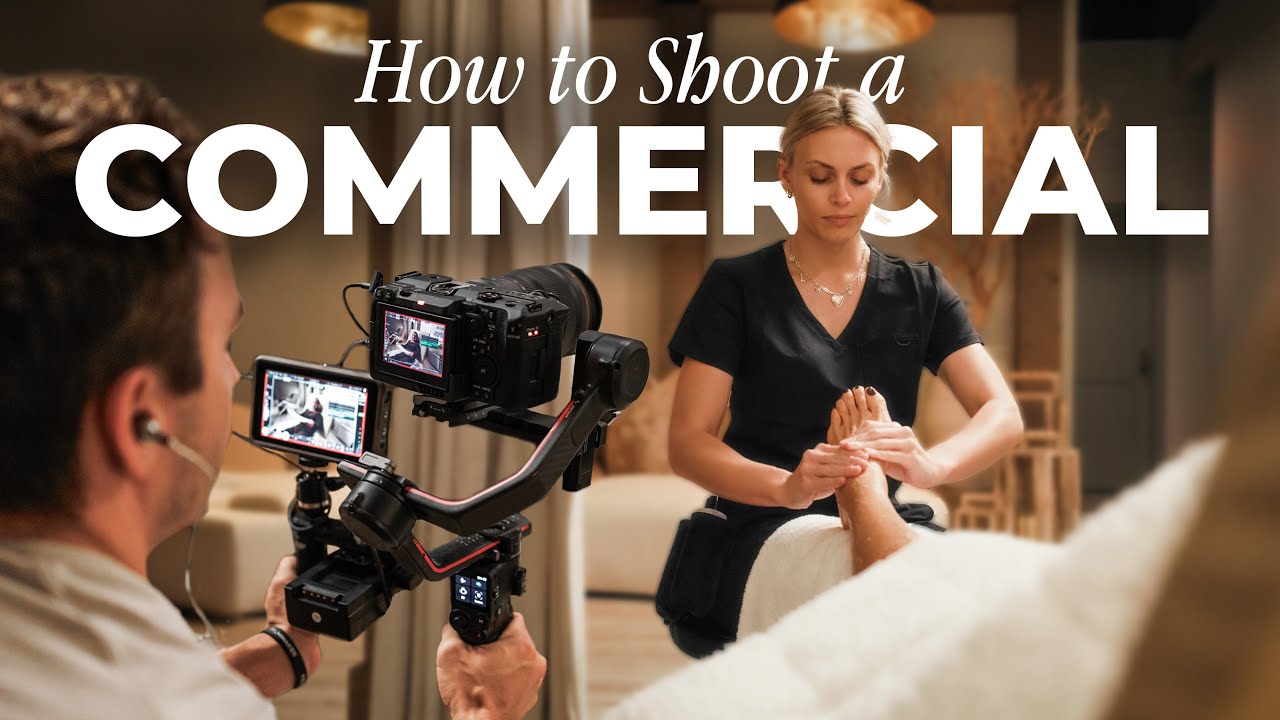
The first five seconds of a commercial are the only seconds that matter. That is the premise behind every creative decision made on a recent production day at Drift Reflexology, a full-body reset studio located in Draper, Utah, where filmmaker and Full Time Filmmaker creator Parker Walbeck set up lights, rigged lavs, and ran a gimbal through a quiet, warmly lit treatment room to capture a 60-second ad from scratch. The shoot is a close-up look at what it actually takes to deliver a commercial that converts viewers into paying customers, not just a polished piece of content that looks good on a reel.
Hook first, script second, B-roll last
The production structure follows a deliberate order built around efficiency. The talent is miked up once, and that single setup is used to capture everything that requires their voice. First comes the hook, the opening lines designed to stop a viewer mid-scroll. Then, while the talent is still warmed up and wired, they record the call to action for the ad’s closing seconds. Finally, still mic’d but no longer on camera, they read the full script from top to bottom so the audio track exists for the B-roll edit that comes later. ‘You guys aren’t quite done,’ Walbeck told the talent after the on-camera portions wrapped. ‘I need your audio while your mics are still hooked up.’ It is a practical sequencing choice that saves a second setup and keeps the shoot moving.
The camera of record for the day is the Canon EOS C50, shooting in 7K open gate at 30 frames per second and recording in C-Log 2. The open gate format is the central technical decision of the shoot. Because the sensor captures more image area than a standard 16×9 frame, a single shot can be reframed in post for both a horizontal website cut and a vertical social media cut without scaling in far enough to lose the subjects. Walbeck keeps markers visible on his monitor during the shoot showing both crop windows simultaneously, so every composition accounts for both deliverables at once. The camera’s dual native ISO sits at 800 and 6400, and on screen the difference between 5,000 ISO and 6,400 ISO shows a visible noise cleanup that makes the upper setting genuinely usable in the dim, candlelit ambiance of the treatment space.
Rigging for smooth handheld without IBIS
The camera does not include in-body image stabilization, a deliberate omission. Canon’s explanation, relayed directly on set, is that professionals surveyed for the design prioritized compatibility with drones and car mounts, where IBIS can introduce an unfixable wobble. For handheld work, the C50 pairs lens stabilization from Canon’s RF zoom lenses with its internal digital stabilization. For the tighter B-roll sequences, a 24-to-105mm zoom goes on the body, the rig is weighted deliberately to dampen micro-jitters, and a harness strap adds a fourth point of contact to go alongside the chest rest, the grip hand, and the elbow. Shot at 105mm, the close-up footage of a customer’s hands and feet comes out steady.
The edit that follows the shoot demonstrates the open gate payoff clearly. The full 7K frame, once cropped to vertical, delivers close to a 4K-resolution image with room to reframe. A Canon C-Log 2 to Rec. 709 conversion LUT handles the base correction, followed by manual temperature and exposure tweaks to pull the image back from underexposed and slightly warm. A creative LUT called X88 Prime, applied at 70% intensity, adds contrast and warmth before a 65mm bloom effect from Dehancer softens the final image toward something that feels filmic without losing the dark, quiet atmosphere of the room.
By the time the ad went live, the client had spent just under $200 on the campaign and received 477 clicks, with multiple sales already attributed to the cut.
The zero-gravity chair at the center of the frame
A zero-gravity chair, described in the ad script as taking pressure off the spine, opening the chest, and letting the body fully relax, appears in almost every B-roll setup of the day.
Walbeck ended the final edit not on the filmed call to action but on a quieter moment: the customer rising from the chair, walking out of frame, and a cut to the logo. The scripted outro went unused. The chair, now empty, made a cleaner close.