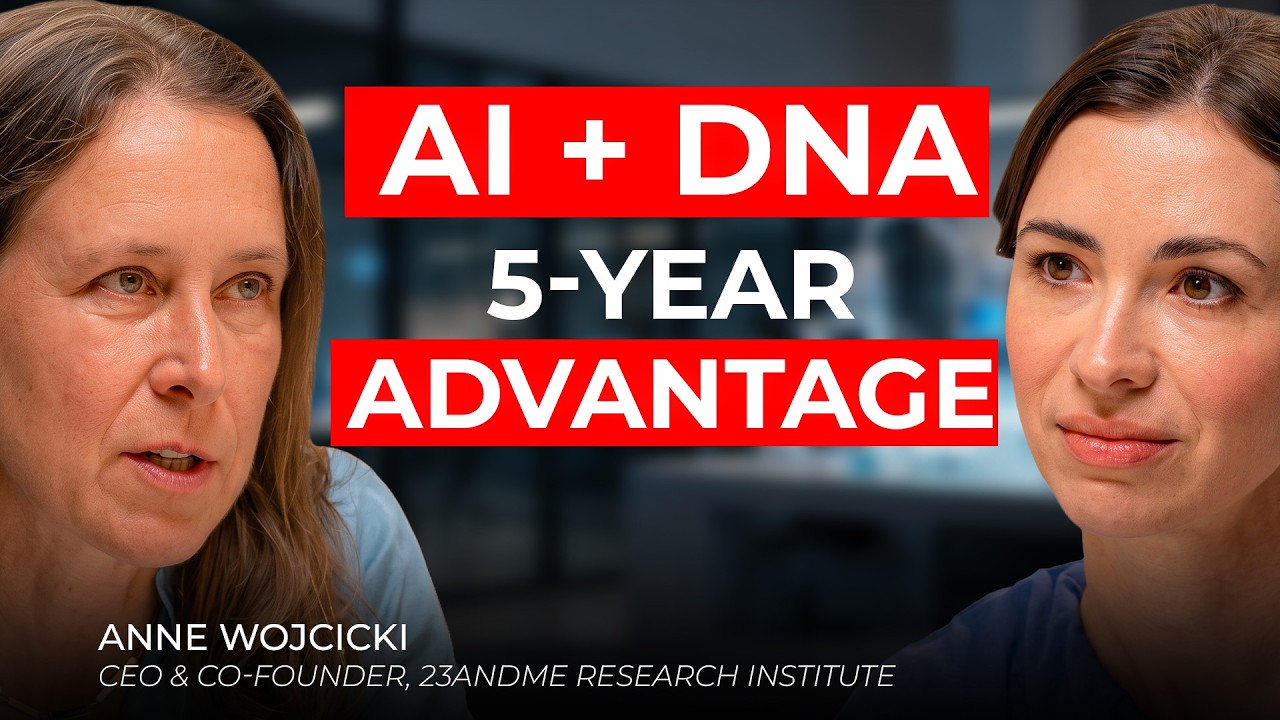
Anne Wojcicki was sitting across from a genetics researcher she had spent two decades building toward, running a company she had just bought back from bankruptcy, and making the case that a DNA test taken today could redirect the course of a disease that will not show up in a clinic for another five years. The gap between what a doctor can catch and what genomic data can predict is the reason 23andMe still exists. And after one of the most brutal years in Silicon Valley founder history, Wojcicki is the reason 23andMe still exists at all.
What AI and DNA together can do that a doctor visit alone cannot
The core argument Wojcicki makes is structural, not speculative. The healthcare system, she points out, compensates physicians to treat disease, not prevent it. That incentive gap means the next layer of protection has to come from individuals themselves, armed with their own data. The tools are now in place to make that real. A person can pull their genetic profile, link it to wearable data from an Oura Ring or Apple Watch, connect their medical records, factor in their zip code’s air and water quality, and let an AI surface where intervention is possible before symptoms begin.
The distinction she draws between monogenic and polygenic risk is where the conversation gets specific. A monogenic variant, like familial hypercholesterolemia, is a single gene change that overrides most dietary interventions entirely. The interviewer, who is 36 and managing exactly that condition, pressed hard on whether statins are avoidable. Wojcicki did not soften it: ‘No matter what you do with your diet, you have to take a statin.’ But she immediately pivoted to pharmacogenetics, the interaction between an individual’s genetics and how their body processes specific drugs, as the frontier where AI-trained physicians will eventually match the right therapy to the right person rather than defaulting to population-level protocols.
Polygenic risk scores work differently. Wojcicki uses herself as the example: she is fit, active, and still carries a genetically elevated risk for type 2 diabetes. That score does not sentence her to the disease. It tells her exactly where to apply environmental effort, regular hemoglobin A1C checks, a continuous glucose monitor, consistent exercise. She put a CGM on her mother, who knew she was pre-diabetic, and watched the behavioral shift happen almost immediately.
For APOE, the genetic risk factor for Alzheimer’s, she recommends a specific AI prompt strategy: ask the tool ten questions about your current lifestyle, provide your APOE status, age, and health metrics, and ask what interventions the research actually supports. She named a researcher, Rob Lustig, a professor at UCSF, who recently visited 23andMe’s team to discuss APOE, Alzheimer’s risk, and the impact of ultraprocessed foods. Her take on ultraprocessed foods was unambiguous: ‘It’s the one food society agrees on is really unhealthy for you.’
Fourteen million people and why the data set still is not big enough
At the NeurIPS conference, 23andMe published findings showing that training AI models on genetic data produces nonlinear improvements in risk prediction once the data set crosses one million contributors. At 14 million, the company holds the largest genetic data set in the world. Wojcicki wants 100 million, and she is candid that even that is a waypoint rather than a finish line. The analogy she reaches for is the one that built large language models: billions of people contributing text created the training base for AI’s current capabilities. Training models on DNA at scale requires the same logic.
Half a million 23andMe customers have already consented to share wearable data. Roughly 50,000 are sharing medical records. The company now links with Apple Health Kit. The 23andMe lung cancer study is running specifically because Wojcicki’s sister Susan, who died from late-stage lung cancer, had never smoked, and the question of why so many women in that category are developing the disease has no clear genetic answer yet. There is no polygenic risk score for lung cancer. Building one requires more data than currently exists.
On the three environmental factors most clearly supported by 23andMe’s data: pesticide exposure, air quality, and the compounding effects of chronic stress. On air quality, she funds researcher Charlie Swanton in the UK, who has documented the inflammatory effects of air pollution on lung tissue. Her practical advice is direct: high-quality air filters in the home, tested water quality, and daily movement broken into whatever increments actually happen. Fifty squats split into five sets of ten. Stairs instead of elevators. A standing desk. The habit, she says, is built by making it small enough that it cannot be skipped.
Her three recommendations for 2026: genetic testing for everyone, daily exercise in whatever small form is sustainable, and cutting added sugar, particularly in drinks.
The friend who called her from the other side of a decision she almost made
During bankruptcy, Wojcicki called a friend who had walked away from his own company years earlier. He told her he thought about it every single day. He wished he had not left.
Wojcicki bought 23andMe back in a court-approved auction and converted it into a nonprofit, motivated in part by a specific concern: her deceased sister’s genetic information lives inside 23andMe’s database. She did not want that data absorbed by a single pharmaceutical company. She wanted every lung cancer researcher in the world to have access to it. Ninety percent of 23andMe’s 14 million customers have opted into research. That consent architecture, she says, is what makes the data set ethically functional at scale, not just scientifically large.
Wojcicki is 52, running a 175-person company, doing annual low-dose chest CTs because of her family history, and tracking her own sleep quality by comparing nights when she reads on her phone against nights when she puts it down and picks up a paper book. She can see the difference in her sleep data. That, she says, is what it actually looks like when the technology starts working.