
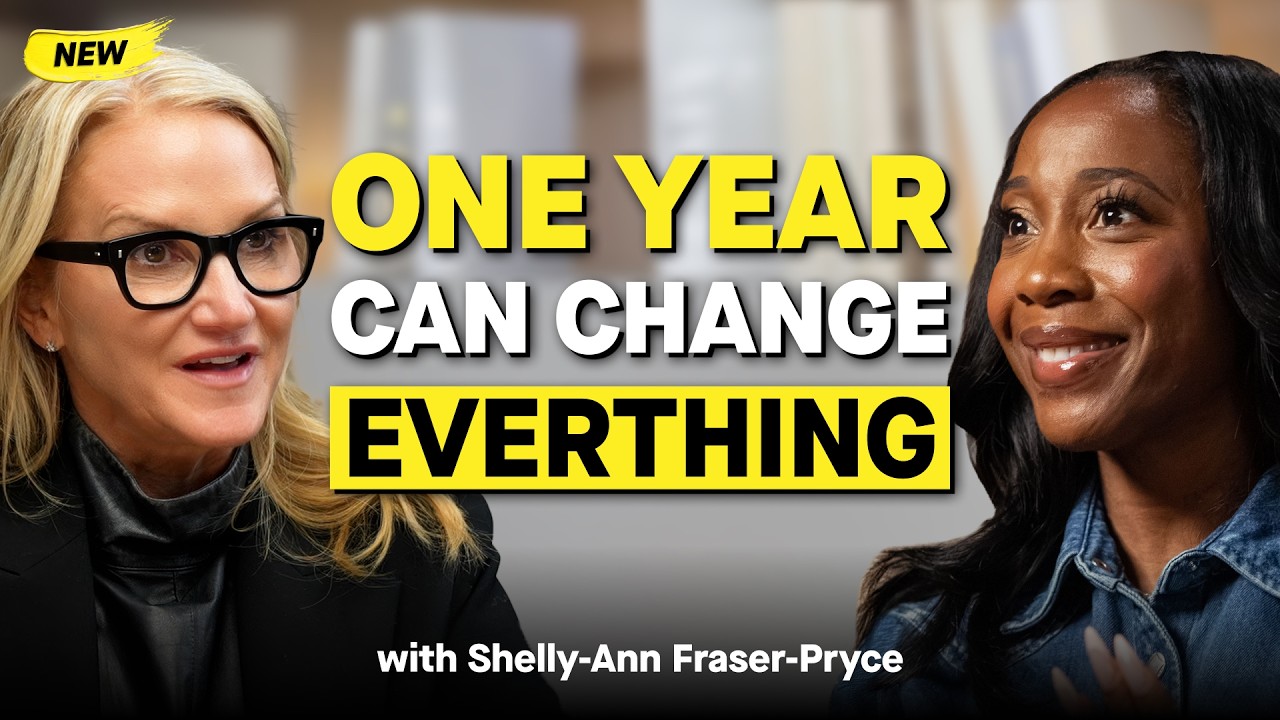
Shelley-Ann Fraser-Pryce was not supposed to be on the track at the 2007 World Championships in Osaka. She was sixth on the relay squad for Team Jamaica, which meant she would only run if someone ahead of her got hurt or dropped out. She was there, she later admitted, just to be there. Her dreams were small. Her confidence was small. And when the coach called her name to run the heats, she cried because she did not want to be responsible for anyone else’s race. A year later, she crossed the finish line in Beijing as Olympic champion, the first Caribbean woman to win gold in the 100 meters. What changed between those two moments is the entire point.
The Friday that has nothing to do with running
For all the medals and world records, the part of Fraser-Pryce’s story that tends to get overlooked is what happens on a Friday at training. Friday is not a running day. It is what her coaching staff calls mental training, a dedicated session where athletes sit, close their eyes, and run the race entirely in their minds before they have ever reached a starting block. She described the practice to Mel Robbins in precise, almost mechanical terms: she hears the crowd settling, she listens for the sound of other athletes placing their feet in the blocks, she feels the starter’s command land in her body, and she crosses the line, all of it, months before the actual competition.
‘Visualization is you putting yourself in a winning position before you have won,’ she said. She was quick to add that it is not a passive exercise and it does not come easily at first. Early in her training she would close her eyes and find herself mentally wandering off to KFC or the beach before a cue phrase pulled her back. Her cue, the line she returns to whenever her focus drifts, is a personal one: ‘Greater is he that is in me than he that is in the world.’ The point she pressed hardest was that this tool costs nothing. No equipment, no money, no vision board. You sit with yourself and you see it. A hard conversation, a presentation, a friendship that needs to end. You do it in your mind first, and it becomes easier after.
When failure tells you how
In 2016, heading into the Rio Olympics and chasing a third consecutive gold medal, Fraser-Pryce fractured a sesamoid bone, one of two tiny bones beneath the big toe responsible for the explosive power a sprinter generates out of the blocks. She could not fit her foot into her spike. She could not practice normally. The surgery she had scheduled for January 2018 never happened because she discovered she was pregnant, and she later said, with full seriousness, that her son saved her career. Removing those bones would have left her with no drive-power at all.
In Rio she won bronze, not the gold she was chasing. Two years later she had her son. Two years after that, at 35, she stood at the World Championships in Eugene, Oregon among competitors more than a decade younger, ran a 10.67, and screamed.
What she described about failure was not motivational shorthand. It was tactical. ‘Failure tells you how,’ she said flatly, and meant it literally. When the normal approach stops working, failure is the information that shows you which door is still open. She went to the pool. She lifted heavier. She rebuilt around what she could do. The 2019 World Championship gold in Doha, won two years after giving birth, is the medal she prizes most, partly because it demonstrated something she believed the sport needed to see: that motherhood does not end a sprinting career. She noted that perhaps two or three women in the history of elite sprinting have dominated at the global level after having a child. She is one of them.
The one thing she says to do when the doubt starts
When asked what a person should do the moment they finish listening, Fraser-Pryce gave a single word: decide. Not plan, not visualize, not write it in a journal. Decide. She drew a clean line between motivation, which she said changes daily and cannot be trusted as a foundation, and standards, which do not. On days she does not want to train, it is her standards, not her mood, that get her to the track at 5 a.m. She recommended starting with something small enough to actually do. Make your bed. Have your coffee. Visualize for 20 minutes. Add something the following week. Let the routine build itself.
Usain Bolt, she mentioned in passing, once told her that watching her career made him feel like an underachiever.
The medal, still sitting there
The 2008 Olympic gold medal she brought to the conversation is heavier than most people expect when they hold it for the first time.
She won it at an age when critics said she was too inexperienced. She won the 2022 world title at an age when the same critics said she was too old. The medal does not resolve either argument. It just sits there, solid, with ‘retirement plan’ as its best description in her own words.
One year of being intentional. That is the distance between number six and Olympic champion. Fraser-Pryce is not offering that as inspiration. She is offering it as a data point from her own life, a specific, measurable span of changed habits and changed self-talk that produced a result the world could time with a stopwatch. The race is still there. The line is still open. You just have to walk up to it.