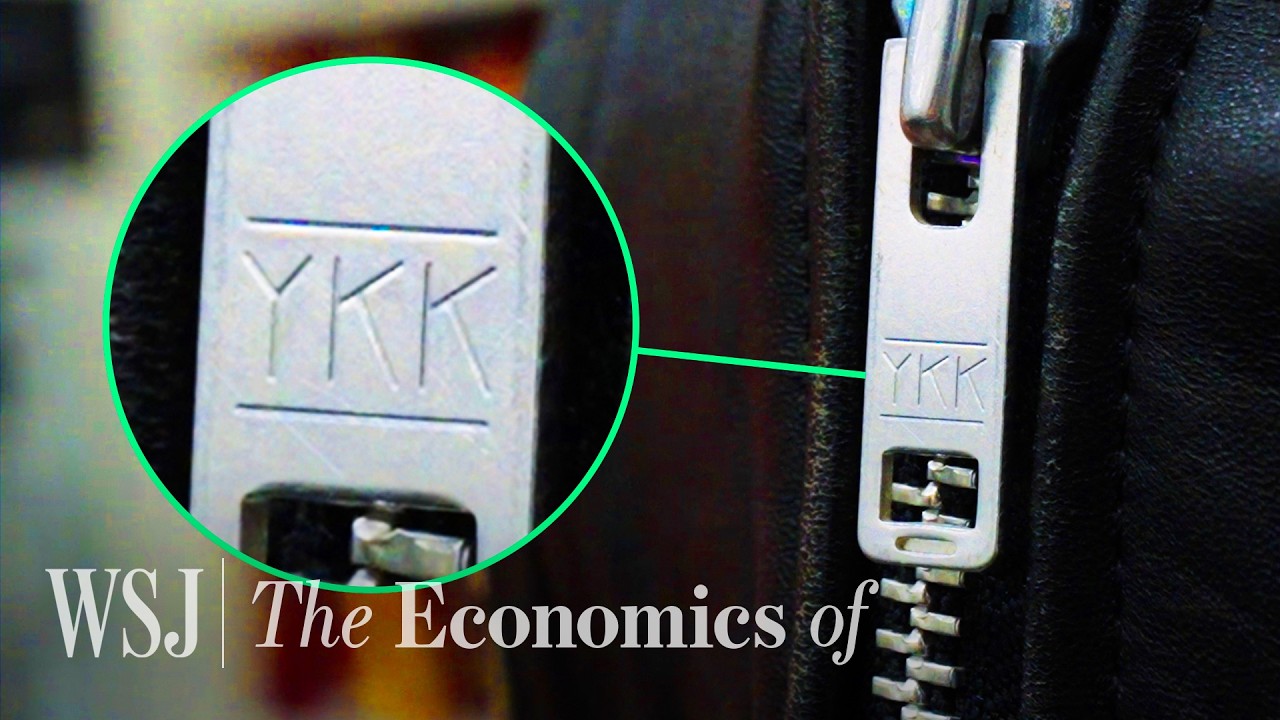
The zipper on a jacket, a backpack strap, a NASA spacesuit, and a US Air Force life preserver all carry the same three letters pressed into their pulls: YKK. Most people have seen those letters hundreds of times without once asking what they mean. The answer traces back to a single Japanese manufacturer that turned a mundane fastener into a multi-billion dollar global operation by refusing to let anyone else control how its product was made.
From a 1934 workshop to 10 billion zippers a year
YKK stands for Yoshida Kogyo Kabushiki gaisha, founded in 1934 by Tadao Yoshida. From the beginning, his fixation was not volume but process. ‘He was very, very conscious about quality,’ said a company representative, ‘not just the product, how we make it, with what material we use.’ That philosophy eventually produced more than 100,000 zipper types offered in Japan alone, a range wide enough that a 1950s souvenir jacket and a modern anti-exposure dry suit can both find exactly what they need from the same manufacturer.
The structural reason YKK can sustain that variety is vertical integration taken further than most competitors attempt. The company developed its own production machinery and proprietary technology in-house rather than outsourcing the manufacturing of the machines themselves. When Chinese competitors began undercutting on price, YKK’s response was not to move production offshore but to engineer new machines capable of making cost-competitive zippers without any quality failures. That machine-building capability became, as the company put it, ‘our priority.’
The Georgia plant that keeps pilots alive
When YKK established its US operation in 1960, Japanese imports carried a specific stigma. ‘Sometimes a import from Asia was taken as cheap garbage,’ one executive recalled. YKK stayed. While American manufacturers moved production offshore through the 1970s and 1980s, YKK dug in deeper, and by the late 1980s had reached number one in the US market.
That presence now has life-or-death consequences. Frank Stagliano has spent 11 years selecting materials for Switlik’s survival gear, roughly 60 percent of which is made for the US military. Anti-exposure dry suits depend on a watertight zipper as the barrier between a functioning suit and one that lets water in and compromises the wearer’s survival. For a US Air Force life preserver called the Switlik LPU-10 Mark 2, YKK and Switlik jointly developed a quick-burst zipper design: yellow elements that rupture on inflation and allow the life preserver to expand instantly. The Georgia facility makes that partnership legally possible. Military supply chain regulations require US-sourced components, and YKK’s domestic plant keeps Switlik compliant.
‘YKK is the go-to manufacturer for those extremely high-performing zippers,’ Stagliano said. The decades-long relationship, he added, built a specific kind of trust that a cheaper alternative simply cannot replicate.
The company’s growth has not been without friction. In 2007, the European Commission fined YKK and other zipper makers for price-fixing and customer allocation. Courts reduced the fine on appeal but largely upheld the findings. YKK told the Wall Street Journal: ‘We view these matters as important reminders of the need to continually strengthen compliance, internal controls, and fair business practices.’
The quick-burst zipper on the LPU-10 Mark 2
The yellow burst elements on the Switlik life preserver sit inert until the moment they are needed, sewn into a product most people hope they never have to use.
YKK now operates in 69 countries and regions and has expanded into architectural products and equipment development, building toward what the company describes as a need to ‘challenge totally new businesses’ as older markets mature. The three letters on the zipper pull, pressed into metal for less than a second of anyone’s attention, are the surface of something considerably larger.