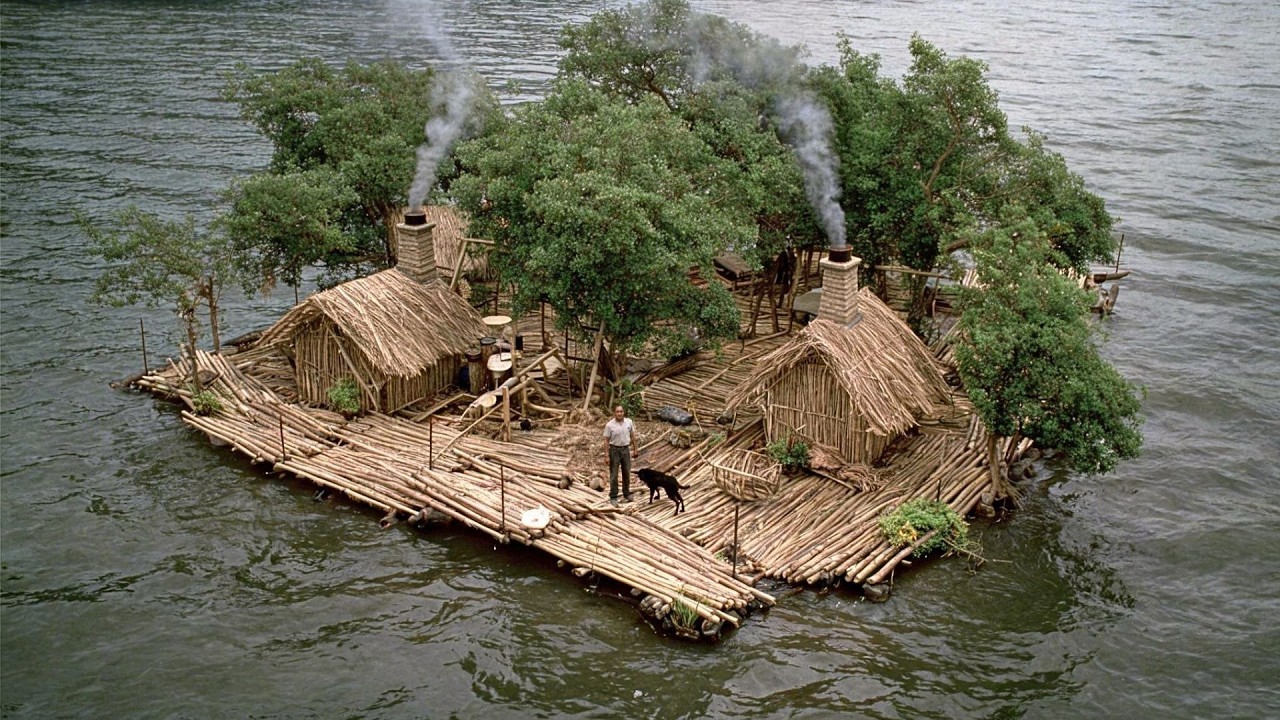
The first shore was too steep and rocky to build on. So he loaded his dog into a makeshift raft, paddled to a flatter sandy bank, and started cutting bamboo. That simple relocation was the first of hundreds of quiet decisions that would, over the next twelve months, turn an empty lake in the rainy forests of Vietnam into a floating homestead with gardens, a fish farm, live chickens, a beehive, and a rice field that rose and fell with the water. The question the whole project rested on was whether raw skill and patience could outpace every season the wilderness threw at him. It very nearly did not.
How a floating floor gets built without a single nail
Bamboo drove every decision from the first week. Strong, buoyant, and growing on every bank, it became structural timber, lashing cord, roofing shingle, planter box, and eventually a pedal-powered boat. To create a flat deck from hollow bamboo cylinders, he made precise lengthwise cuts that allowed each tube to unroll flat, a technique that produced a durable, waterproof surface without any milled lumber. The main shelter above it used traditional mortise-and-tenon joinery, square holes hand-carved to accept matching wooden pegs, assembling a rigid frame with only a knife, a small saw, and a hammer. When it came time to haul hundreds of pounds of bamboo shingles onto the completed raft, he engineered a lever crane from the same material, reducing what would have been hours of backbreaking carries to a series of controlled lifts.
Building on water was not just an aesthetic choice. As the rainy season approached, pythons and other animals would seek dry ground, making a land shelter a target. A floating home removed that threat entirely while also simplifying the movement of heavy materials across the lake. Three weeks after the initial build, he relocated the whole raft to a resource-rich area with deeper water and better timber nearby, then reinforced the platform before the first serious storms arrived.
When survival gives way to something closer to farming
The shift from gathering food to producing it happened in stages. A spear gun and a hand-fashioned diving mask opened up the lake’s deeper fish. Traps baited along high-traffic jungle paths caught a pair of wild chickens, which he raised on the extended platform inside a purpose-built coop, feeding them protein-rich grubs pulled from rotting logs. A bamboo pool lowered through a deliberate gap in the raft’s center filled naturally with lake water and became a fish farm, its first long-term resident a catfish raised for months before harvest.
The rice field came next and was his most complex project. He lined a floating bamboo platform with large banana leaves to hold soil, then mixed composted leaves and stove charcoal into a homemade fertilizer. Three to four months of tending followed before the plants went golden. Harvesting required a sequence of hand-built tools: a wooden box for threshing the stalks, a woven bamboo mat for drying the grain in the sun, a fire-hardened mortar, and a foot-powered trip hammer that used body weight to crack the hulls. The final step, winnowing, meant tossing the mix into the air and letting the wind carry the husks while clean grains fell back into a bamboo tray. As he put it at that moment of completion: ‘He has finally done it.’
The lift net that came later may have been his most efficient invention. A wide mesh resting just below the surface, nearly invisible in still water, was raised by hand-carved wooden pulleys when fish gathered above it. He added a hook light at night, whose glow drew schools of fish directly over the trap. The first real catch from the net was paired with a fresh-grown loofah from the vines climbing his pergola and chilies from the deck garden, his first complete meal drawn entirely from systems he had built himself.
When the pedal boat grew too slow and unstable, he felled a log, cut it into planks, and shaped a canoe using a design inspired by traditional Vietnamese fishing boats, sealing the hull with natural latex tapped from a tree on the mainland. Two small kittens adopted the raft after smelling the rice harvest, and he went looking for them with a woven basket when they disappeared for two days, finding them sheltered near a waterfall.
The beehive he moved with his bare hands
The wild hive was the riskiest hour of the entire year. Finding a colony inside a felled tree, he opened the log completely unprotected, located the queen with his bare hands, and placed her inside a purpose-built box fitted with removable frames so future honey harvests would leave the colony intact. The rest of the swarm followed the queen in.
By month ten, the raft carried a main shelter, a reinforced kitchen cabin with a dense clay stove, a canoe, a stocked fish farm, a working lift net, two chickens, two cats, a dog, a beehive, climbing vegetable vines, a second vegetable garden mulched with dried straw to prevent soil washout, and a harvested rice supply. He crafted a new low table and a drinking cup from fresh green bamboo, the final refinements of a home that had moved well past survival.
The two cats that nearly didn’t make it back
Both kittens sheltering near the waterfall caves, unhurt, waiting. He carried them home in the basket he had woven that morning.
Twelve months earlier, the first shore had been too steep to build on. He found a better one.