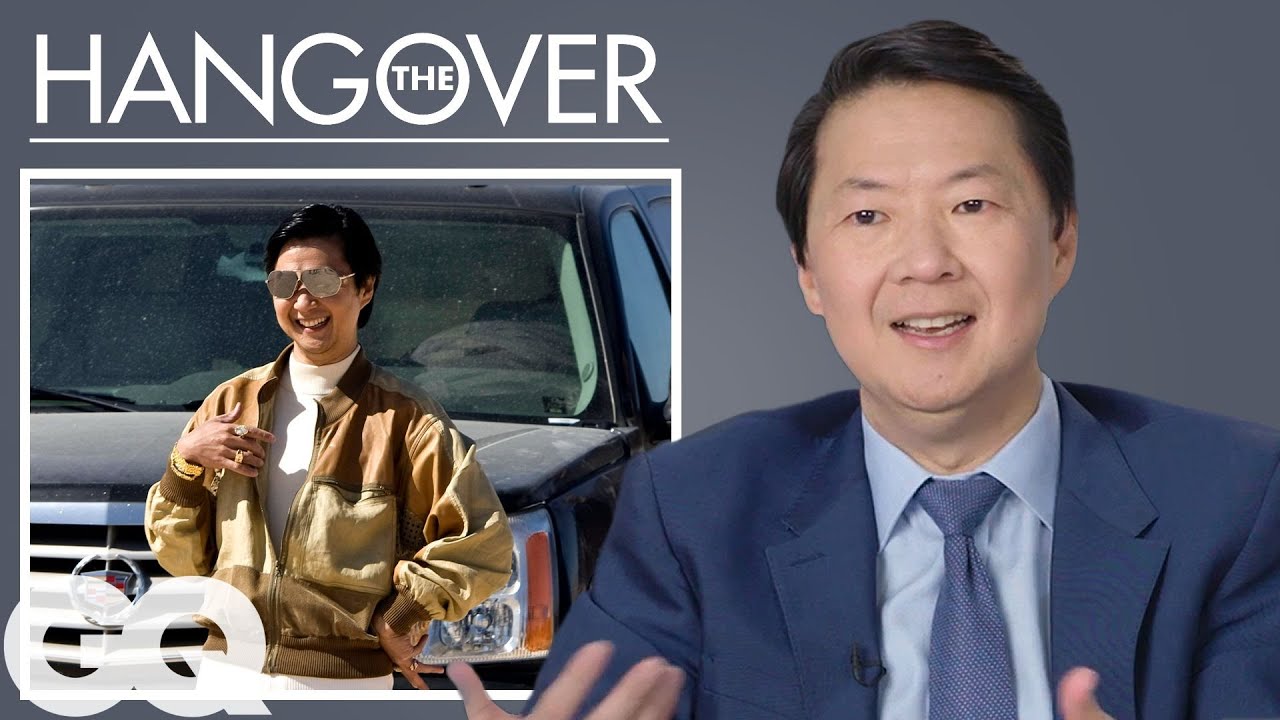
Ken Jeong was standing at an ATM in the Mojave Desert at dawn when a man in a sedan locked eyes with him through a half-cracked window and just stared. The light turned green, and as the car pulled away, the man made a small gesture that Jeong now gets every single day. That was the moment he knew ‘The Hangover’ had changed everything. The film did not just open doors for a working doctor-turned-actor; it blew them off the hinges, turning a guy who had been a pretty anonymous character actor into someone who would spend the rest of his life being recognized as Mr. Chow.
How a naked jump from a car trunk became his most famous scene
The idea to go fully naked in ‘The Hangover’ was Jeong’s own. The script had Mr. Chow in slacks when he burst out of the trunk, and Jeong felt that landing fully clothed would waste the moment. He ran the idea past his wife, Tran, before he ever pitched it to director Todd Phillips. Her response was immediate: ‘It’ll be the feel-good movie of the summer, because every guy will go home feeling good about themselves.’ Phillips, who has a notably deep voice, signed off with what Jeong describes as genuine enthusiasm, then made him sign an agreement confirming the nudity was entirely his own voluntary idea and that he could not change his mind. Jeong did at least 35 to 40 takes, jumping from different angles, and he still calls the finished film his Sergeant Pepper: ‘It changed my life from black and white to Technicolor.’
Before any of that, ‘Knocked Up’ had cracked the door open. Jeong put himself on tape for Judd Apatow and then heard nothing for three months. He assumed he had not gotten the role. When a producer finally called, production was already underway; the offer was simply to attend a table read with Seth Rogen, Jonah Hill, Jason Segel, Craig Robinson, and Adam Scott. Jeong calls it ‘The Avengers of comedy.’ He describes the preparation for that role with unusual specificity: he modeled the performance on a few doctors he had not particularly liked working alongside, and he actually wrote their names on the script to lock himself into the right register of authority and cold condescension. Apatow gave him a free reel at the end of a shoot day, and the resulting five minutes and 46 seconds of pure improvisation became a DVD feature called ‘Cooney Gone Wild.’
The role that turned him into a better writer than an actor
Community was, by Jeong’s own account, his conservatory. He arrived from film sets where improvisation was encouraged and very nearly derailed the show in his first scene as Senor Chang, when he turned Dan Harmon’s carefully written words into an unscripted monologue. Harmon was furious. Jeong stopped improvising, and in doing so discovered something: he found out exactly who he was as an actor. He describes that restraint as the beginning of real confidence, the difference between throwing out the kitchen sink on every take and learning to pick his spots.
When Dr. Ken was cancelled, director Jon M. Chu called within what felt like moments, and Jeong was on a flight to Singapore and Malaysia to shoot ‘Crazy Rich Asians.’ The film became the number-one movie three weeks running and the biggest romantic comedy in a decade, the first all-Asian American cast in a major Hollywood studio film since ‘The Joy Luck Club’ 25 years prior. He quotes his co-star Nico Santos on what it meant: ‘A rising tide lifts all boats.’
The Masked Singer, which is his mother’s favorite show, came next, and Jeong leaned into the confusion completely. His approach was to guess as stupidly and freely as possible: ‘Senator Chuck Schumer, welcome to the Masked Singer.’ His manager, who went to every single taping supposedly for moral support, ended up texting Jeong mid-show with his own frantic theories about who was behind each costume.
The script with names on it
Somewhere, there is a working copy of the ‘Knocked Up’ script with the real names of Jeong’s least-favorite former colleagues written into the margins as character notes.
Jeong wrapped his Netflix stand-up special after 17 years away from the form, which he describes with the same academic framing he applies to everything: if community was his acting school and Dr. Ken was his fellowship, the special might be his post-grad work. He is not entirely sure the metaphor holds, but he keeps reaching for it. It is his way, he says, of finding a deeper meaning in the work than fame or fortune. Something that feeds here, he adds, gesturing at wherever he keeps the part of himself that was once just a Korean kid who thought he would be a doctor forever.