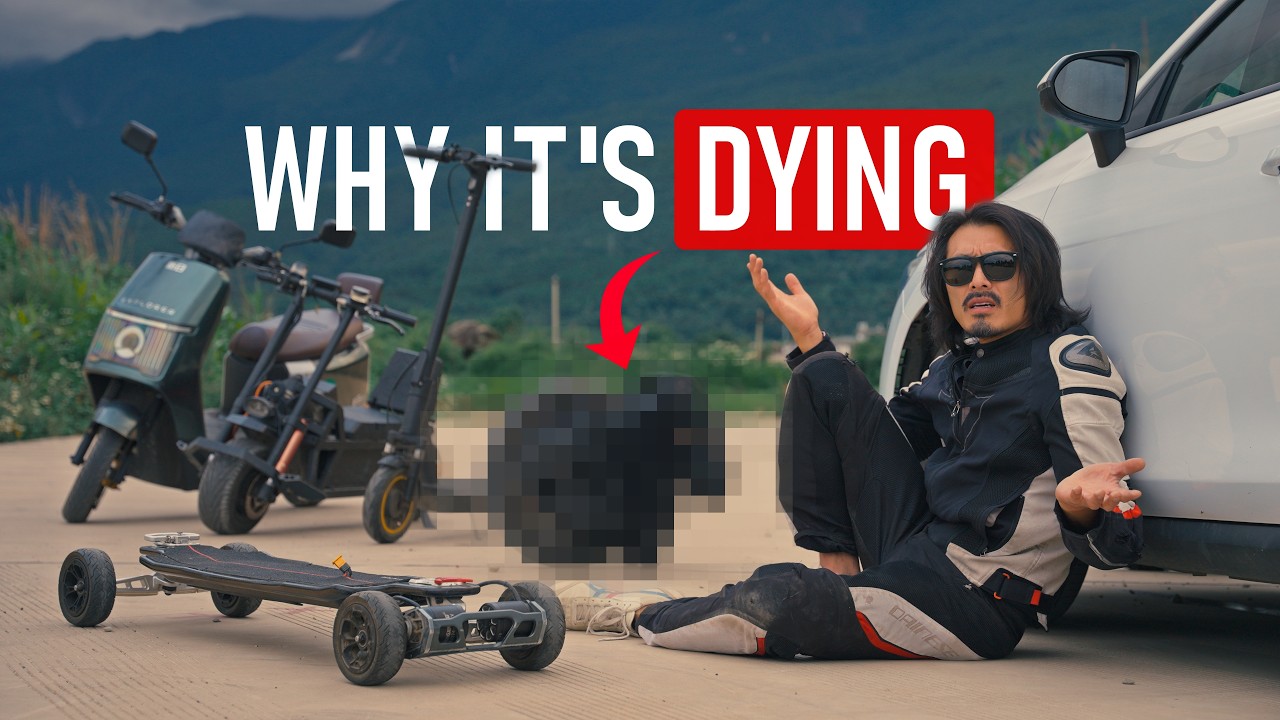
Kuji Rolls has ridden almost every personal electric vehicle ever made, and he will tell you without hesitation that the electric unicycle is the most capable and compact one among them. It also happens to be the one almost nobody wants to ride. That contradiction sits at the center of a machine that can hit 90 mph, weighs roughly as much as a dog, and still struggles to attract a mainstream audience despite more than a decade on the market.
Pound for pound more powerful than a Tesla Model S Plaid
The case for the electric unicycle, also called the EUC, starts with the numbers on the Inmotion P6. Top speed of 90 mph. A weight class that no other vehicle comes close to matching at that performance level. The larger tire and built-in suspension mean it handles terrain that would stop a kick scooter or an electric skateboard cold. Kuji Rolls describes riding one as ‘the closest thing I’ve experienced to snowboarding, which is actually my true love,’ a comparison that captures the carving, leaning, full-body feel of the machine in a way that raw specs cannot.
The EUC did not appear from nowhere. In 2011, hoverboard inventor Shane Chen removed one wheel from the two-wheeled personal transporter format and the electric unicycle was born. Shane Chen later described the worldwide response to his Solo Wheel as ‘awesome,’ and he was not wrong about the enthusiasm, at least among early adopters. Kuji Rolls was one of them, and by 2017 he had packed his bags for Beijing to join Segway’s innovation team, helping design their next EUC in hopes of pulling more riders in. Segway ultimately decided the market was too small and pivoted, now manufacturing roughly 80 percent of the world’s kick scooters. Smaller companies kept building, and modern wheels are now up to nine times faster with 20 times the range compared to where EUCs stood 15 years ago.
Four objections that keep the curious on the sidewalk
Kuji Rolls has spent years trying to recruit new riders, and four concerns come up almost every time. Balance is the first. The honest answer is that it takes real time, somewhere between a few minutes for an experienced skateboarder to several hours for someone who has only ridden a bike. Safety is the second. The machines can exceed 50 mph, and Kuji Rolls is direct: riders should not approach those speeds until they have thousands of miles logged and have already handled a crash or two. ‘Confidence grows quicker than skill,’ he notes, which is the part that actually creates danger. Cost is the third barrier. A quality EUC runs around 3,000 dollars, an investment that only makes sense if the machine replaces a primary commute rather than sitting in a garage as an expensive novelty. Expect roughly five years of use and tens of thousands of miles before the math turns in your favor. The fourth concern is legality. Because most traffic laws define vehicles by handlebars, foot decks, and wheel count, the EUC falls into a category that existing legislation often does not address at all. In practice, as Kuji Rolls puts it plainly, most police do not intervene unless a rider is ‘riding like a dick.’
Manufacturers are working on the access problem. A two-wheeled training variant has recently appeared that lets new riders understand the balancing mechanics in minutes before stepping up to a single wheel. Design has also improved: wheels like the Ninebot Zino have begun to shed the awkward appearance that dogged earlier models.
The training wheel that still cannot handle a bumpy road
The two-wheeled entry model is limited in steering and struggles on rough pavement, a real constraint that Kuji Rolls names honestly. It offers a taste of the experience without delivering the full thing.
The electric unicycle will probably never challenge the bicycle for mass adoption. But for the small slice of riders willing to commit the time, the gear, and the learning curve, the machine offers something the rest of the personal EV market has not managed to replicate.