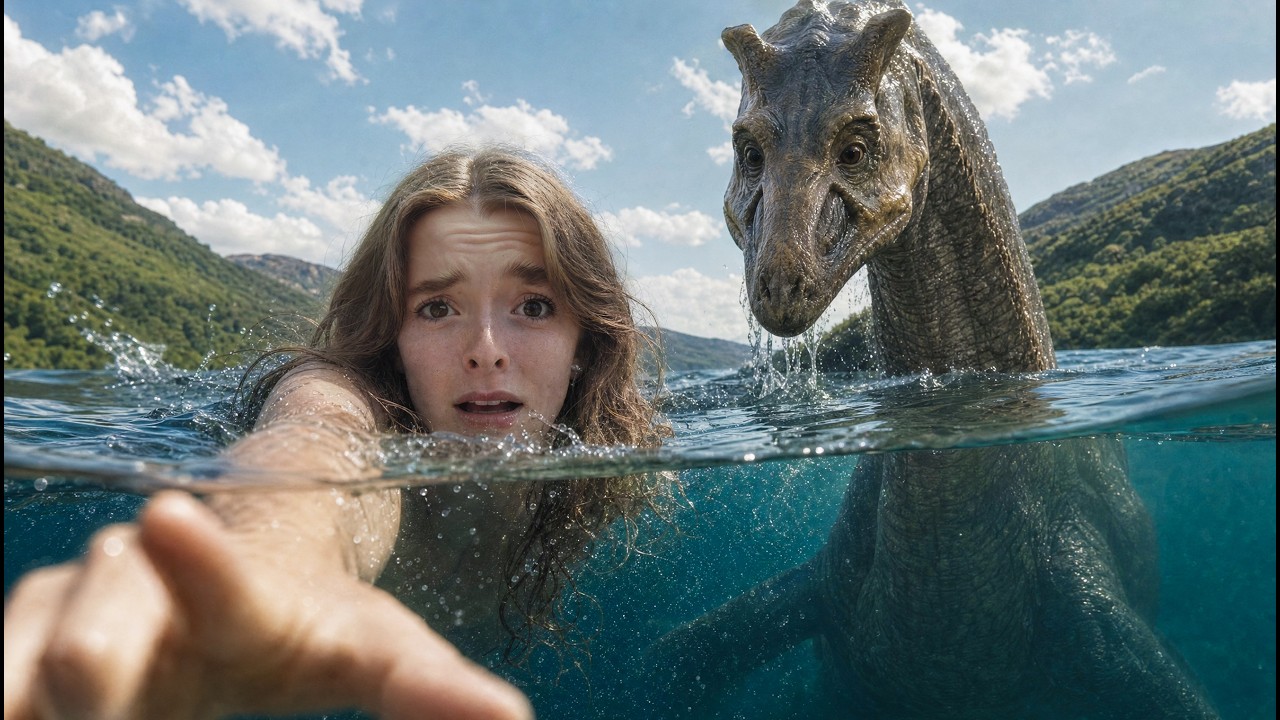
Seven years ago, Maria Kallevik made her first VFX shot at a tiny lake near home, with a friend’s little brother she basically had to bribe into acting and her mom wrestling a green screen into submission. The result was not a masterpiece. But the gap between that first attempt and what she just pulled off at the real Loch Ness in Scotland is the kind of distance that makes people scream out loud, which is exactly what happened when her collaborator Eric watched the original footage back.
A four-hour drive and a monster called Messi
After flying into Edinburgh and making the four-hour drive north, Maria and her crew arrived at Loch Ness and started shooting immediately. There were running shots along the shore, thirty minutes spent on a single close-up of Maria stopping mid-stride (a take she ultimately never used), and reaction shots of her pretending to pet a creature that did not yet exist. For the higher-angle footage, Eric climbed onto the shoulders of their friend Luke to get the framing right. Maria, reflecting on that moment on the lakeshore surrounded by people who genuinely cared about the project, noted how different it felt from the original shoot. Back then, she was completely alone in her interests. ‘I think 16-year-old me would be so, so happy if she knew it was only temporary,’ she said, ‘that eventually one day she’d find her people.’
Nessie herself, affectionately nicknamed Messi on set, needed to be built from scratch. Rather than reusing the ready-made 3D model from the original shot, Maria commissioned a custom sculpture from Marvin and Till, two artists who have worked on major film productions and were part of creating Baby Groot. Her brief called for a long neck, detailed skin, a ridge-like structure on the back, a slim face, pointy ears, and dinosaur-like textures. The goal was not a monster but something that looked like a friend. A few weeks later, the model arrived and matched the description exactly.
Seven hours to simulate, twelve hours to render, four days on one shot
The water simulations nearly ended the project. Maria had avoided Houdini, the industry-standard simulation software used on major films, since her first attempt seven years earlier. She enrolled in a beginner course, breezed through it, then opened the advanced water course and described the jump in difficulty as going from learning two plus two to quantum physics. Eric stepped in with private tutoring. The jumping shot alone required a seven-hour particle simulation, a separate five-hour mesh conversion, and a twelve-hour render. The shot where Nessie slowly emerges from the water took four days of adjustments, including a second simulation layered on top of the first, before the water slid off the creature’s body the way it needed to. Nine shots total, across three agonizing weeks.
In compositing, Maria imported the Houdini renders into Nuke, rendered Nessie separately in Blender to fix flat lighting, then layered in her shadow, her reflection, and a dripping water effect for realism. For the close-up where Maria touches Nessie’s nose, she extended the frame in Photoshop, rotoscoped her own hand, added shadow contact points, and darkened the skin slightly where the fingers land. The practical assets Eric’s family helped film at a cabin, rocks splashing into dark water late in the evening, were cut in during the jumping sequence for extra weight.
Two months after the Loch Ness trip, the project was done. The crew also adopted a dog during the final render wait, and named her Missy.
The desk that nearly collapsed through all of it
For the better part of those two months, Maria worked at a desk she described as likely to collapse at any moment, in an office with no curtains, making daytime work nearly impossible. A shared green screen kept migrating toward Eric’s side of the room.
The final composite ran two months after the original Scotland shoot. ‘Even now with years of learning and months of work on this project, it’s still not perfect,’ Maria said before the reveal. ‘And honestly, I think that’s okay.’
Missy the dog, named after a digital lake monster, was asleep somewhere off-screen when the render finally finished.