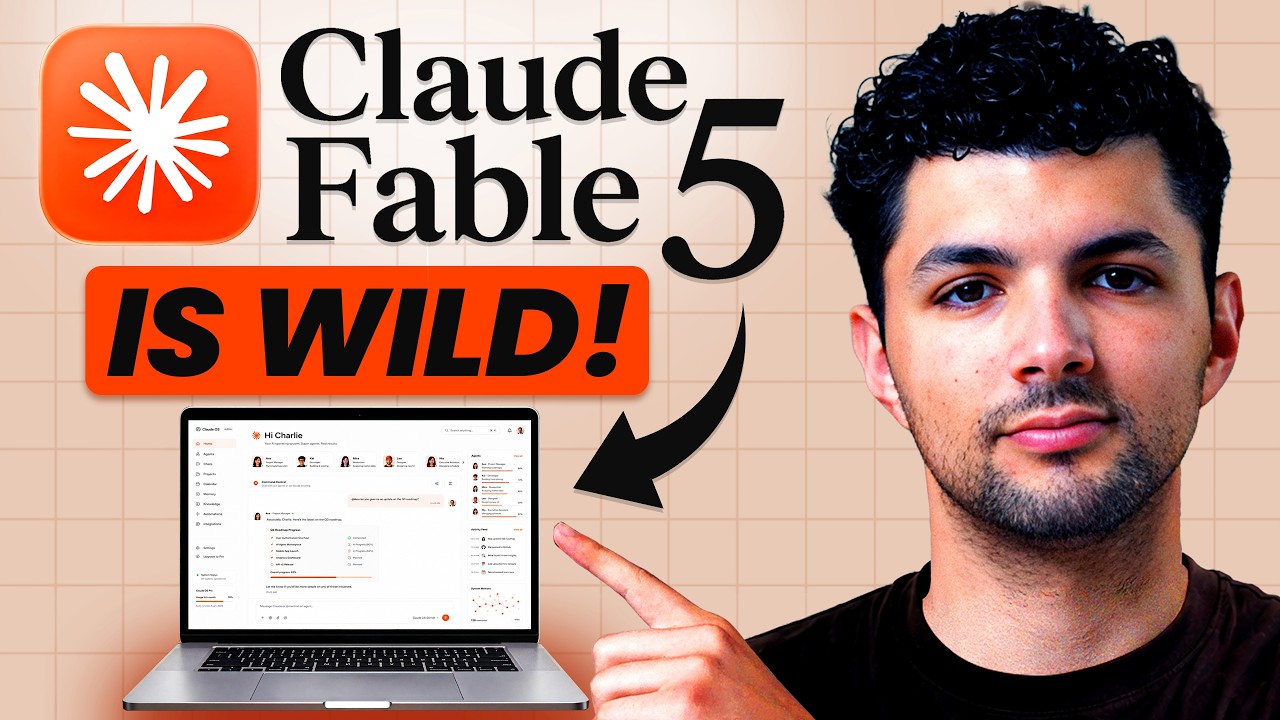
Charlie Chang uploaded 17 photos of his real office and typed four prompts. What came back was a navigable 3D environment, complete with the guitar on the wall that he had forgotten was even there. That moment, a model noticing a detail the human missed, is the clearest early signal of what Claude 4.5 actually is. Anthropic released the model in August 2026, and for anyone who builds things on a computer, the gap between this and every prior release is wide enough to change daily workflows.
A model that started life behind a locked door
Claude 4.5 belongs to what Anthropic calls the Mythos class, a tier the company had previously kept entirely off the public market. The reasoning was blunt: the underlying model showed capabilities in cybersecurity and biology that, without safeguards, could be misused in serious ways. The public version of Claude 4.5 handles that tension by routing sensitive biology and cybersecurity queries back to an older model automatically. The full unsafeguarded Mythos build remains available only to vetted enterprise partners working directly with Anthropic.
What cleared the guardrails is already striking. The model beat Pokemon Fire Red using only its vision, meaning Anthropic placed the game on a screen and let it navigate without any game-state data feed. It can generate solar system simulations and predict solar eclipses. In one documented case, it helped accelerate a drug design process by roughly ten times. On the practical side, the jumps in agentic coding, spatial reasoning, tool use, and multidisciplinary reasoning are measurable across benchmarks, though Chang is quick to note that benchmarks alone rarely tell the whole story.
Four prompts, one 3D office, and a landing page with taste
The office reconstruction is useful to understand because it shows the model’s spatial reasoning working on real-world, unstructured input. Chang fed it 17 images, no floor plan at first, and the model returned a walkable 3D environment that correctly placed rooms, identified a sink and a table, reproduced a poster reading ‘No Risk, No Rari’, and caught the guitar. The accuracy surprised even him.
The landing page test pushed harder. Chang asked Claude 4.5 to build a site for a fictional minimalist headphone brand called Academy, specifying GSAP and Three.js for motion, a light and luxurious color palette, and heavy scroll effects. He told it to act as creative director. After roughly 17 to 18 minutes of uninterrupted work, the model returned a brief before touching the code: ‘ivory and bone tones, champagne metal accents, huge editorial serif typography, and a structural 3D headphone floating through the page as a single hero object choreographed entirely by the scroll.’ Then it built it. Then, without being asked, it scrolled through its own output, took screenshots, identified problems, and kept revising.
Chang put it plainly after watching the scrolling headphone demo load in the browser: ‘I think all the previous models did not have taste, but something feels really different here.’
For ongoing work, the Claude desktop app connects directly to Google Drive, GitHub, Figma, Canva, Notion, and dozens of other tools. The routines feature lets users schedule repeating tasks, local ones run on the machine, remote ones run in the cloud, which means the model can handle weekly or daily computer work autonomously once it is set up.
The guitar nobody mentioned
In the 3D reconstruction of Chang’s office, there is a film room with a board and a guitar on the wall. Chang had not included it in his instructions. The model pulled it from one of the 17 uploaded images and placed it in the correct room anyway.
The landing page it built for Academy is still sitting in a browser tab somewhere, ivory tones shifting to champagne as the headphones drift down the scroll, an email capture at the bottom, all from a single prompt to a model that taught itself what the brief should look like before it wrote a line of code.