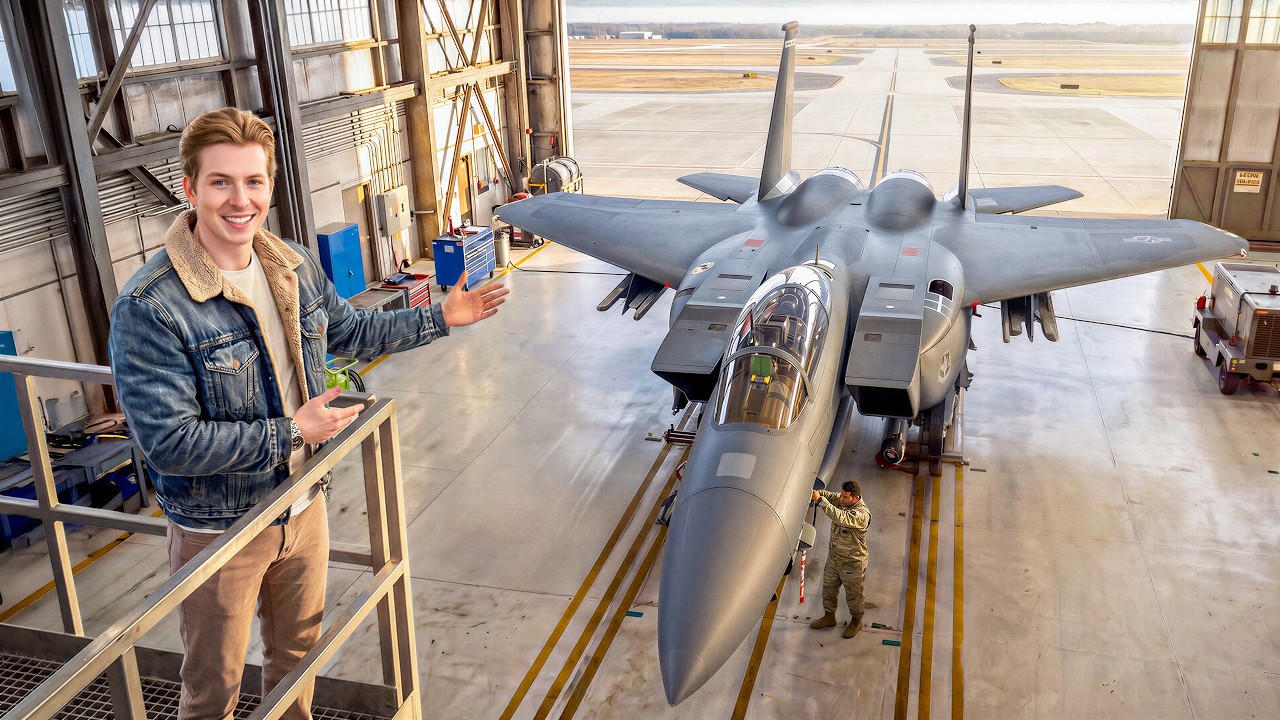
Inside Boeing’s Building 75 in St. Louis, a fighter jet sat on the hangar floor with a name stenciled on its fuselage that had no business being there: Sam Eckholm. The F-15EX is the US Air Force’s newest and most advanced version of the legendary Eagle, and for a brief, physics-defying afternoon, a civilian was in the backseat helping put it through the paces of an official Acceptance Check Flight. For anyone who has wondered why the Air Force is still building a jet whose lineage traces back to 1972, the answer turns out to be less about nostalgia and far more about what nothing else in the sky can carry, sustain, or survive.
The story of the EX begins with a 106-to-zero record. Over five decades, F-15 variants have shot down 106 enemy aircraft without losing a single airframe in air-to-air combat, a number that borders on the surreal. That legacy set the conditions for what Boeing engineers eventually assembled by combining everything learned from the F-15E Strike Eagle with upgrades developed for international Advanced Eagle variants: an AESA radar that can sweep the entire airspace and identify airliners the moment the jet levels off after takeoff, a 19-inch all-touchscreen glass cockpit running at 1080p, and fly-by-wire controls that give the pilot a vote while the computer interprets intent and executes it with precision the older mechanical systems never could.
What fly-by-wire actually changes in the air
Lieutenant Colonel Matthew Olde, call sign Cain, is an Active Duty Air Force test pilot stationed at Boeing St. Louis. When a new F-15EX rolls off the production line, the Boeing team flies it first, then hands it to Cain, whose job is to flip every switch, push the jet to the edge of its flight envelope, and even restart engines mid-air to confirm everything holds. He walked through the EX’s weapons loadout before the flight: twelve AMRAAMs distributed across four outboard stations, two inboard stations, and two shoulder stations on each side, plus a 20-millimeter gun capable of firing multiple round types, plus bombs. As Cain put it plainly: ‘Nothing carries more than the F-15EX.’ The reason is the one the jet makes no attempt to hide: it is not trying to be stealthy.
Before climbing in, the Boeing team demonstrated a full afterburner engine run inside the facility’s Hush House, roughly 80 feet of hollowed tunnel designed to contain the noise. Two General Electric F110-129 turbofan engines producing nearly 29,000 pounds of thrust each, combined to roughly 60,000 pounds total, lit off at full burner inside an enclosed space. The afterburner plume extends about 20 feet from the nozzle. Standing anywhere near that boundary made the demonstration feel less like a ground test and more like a controlled natural disaster.
The flight that tested everything at once
The Acceptance Check Flight began with an unrestricted climb out of the St. Louis field, Cain noting that the engines run at max thrust through the entire departure. Cruise altitude reached 41,000 feet. From there the checklist unfolded in sequence: a supersonic speed run pushing past Mach 2 to verify the airframe handles the stress without failure, a deliberate spiraling free fall dropping 20,000 feet to stress-test the flight computers and engines under the worst aerodynamic conditions, a nose-high low-speed recovery that intentionally flew the jet into a full stall at 100 knots and let the computers bring it back, and basic fighter maneuver snap rolls simulating a break from a tail-pursuing enemy. When the fuel ran low, Cain linked up with a KC-135 Stratotanker for aerial refueling, then shut down one engine mid-flight and restarted it in the air to confirm combat engine-failure recovery.
The flight ended with Cain handing the controls to the backseat. The brake turn sequence, pulling the stick as hard as possible through a 90-to-110 degree bank, registered 8 Gs. In a legacy F-15, that kind of uncontrolled input risked bending the wings. In the EX, the over-G protection software stepped in, capped the load, and kept both the airframe and its unqualified passenger intact. The jet passed every item on the checklist. Cain’s official verdict: ‘We will buy it, test.’
The patch swap after landing
On the ramp after touchdown, a small exchange happened that the hangar tour earlier had quietly set up.
Before the flight, the Boeing team had stenciled Eckholm’s name on the side of the aircraft, a detail he noticed while familiarizing himself with the ladder he would climb again hours later. After landing, he pulled off his patch and swapped it for an Access Granite patch, the kind of quiet ground-level ritual that tends to follow a flight that, by the numbers, never should have included a civilian at all.