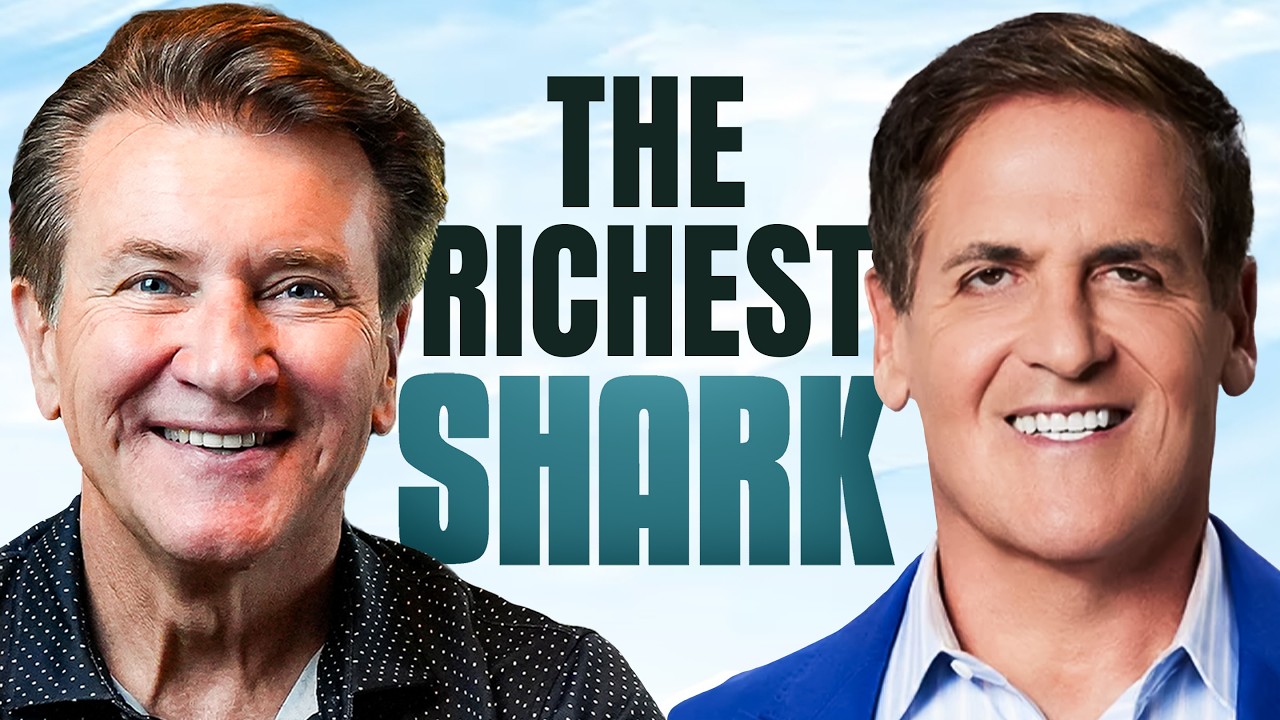
Robert Herjavec walked into his first day on Shark Tank expecting a billionaire in a nice shirt, maybe even a blazer. What he found was Mark Cuban in a t-shirt and jeans, tossing his stuff on the floor like he owned the place, which, effectively, he did. That image, the most powerful person in the room dressed like he had nothing to prove, stayed with Herjavec for 16 years and quietly rewired the way he thinks about money, competition, and what it actually means to win. Cuban, who recently sold 50% of the Dallas Mavericks for $2 billion after buying the team roughly 20 years ago for $200 million, was never trying to make a point with the t-shirt. He explained it simply: ‘because I can.’ That was the whole lesson.
The wardrobe, the jet, and what you are actually competing for
The first thing Herjavec catalogued from years sitting beside Cuban is that the person in the t-shirt usually holds more power than the person in the suit. The suit signals you are still trying to earn your seat. The t-shirt signals the seat was never in question. Herjavec, who by his own admission wore a suit and tie every day before meeting Cuban, did not abandon his collar entirely, but he absorbed the underlying logic: dress codes are a form of social negotiation, and the person who opts out has already won that negotiation.
The jet story cuts deeper. At a high school appearance with all five Sharks, a student asked Herjavec why he still worked so hard. Trying to land a joke, he said it was to afford a jet bigger than Cuban’s. Cuban, without a pause, said: ‘which one.’ He owned three. Herjavec went quiet, then spent two days thinking about what it meant that he had been silently competing with a friend over a single aircraft. The original goal of his working life, set when he was a broke immigrant in Canada, had been to make $1,000 for each year of his age and pay off his mortgage. Somewhere between that basement ambition and the Shark Tank set, he had drifted. ‘I’ve lost my purpose,’ he said. ‘I’ve become honestly a bit of a jerk.’
The three reasons to sell, the 24-second clock, and why speed is a truth serum
When a private equity firm offered Herjavec $100 million in cash for his cybersecurity company, he brought the dilemma to Cuban in a makeup chair between pitches. Cuban did not hesitate: there are only three reasons to ever sell a business. One, you no longer want to run it, because someone who does will outwork you. Two, you believe you have already reached the peak value of the opportunity. Three, the money will fundamentally change your life. Herjavec walked through each condition honestly. He still loved the business. He believed cybersecurity was nowhere near its ceiling. And $100 million, while enormous, was not going to change the shape of his days the way his very first sale had: a $600,000 exit that let him pay off his mortgage and gave him the psychological freedom to start again. He turned down the offer. A few years later, he sold a majority stake in the same company for many more hundreds of millions and retained 25% besides.
Cuban also introduced a different kind of pressure to the tank: the 24-second shot clock. Borrowed from basketball, where a team has 24 seconds to shoot or the possession ends, Cuban began attaching it to live deals. Mid-pitch, while other Sharks were still deliberating, he would make an offer and tell the founder the clock was running. The room froze the first time. The pitcher hesitated past 24 seconds and Cuban pulled the deal. Herjavec’s observation about why the tactic works is sharper than it sounds: ‘the less time people have, the more honest they are with their decision. Most people need time to formulate a lie.’
The remaining lessons follow a consistent logic. Business is a 24-hour contact sport with no off-season, and the bigger you grow the larger the target on your back. Time is the only commodity that cannot be recovered, which is why a private jet is not a status symbol but a time machine. When everyone in a room already knows the answer, the opportunity is gone. Trophies belong to winners, not participants, and on one Shark Tank deal Cuban admitted afterward he could not even remember the business he had just competed to win. ‘I just wanted to win,’ he said. And finally, the one that Cuban delivered in season four or five to an entrepreneur who assumed his success had always been inevitable: nobody remembers your failures. ‘I failed more times than I can remember, but I was right once. I sold my company for six billion dollars.’
The $600,000 sale he still considers his most important
Of all the financial moves Herjavec has described across his career, the one that comes back most often in this account is not the nine-figure exit. It is $600,000 and a mortgage paid off, a number so small by his current standards that it barely registers as a rounding error, but one that handed a scared immigrant the one thing money can actually purchase: the courage to try again.
Herjavec is 16 years into learning from the man in the t-shirt. The jet count still stands at one.