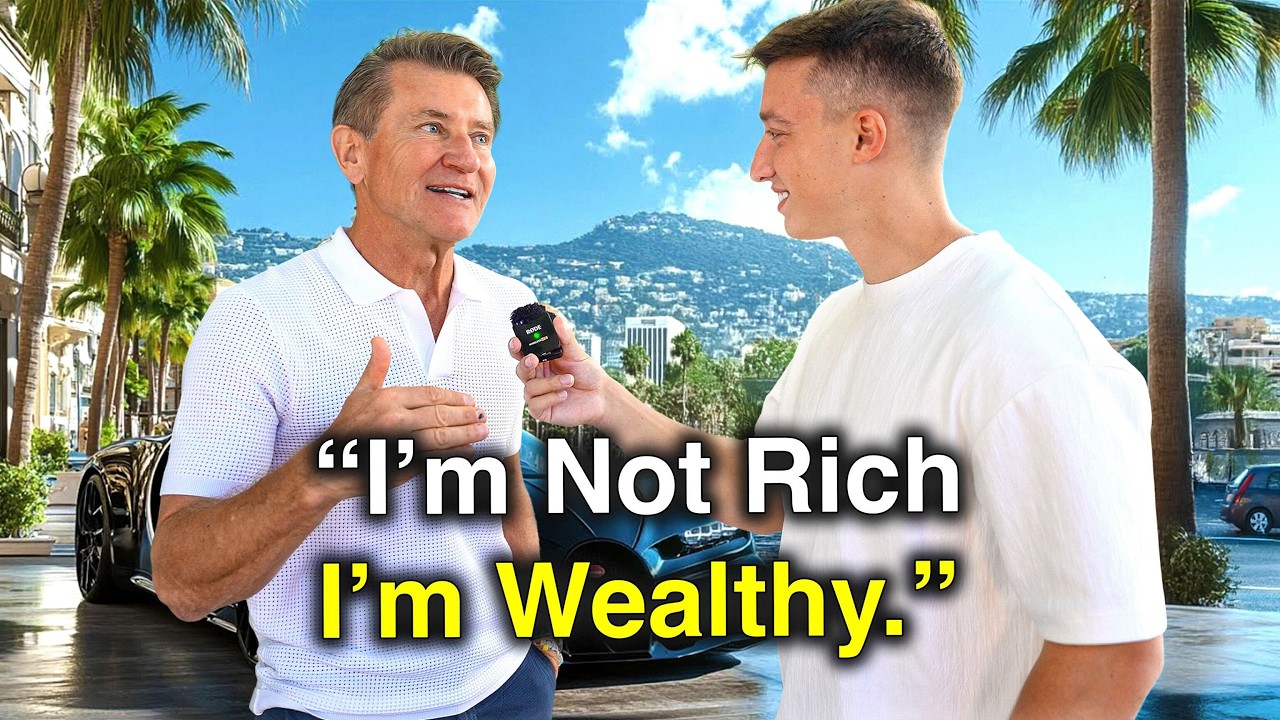
Robert Herjavec was standing on a Beverly Hills street when the question came at him straight: if he lost everything tomorrow, could he make it all back? ‘Yeah. No doubt,’ he said, without pausing. For anyone trying to understand how a kid whose parents crossed a border in the middle of the night ends up selling a cybersecurity company for hundreds of millions of dollars, that answer is the whole story in two words. The School of Hard Knocks crew had traveled to Beverly Hills to pin down the Shark Tank investor and cybersecurity mogul on the exact mechanics of how he got there, and he did not soften a single answer.
The income trap most people never escape
Herjavec‘s single most clarifying line came early in the interview. Asked about the most money he had ever made in one year, he said 500 million, then immediately corrected the frame: ‘But that included the sale of a business in capital gains. On an income basis, probably $18 million.’ The distinction is the entire lesson. ‘You can get very rich making income,’ he said. ‘It’s very hard to get wealthy making a big income. You got to have capital gains. You got to build something of value that you can sell.’
His first company sold for 30 million. His most recent sale ran into the hundreds of millions. None of it, he argued, came from a salary. It came from building equity and holding it long enough to matter.
On real estate, he passed along advice Charlie Munger once gave him directly: ‘If you want to become rich in life, never sell a house. Always keep every house.’ He said he has never lost money on real estate, and when pressed on whether you need significant capital to start, he was blunt. You need the ability to hang on. If a property can be held for ten years, the math works. The problem is liquidity.
What obsession actually looks like at the top
When asked what single trait the most successful people he knows share, Herjavec did not say discipline or work ethic. He said obsession. ‘Motivation is easy. Passion is easy. But all that stuff fades. Obsession lasts.’ He described it as the capacity to see the world not as it is but as you intend to make it, which he acknowledged is functionally indistinguishable from being a little crazy.
His sales philosophy follows the same logic of attention over pitch. ‘Biggest mistake people make in sales is they have a pitch and they apply that pitch to every single person,’ he said. ‘Before I open my mouth, before I tell you how great my product or I am, I got to know who you are. I got to know your need.’
And his answer on what matters more, what you know or who you know, was pointed: ‘What you know. Absolute.’ His parents had no connections. Every piece of conventional advice he received when he was 23 told him he needed money to make money and contacts to get contacts. His workaround was to become somebody worth knowing. ‘Build your own brand,’ he said. ‘Other people will come to you.’
Asked where to look for opportunity right now, he said AI without hesitation, specifically the data infrastructure layer rather than the consumer-facing tools. As a demonstration of how far the technology has come, he mentioned that his own AI model has been trained so thoroughly on his writing style that it now, in his words, ‘writes better than I do.’
For anyone doubting the cost of getting there, he quoted Elon Musk’s description of entrepreneurship as eating glass and staring into the abyss, then added that when his own sales manager was caught stealing from him for an entire year, fellow Shark Barbara Corcoran gave him the framework he still uses: ‘The difference between successful people and others is how long they wallow in misery.’ His own version of that took five minutes.
The man in the t-shirt
Herjavec’s parting principle was three words: ‘Sell joy.’ He described cold-calling clients early in his career when he understood almost nothing about the technical side of the business, and said the one thing he could offer was making people glad they picked up the phone. Whoever dealt with him remembered him as the fun guy. Emotion, he said, is not separate from business. It is the infrastructure beneath it.
The deepest quote he had heard, he attributed to a priest friend: ‘You will never find anything in life as fascinating as another human being.’ He said he tries to approach every conversation that way. It is also, he noted, the best sales training he has ever encountered.
The guiding principle still sitting in Beverly Hills
Before the Herjavec interview, a man outside a car show on Rodeo Drive said his house had burned down in the Palisades fire, and said that here of all places, people tend to believe they are defined by material things. He left a single question behind before walking back to his son: ‘What are you made of?’
Herjavec, still standing in the Beverly Hills sun a short while later, gave his version of the same thought. The biggest flex of wealth today, he said, is not a car or a jet. It is staying in shape. ‘If you’re not using your money to stay healthy, what’s the point?’
Two men, two different net worths, same afternoon, same street, same answer.