Reese Witherspoon was sitting across from studio heads, one by one, asking a simple question: how many films are you developing right now with a female lead? Every single one of them said they had nothing. One told her they had already made one movie with a woman at the center and could not make two that year. She went in angry and walked out seeing something else entirely: a massive gap that nobody with the resources to fill it felt any urgency to close.
That moment sits at the origin of Hello Sunshine, the company Witherspoon built from a four-person producing operation barely covering its overhead into a storytelling enterprise that reshaped what Hollywood believed women-centered stories were worth. The stakes were higher than a business plan. Her daughter was thirteen.
The problem nobody else was losing sleep over
Witherspoon had spent two decades inside the film industry before the frustration became unbridgeable. Around 2011, the scripts arriving for women had, in her telling, hit a particular low: poop jokes, boob jokes, two women competing for one man’s attention. She called her agent and said she was not auditioning. Her agent told her every actress in Hollywood wanted those parts. That was the point. There was nothing else.
She traced the structural cause herself. When the DVD market collapsed, it had removed roughly a third to forty percent of studio revenue almost overnight. Studios responded by shifting toward superhero tentpoles with massive budgets and global merchandising potential. The mid-range films that had historically centered women, romantic comedies, family dramas, thrillers in the thirty to sixty million dollar range, were the first cut from development slates. It was not malice. It was math, and nobody at the top of the system had a personal reason to fix it.
Witherspoon’s solution was to remove that dependency. She would come in with independent financing, option known IP, attach vetted filmmakers, and present a complete package. Her first two options were ‘Wild’ and ‘Gone Girl’, both of which reached number one on the New York Times bestseller list. Turned into films through her earlier production shingle Pacific Standard, alongside producing partner Bruna Papandrea, they generated three Oscar nominations and over six hundred million dollars at the box office. Then came ‘Big Little Lies’ with Nicole Kidman.
And yet, with that track record, she had four employees and was breaking even. The producer fees were not building anything.
Walking with purpose toward something people could follow
Hello Sunshine was formalized as a standalone company when Witherspoon moved past self-funding, pitched investors, and secured two of them before any sale. She gave equity generously to the team she recruited away from comfortable corporate positions, explicitly because she wanted them to feel the company was theirs and to win in the upside.
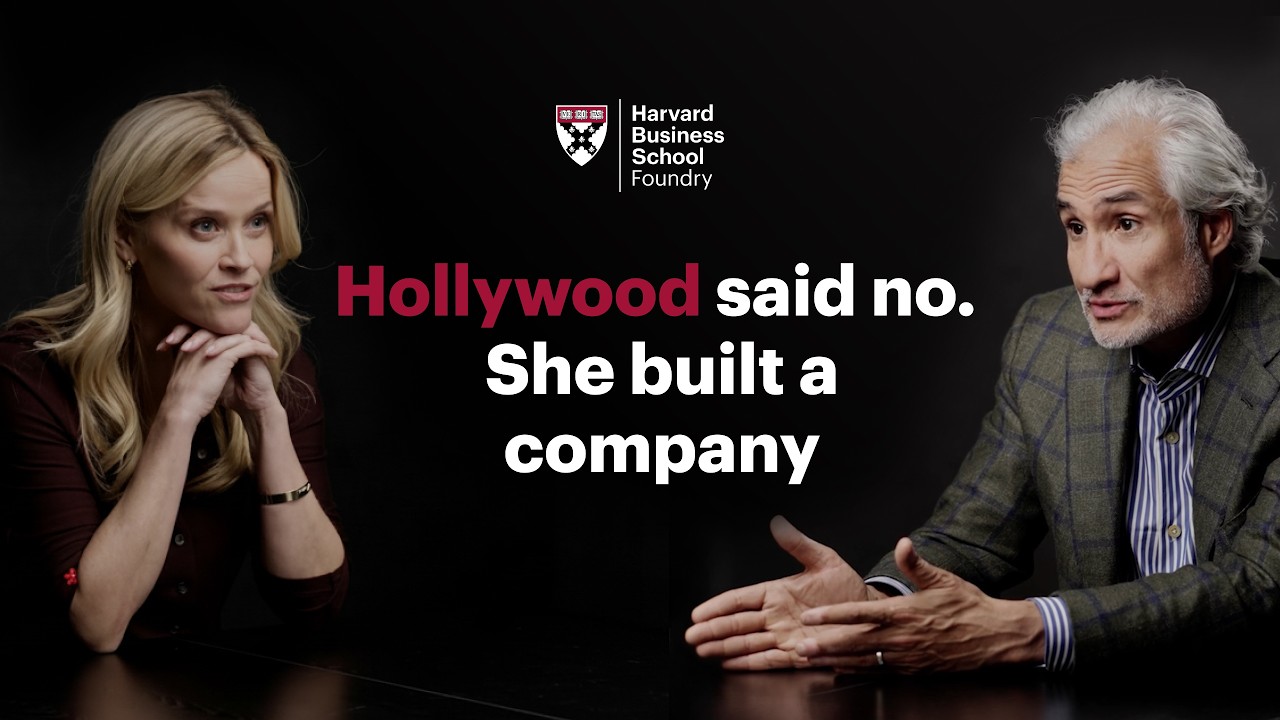
When Harvard Business School professor Reza Satchu pressed her on what her founder superpower actually was, she named two things without much hesitation: extreme empathy, and ambition that reads failure as data rather than verdict. ‘You’re probably in an arena with somebody who’s better than you,’ she said, ‘so you’re in the right arena.’ The analysis after a loss, in her framing, is the asset.
In 2018, the commitment ran all the way to its logical extreme. She was simultaneously shooting ‘The Morning Show’, ‘Big Little Lies’, and ‘Little Fires Everywhere’, sometimes moving between soundstages within the same day, playing three different characters. She described those two weeks as wanting to lay down sideways and melt into the earth. She had created the situation herself. It all worked.
The mantra she used to tell her children crossing a busy parking lot became the one she used inside the company: walk with purpose in the direction you’re going. She believed, and still does, that clarity of mission pulls like-minded people into alignment without recruiting them directly.
A newsletter that became something larger
Hello Sunshine, she admitted with some amusement, started as a vision of a newsletter, maybe some affiliate fees. The actual scope arrived incrementally. ‘I didn’t think about eating the whole elephant,’ she told Satchu. ‘I just thought about eating the toe. And then I was like, that tastes pretty good.’
The company sold, and the number was large enough to become its own argument: a female founder building something of real equity value is not a theoretical proposition.
‘I hope that people out here who are listening to this podcast will think I’m going to have the next Hello Sunshine,’ Witherspoon said near the close of the conversation. ‘Because it is possible.’
The financial architecture of Hello Sunshine sits at the back of that hope. Witherspoon was explicit that she did not prioritize money over purpose, but she was equally explicit that empowerment without economic ownership is incomplete. Her team made money. That was intentional from the start.