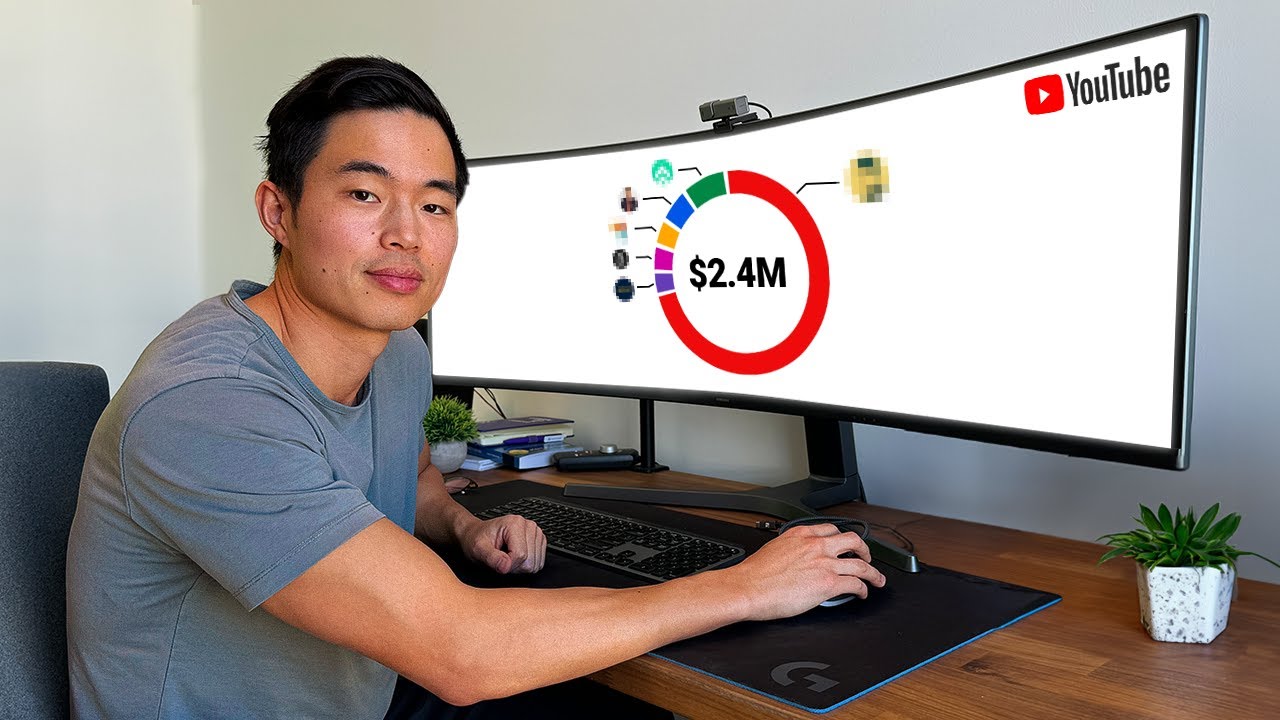
Charlie Chang woke up one morning in 2020 and saw $750 land in his AdSense account from a single day of views. For someone who had spent years grinding through photography, a clothing brand, a marketing agency, real estate, and mortgages while watching college friends collect tidy accounting salaries, that number changed the math entirely. The possibility that a YouTube channel could become a real business is not abstract for most people who have tried and quit. But Charlie, a self-described introvert operating out of Southern California, now runs six channels that pull in $200,000 to $250,000 a month, with a record month approaching $300,000. Pat Walls of Starter Story flew out to California to find out how he actually did it.
The day everything shifted
Charlie started making finance content in 2018. By his own account, those first videos were rough, and the channel generated nothing for a long stretch. He kept going, not with a master plan but with a working theory: make enough videos until one pops. When the 2020 channel surge arrived, he was growing at 500 to 1,000 subscribers a day and generating $10,000 to $20,000 a month from AdSense alone. He was doing it entirely by himself.
The content strategy that drove that growth was deliberately unsexy. Rather than chasing viral moments, Charlie focused on what he calls Evergreen SEO content, topics people are actively searching for, like how to invest in stocks, layered with timely pivots toward whatever was trending. When crypto boomed, he covered crypto. When side hustles dominated search, he covered side hustles. His most-watched videos tend to combine a relatable personal angle, a specific dollar figure, and a number that makes a stranger curious enough to click. As he put it: ‘something like that where you have an age that people can relate to, big number like 10 sources of income, like wow, and then a dollar amount just really makes them curious to click on it.’
One of his strongest-performing videos, asking Coachella VIPs what they do for a living, worked because it blended an experience most viewers would never have, a trending moment, a strong thumbnail, and real storytelling inside the video that kept people watching to the end.
The business behind the channels
Today, the media operation runs with 26 people. Charlie’s COO handles day-to-day operations, overseeing two or three project managers who each work with teams of video editors, thumbnail designers, graphics people, and website staff. The monthly cost to run that team is roughly $20,000 to $25,000, kept low by relying heavily on overseas talent sourced through platforms like Upwork and Fiverr, and increasingly through his own staffing company, which charges a one-time placement fee and matches clients with vetted overseas hires at $600 to $1,000 per month for most full-time positions.
Revenue across the six channels breaks down as roughly 50 to 55 percent affiliate marketing, 20 to 25 percent brand sponsorships, and 20 to 25 percent AdSense. The staffing company is a separate low-six-figure operation he is actively building toward a potential acquisition.
For content production, the team uses ClickUp for planning, Frame.io for footage review and editorial notes, and Slack for team communication. Short-form clips are cut from long-form content using tools including Submagic, Descript, and Opus. ‘If you make long form content,’ Charlie said, ‘you might as well cut that up into short form content.’
One day, a Ferrari and an RV
Charlie owns three vehicles: a Range Rover, a Ferrari, and an RV Sprinter van he notes was purchased partly as a tax write-off. He wakes between 5:30 and 6:30 a.m., works 30 to 50 hours a week in focused time, and describes the rest of his mental bandwidth as permanently on. His girlfriend, Pickleball, the gym, and Netflix fill the gaps.
For anyone at the start of this road, Charlie’s advice is simple and pointed: do not overanalyze the idea, pick something, move fast, and learn a high-value skill that compounds into the next one. He spent years feeling out of place for not wanting the traditional path. Moving to Southern California, surrounding himself with other entrepreneurs, and building something that runs without him there every hour finally gave him the environment he had been missing the whole time.
The $750 AdSense day that started it all now looks like a rounding error on a $2.4 million year.