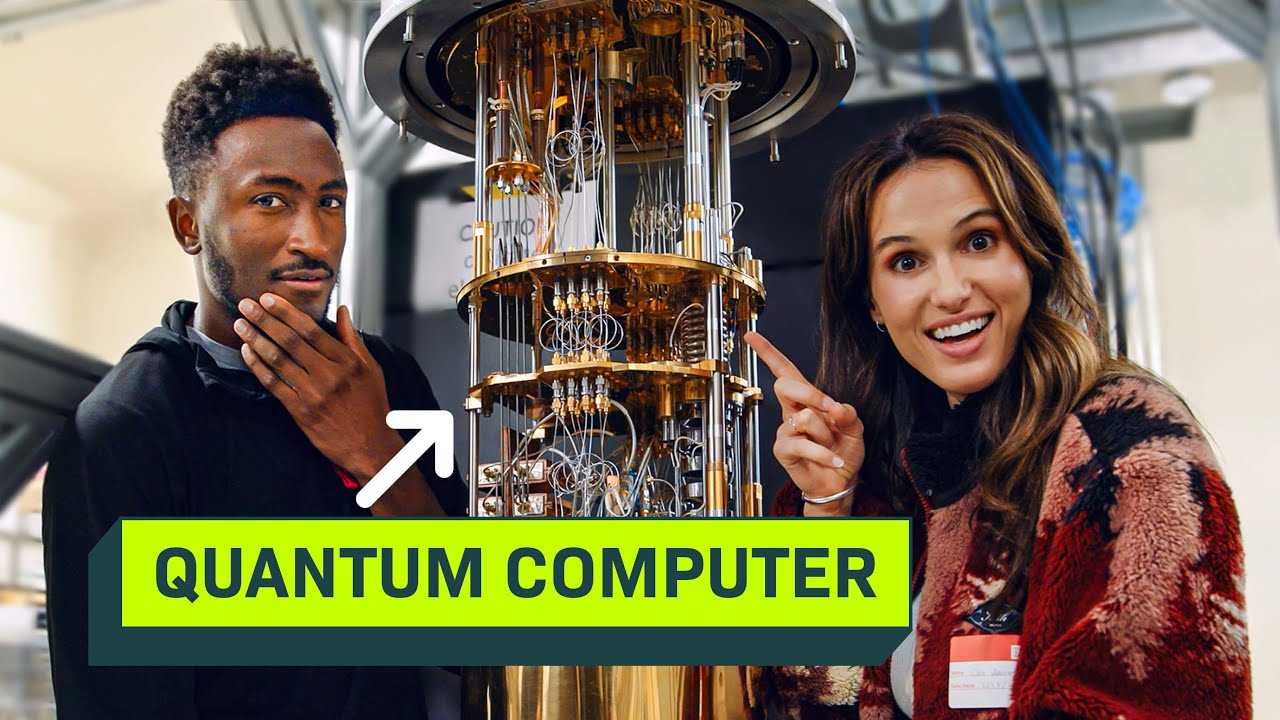
Marques Brownlee stood in front of a refrigerator the size of a chandelier, wrapped in gold-colored concentric rings, and said what most people would say: this is not what he pictured. The machine in front of him at IBM’s research division was a real, operating quantum computer, kept at 15 millikelvin, colder than outer space, and it looked, in his words, exactly like the press images he had seen and been confused by. That confusion is the whole point. Quantum computers are not bigger, faster versions of the machines already in people’s pockets, and understanding what they actually are turns out to matter more urgently than most people realize.
Cleo Abram, who brought Brownlee along as a co-explorer, had spent weeks talking to researchers before the visit, including one quantum physicist who was openly frustrated by how the technology gets covered. That frustration produced an analogy worth carrying.
Cars, boats, and why a quantum computer will never beat your phone at addition
Picture a video game map where getting around depends on your ability to do math. Early humans crossed it on foot, pencil in hand, working out geometry and astronomy one slow step at a time. Early computers gave everyone horses, then roads and cars, steadily opening terrain that had been unreachable. Classical computers kept improving along that same axis, just faster vehicles on better roads.
Quantum computers are not faster cars. They are boats. A boat does not beat a car at highway driving; it reaches water. Quantum computers solve a different class of problem entirely, one that lives in mathematical terrain classical machines simply cannot enter. When Brownlee heard this, he pushed the analogy one step further on the drive home, upgrading ‘boat’ to ‘submarine,’ because the ocean those machines are entering has no visible bottom.
IBM researcher Olivia Lanes, who guided the visit alongside lab scientist Brent, walked them through the mechanics. Classical computers run on bits, each locked at zero or one. Quantum computers run on qubits, which exist as a probability wave between states. The computer does not ‘try all the answers at once,’ a common and wrong shorthand. It is closer to watching ripples in a pond, tracking how waves from multiple qubits interact, constructively or destructively, and reading the most probable answer from the pattern that emerges. ‘You are altering the probabilities while you’re running an algorithm,’ Lanes explained.
The encryption clock that is already ticking
The most consequential near-term application is not a new gadget. It is a threat to the security infrastructure that runs global commerce. An algorithm called Shor’s Algorithm, developed by mathematician Peter Shor, can find the prime factors of very large numbers efficiently on a quantum machine. That matters because RSA encryption, the foundation of most online transactions, is secure today only because factoring those numbers would take a classical computer billions of years. A quantum computer powerful enough to run Shor’s Algorithm could do the same work in hours to days.
IBM’s record at the time of the visit was 433 qubits. Running Shor’s Algorithm at scale would require roughly a million. That gap is real, but Lanes was direct about the pace: ‘In the next five or even less years, we’re going to see people switching over to quantum safe algorithms.’ RSA does not disappear overnight, but the migration has already begun quietly in standards bodies and government systems.
The other side of that same capability is more hopeful. Because nature at the molecular level obeys quantum physics, quantum computers can simulate it in ways classical machines cannot. Battery chemistry, new materials, long-chain molecule drug design: these are all problems where the math outgrows classical hardware at a certain scale. A quantum computer operating in that water could help design medicines and materials that are currently beyond anyone’s reach to model.
Brownlee summed up what the visit clarified: ‘It helped me understand that this is a fundamentally different technology. It just looks so weird.’ That weirdness is not a bug. It is the whole reason governments are racing to build these machines faster than anyone else.
The sound nobody expects
Before the formal tour began, the group paused near one of the operating units to listen. The sound a quantum computer makes while running is not a hum or a fan. Lanes demonstrated it, and the closest written approximation is something like sh-pp-sh-ppp-sh, a rapid percussive flutter that means the machine is working.
As the IBM building receded behind them, Abram and Brownlee drove away with a cleaner picture of a technology that had previously resisted explanation: not a supercomputer, not a threat to replace anything already in daily use, but a submarine pointed at a bottomless ocean that classical machines will never be able to enter.