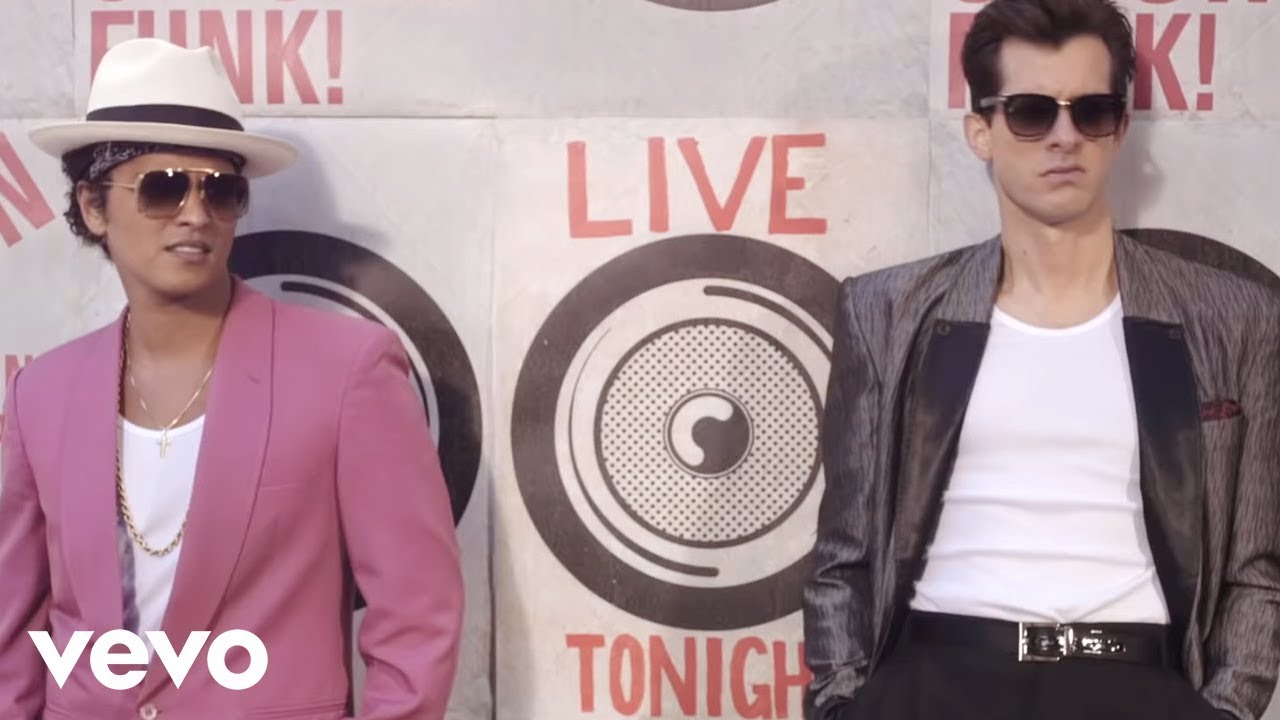
Bruno Mars opens his mouth and the first word out is a dare. ‘Don’t believe me, just watch.’ It is a Saturday night somewhere, the spot is packed, and the song that is about to play has already decided how the evening ends. ‘Uptown Funk’ is the kind of track that makes a case for itself before the chorus arrives, built on the shared, uncomplicated conviction that if the groove is right, nothing else requires explanation.
A groove that argues its own case
Mark Ronson constructed the song around a specific social contract: you show up, you show out. The lyric maps a geography of confidence, touching Harlem, Hollywood, and Jackson, Mississippi in a single breath, places that carry their own weight and need no introduction. Bruno Mars inhabits the song with the kind of swagger that is too specific to feel generic, name-dropping Chucks worn with Saint Laurent, invoking Michelle Pfeiffer as shorthand for a particular quality of cool, and comparing the group’s collective smoothness to ‘a fresh jar of Skippy.’ That last image is exactly the kind of detail that should not work and absolutely does, landing with the precision of a writer who knows the difference between bravado and comedy and decided to use both at once.
The chorus strips everything back to its simplest offer. Uptown Funk is going to give it to you. The song does not specify what ‘it’ is, and that is the point. The listener fills in whatever they need most on a Saturday night.
The thing about ‘just watch’
The repeated command to watch is doing real structural work. It appears as a taunt at the top, a reassurance in the middle, and practically a religious refrain by the end. Mars sings it the way someone who has already won the argument states their position: calmly, repeatedly, with full confidence that the evidence is incoming. The bridge drops the pretense of subtlety entirely. ‘If you sexy then flaunt it. If you freaky then own it. Don’t brag about it, come show me.’ It is an instruction manual for exactly one hour of one evening, and the instruction is to stop hedging.
Ronson later described the track as a song built for a specific feeling rather than a specific moment, which is part of why it has refused to age into a period piece.
Julio, the stretch, and an unchecked detail
Somewhere in the middle of all the Saturday-night theater, a person named Julio is told to get the stretch. Whether Julio got it remains, technically, an open question.
The song ends where it began: a body in a spot on a Saturday night, too hot, hot damn, already dressed for whatever comes next.