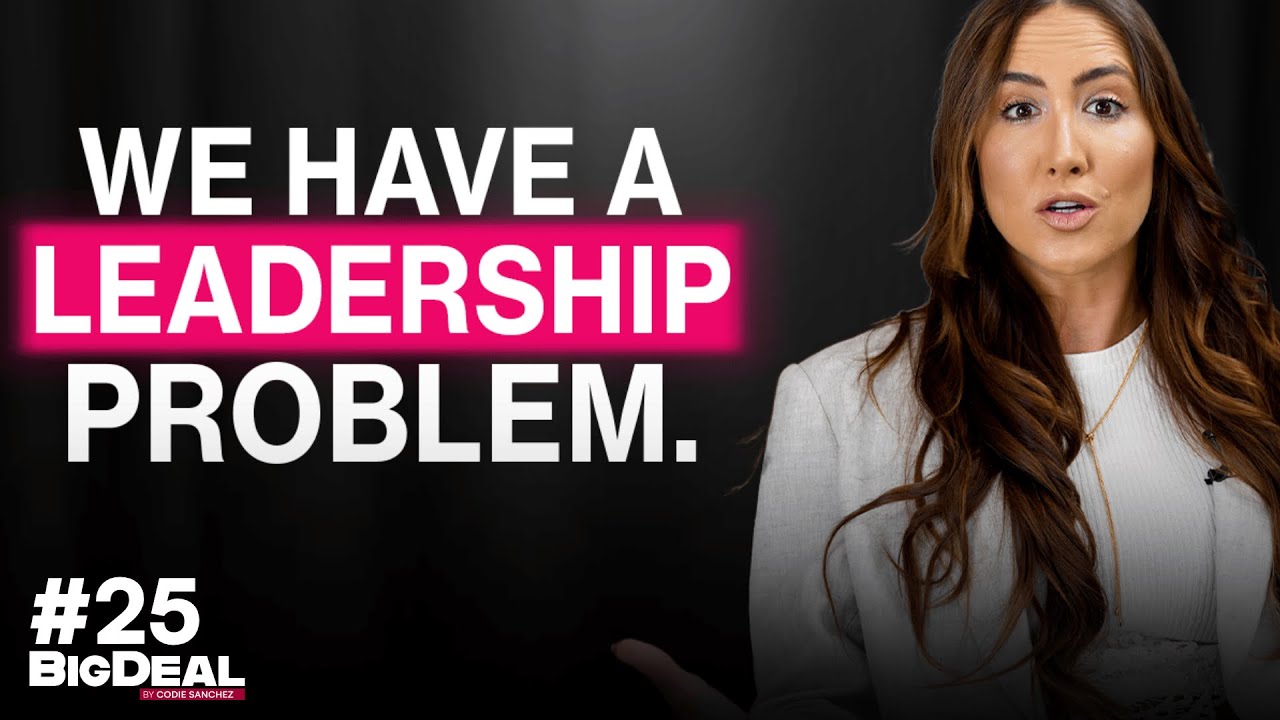
Codie Sanchez opens with a number that is hard to sit with: roughly 12 million Americans believe their leaders are, literally, shape-shifting lizard people. That detail is not a punchline. It is a diagnostic. When trust collapses that far, something has gone genuinely wrong at the top, and the people running companies, teams, and communities are the ones who have to fix it. Sanchez, who has built multiple eight- and nine-figure businesses and describes herself as far from perfect, spent years compiling a set of principles she calls a Creed: 13 commitments, one for each week of the quarter, designed to replace vague values with something a team can actually act on.
Why most companies are about to feel the pain they avoided
Sanchez frames the current wave of corporate layoffs not as a market problem but as a leadership problem. Intel is her sharpest example. The company that started a revolution in computer chips, and survived harrowing conditions in the mid-1980s under Andy Grove, is now struggling under a different kind of leadership. The 1980s crisis is instructive: Japanese producers had flooded the memory chip market with better quality at lower prices, and Intel’s position looked terminal. Grove and a fellow executive stood at a window at headquarters and asked each other what a new CEO, brought in from outside, would do. The answer was immediate: get out of the memory business. So they did. Intel reinvented itself and became one of the most profitable companies of its era.
The lesson Sanchez pulls from that story is not about pivoting industries. It is about the willingness to accept short-term pain instead of chasing short-term gain. ‘All short-term gain ever leads to is long-term misery,’ she said, and Intel’s current difficulties, in her reading, are a clean illustration of what happens when leaders stop asking the hard question Grove asked at the window.
Grove’s own advice on careers follows the same logic: there is no lifetime guarantee of employment, so treat yourself as the CEO of your own one-person company, look around the corners, and ask whether you are keeping up with whatever could make you obsolete. His book, ‘Only the Paranoid Survive,’ is Sanchez’s recommendation for anyone who wants to sit with that question for a few hundred pages.
The 13 commitments Sanchez reads to her teams every week
Every Monday, Sanchez sends a five-to-ten-minute presentation to all of her teams through a group message thread, and each week she highlights one item from the Creed. The full list, which she says took years to compile, runs like this: people who say it cannot be done should not interrupt those who are doing it; be a great human and do what is right even when it hurts; how you do anything is how you do everything; do the dirty work; your word is your contract; find your lever (a reference to Archimedes); winners want pressure; better weird than boring; the job is not done until the job is done; assumptions are for people unwilling to find the truth; fewer words, more meaning; make every creation worth stealing; and show results, not intentions.
The number 13 is deliberate. ‘Who needs luck,’ she said.
The creed philosophy itself she traces to basketball coach John Wooden, whose father gave him a two-dollar bill and a small white card carrying a poem by Henry David Thoreau. Wooden kept that card and the seven-point creed on it for his entire life, and his belief was that if you keep the spirit, the statistics follow. Sanchez applies the same logic to business: obsessing over the scoreboard while ignoring the values behind it produces the wrong outcome in the wrong order.
The practical application she borrows from Elon Musk’s internal Tesla memo is equally concrete: cut large meetings unless they provide value to everyone in the room, eliminate acronyms that require a glossary, let information travel the shortest path rather than up and down a chain of command, and use common sense as a guide. ‘Walk out of a meeting or drop off a call as soon as it is obvious you are not adding value,’ the memo reads. ‘It is not rude to leave. It is rude to make someone stay and waste their time.’
Sanchez put it in her own terms: ‘Don’t be nice. Be honest. You aren’t sweet. You need to be effective. You don’t want people to like you. You want people to become better because you are around them.’
The investor who moves before the committee even sits down
Sanchez relayed a conversation with investor Bill Perkins, who she asked why he had been more successful than almost anyone else she knew across multiple different ventures. He paused for about ten seconds. His answer: ‘I just move faster than everybody else. By the time they’ve thought about it, taken it to investment committee, thought about a name, I’ve already made a decision, made three mistakes, and found a better way.’
Sam Walton made the same point in different language: Walmart’s management meetings could get loud and contentious, but the rule was that no item left the room unresolved. ‘We will make a decision in that meeting even if it is wrong,’ Walton said. ‘Decision on Friday, acted on in all the stores on Saturday.’
The phrase Sanchez keeps coming back to across all of it is simple: ‘We do not do what we want. We do what is required.’
Andy Grove’s office window, where he and a colleague asked themselves what an outsider would do, is still there at Intel’s headquarters.