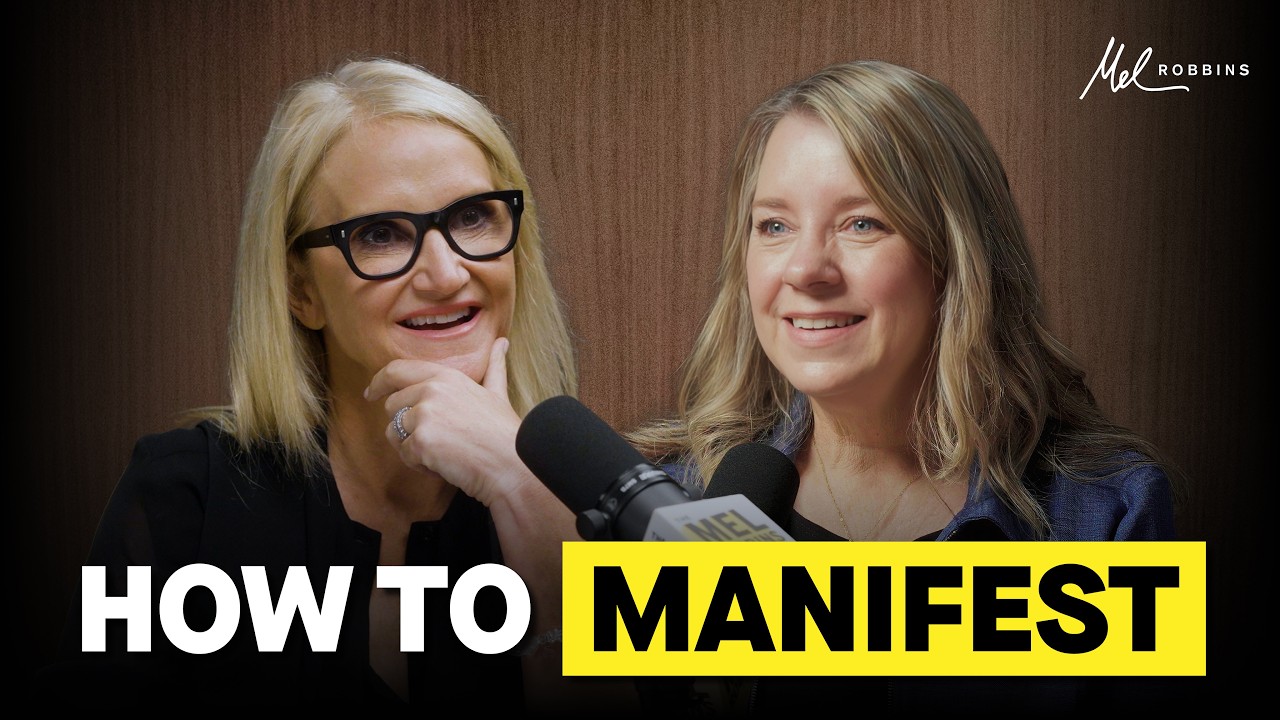
Dr. Cassandra Vitton was describing a moment she had spent years trying not to repeat. Standing at the top of a mountain in the desert outside Anza-Borrego, she had asked the universe what it needed people to know about imagination, and the answer came back immediately: ‘It is the place where we can most easily talk to them.’ That single exchange planted the seed for a years-long effort to bring the science of imagination into practical reach for ordinary people. And for the 70% of listeners who told Mel Robbins in a recent survey that they feel like they are reacting to life rather than creating it, what Vitton shared during their conversation may be the most useful hour they spend this month.
Why your brain treats imagination as a dress rehearsal for real life
Vitton opened with a distinction that changes how the whole conversation lands. Imagination, she explained, is the umbrella. Visualization and manifestation are techniques inside it, and the brain does not draw a clean line between imagining something and actually experiencing it. When you imagine seeing something, the visual cortex lights up. When you imagine moving, the motor cortex fires. When you imagine a worst-case scenario on repeat, you are flooding your body with cortisol as though the threat is real. Vitton quoted a line attributed to both Seneca and Mark Twain to make the point plain: ‘I have experienced many terrible things, most of which have never happened.’
That same mechanism runs in reverse. Research on athletes shows that those who imagine practicing basketball or soccer perform better than those who skip the mental rehearsal. Billie Jean King, Vitton noted, would lie in bed before sleep and imagine the ball arriving from every single angle and rehearse every return. The brain was still training, even in pajamas by a window with a cup of tea.
For people who have always believed visualization means closing your eyes and running a crystal-clear internal movie, Vitton offered immediate relief. ‘I always thought you had to picture it in your mind,’ Robbins admitted. Not so, Vitton said. Some people are social-emotional imaginers who cannot produce vivid mental pictures but can read a room with precision. Others are gustatory imaginers, chefs who taste a dish in their minds before it exists. The profile is like a fingerprint, unique to each person, and every type is a genuine strength.
The pinball machine, the hiking story, and how to write your way to a different life
Vitton’s most immediately usable tool arrived wrapped in a metaphor. She described a client whose internal story was that she was a pinball, shot out of a tunnel every morning and blasted around without any say in the matter. The rewrite Vitton offered was concrete: the hiking-through-the-Alps woman, who faces uphill stretches, breathes deliberately, walks methodically, and stops to sit with a small flower pushing up through rock. That reframe, Vitton said, is a legitimate form of visualization even for someone who cannot see a single image in their mind. Write the story instead of trying to screen the movie.
For people who feel completely stuck, she offered what she called a thought experiment: write down ten ways you could make your situation worse. Deliberately, specifically, ten ways. Then flip the list. The opposites become a road map you would never have generated by asking yourself what you should do. Robbins tested it live: ‘I could light the house on fire. I could spend all my money gambling.’ The inverse of each, Vitton confirmed, is the direction worth moving.
Manifestation, in Vitton’s framing, is not about conjuring objects or outcomes you cannot control. It is the daily discipline of keeping both feet pointed the same direction. ‘A lot of times people are moving into the future with one foot on the gas and one foot on the brake,’ she said, ‘and they do not even know they have the foot on the brake.’ Robbins described her own morning practice: five things written down each day that she wants to create, then a physical rehearsal of the feeling of working toward them, including the boring 6 a.m. training run in the rain, not just the summit.
Vitton runs a workshop she calls ‘The Next You,’ in which participants, after a few minutes of breathing or music to settle the busy mind, walk to an imagined front door and open it to meet their future self, five, ten, or fifteen years on. The instruction is deliberate: do not picture the mansion or the car. Picture the feeling the mansion and car represent. Freedom. Balance. Vitality. Then ask that future self one question: what is the single thing more than any other that got you here? The answer, Vitton said, is almost always short and pointed, and it tends to surprise.
Her own manifestation practice produced a result she could not have scripted. When she and her partner could not afford a house in the Bay Area during graduate school, she imagined a tiny house with an ocean behind it and told herself daily that the ocean view was coming. What they found was a 640-square-foot houseboat floating on the ocean. As she put it: ‘It was not going to be the ocean view. It was going to be literally on the ocean.’
The dragon that has moved through the family for generations
One of the most striking moments in the conversation came when Vitton described a client who had lost her son to a drug overdose while she herself was in active addiction. The guilt had calcified into a story that his death was entirely her fault, and that punishing herself was the correct response. The work Vitton did over a long period was not to erase the facts but to find a story large enough to hold them. Together they reframed it: addiction moved through their family like a dragon that had swept through the village for generations, long before either of them was born. When the dragon came, it took her son. Now she stands beside others facing the same loss, because she has been through it. ‘Not that the situation was different,’ Vitton said, ‘but the way you look at it is different.’
That is what she calls transcending, the third movement of imagination, beyond simulating reality and reconfiguring it. It is finding a frame big enough to match what actually happened.
The researcher who nearly let silence make everything worse
Vitton was a tenured psychologist with a prestigious job, a good home, and, she said, everything she had wanted, when the pressure of a divorce and mounting stress pushed her into heavy drinking. The story she told herself to survive it was: ‘It is going to be okay as long as you do not tell anyone.’ That story, she noted with a short laugh, was imagination doing damage. It kept her isolated for long enough that the consequences compounded. When she finally called a colleague and said she could not stop drinking, he said he would be right over, told her she was already off work for the next sixty days, and that the team had everything covered. ‘Did I imagine that would happen?’ she said. ‘Never in a million years.’
The gap between the catastrophic story she had imagined and the actual response she received is, for Vitton, the clearest evidence of what she means by maladaptive imagination: a story that feels like reality but is not, told so convincingly that asking for help seems more dangerous than the crisis itself.
That houseboat on the Bay is still out there somewhere, bobbing on the water she imagined before she knew what shape it would take.